The Anatomy of the Brain
Before looking at how a Traumatic Brain Injury or CTE can affect the brain, it helps to understand how the brain normally works.
The brain is one of the most important organs in the body. It controls how we move, think, feel, communicate, and interact with the world. While different areas of the brain have different roles, they all work together.
The brain has three main parts:
Hindbrain – controls vital functions such as breathing, heart rate, balance, and coordination. This part helps us carry out everyday movements like walking, writing, or riding a bike.
Midbrain – helps control reflexes, eye movement, and communication between different parts of the brain and body.
Forebrain – the largest part of the brain, responsible for memory, emotions, thinking, decision-making, language, and awareness.
The forebrain is divided into two halves, called the left and right hemispheres, which constantly share information. Each side of the brain mainly controls the opposite side of the body. For example, damage to one side of the brain can affect movement or sensation on the other side.
The outer layer of the brain, often called grey matter, is where much of our thinking and information processing takes place.
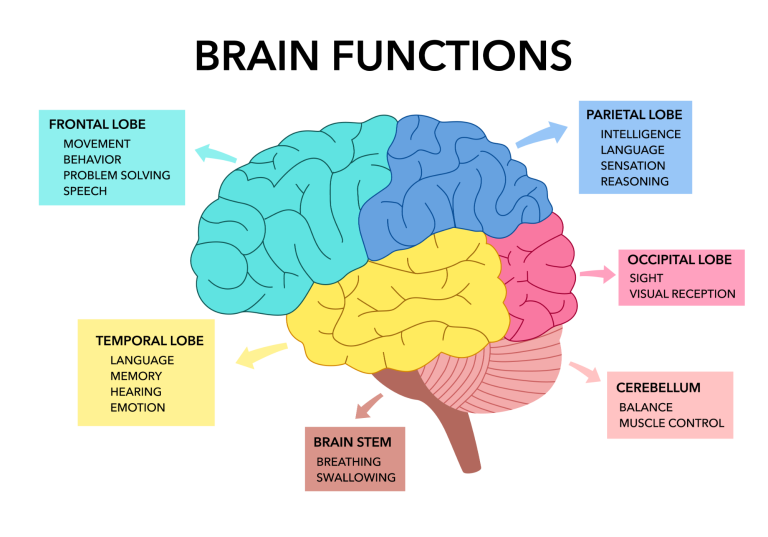
Each half of the brain is divided into different areas, known as lobes, and each one plays a specific role in how we think, move, and experience the world.
Frontal lobes sit just behind the forehead. They help with short-term memory, decision-making, planning, and controlling voluntary movement. This area allows us to move our arms, legs, hands, and feet on purpose.
Parietal lobes help us make sense of touch, taste, and body awareness. They allow us to recognise sensations such as heat and cold, and also support skills like reading, writing, and basic maths.
Occipital lobes, located at the back of the brain, are responsible for processing what we see, including shapes, colours, and movement.
Temporal lobes sit on the sides of the brain near the ears. They process sound and play an important role in understanding language, recognising objects and people, and forming and recalling memories.
Together, these areas work as a connected system, allowing us to move, communicate, learn, and respond to the world around us.
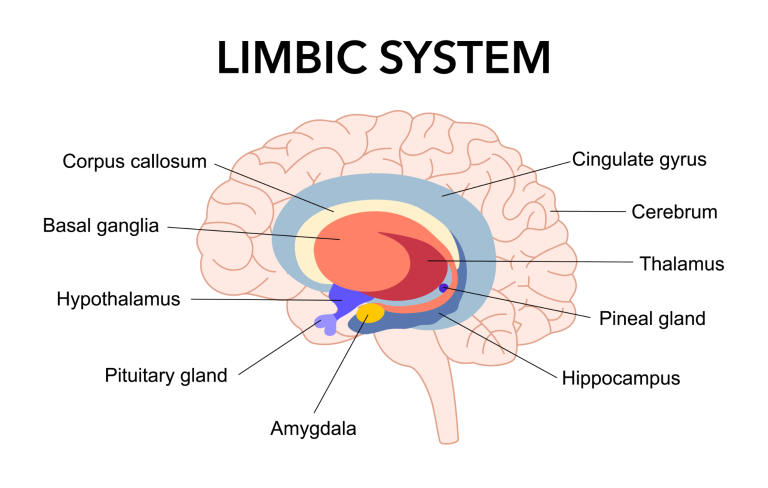
Beneath the outer surface of the brain sits the inner brain, which contains several important structures that help regulate our body, emotions, memory, and movement. These structures sit deep inside the brain and, like many other brain areas, are present on both the left and right sides.
The hypothalamus is very small — about the size of a pearl — but it plays a big role. It helps regulate hormones, stress responses, sleep and wake cycles, appetite, and emotional balance. It also plays a part in releasing adrenaline and helping us wake up in the morning.
The thalamus acts as a relay centre. It receives information from the body and senses and directs it to the appropriate parts of the brain. It also plays an important role in learning, memory, sleep, alertness, and consciousness.
The hippocampus is closely involved in forming new memories and helping us retrieve them when needed. It acts as a kind of organiser, helping move memories to different parts of the brain for long-term storage.
The basal ganglia are a group of structures that work together to help start and control movement. They play an important role in coordinating smooth, purposeful actions.
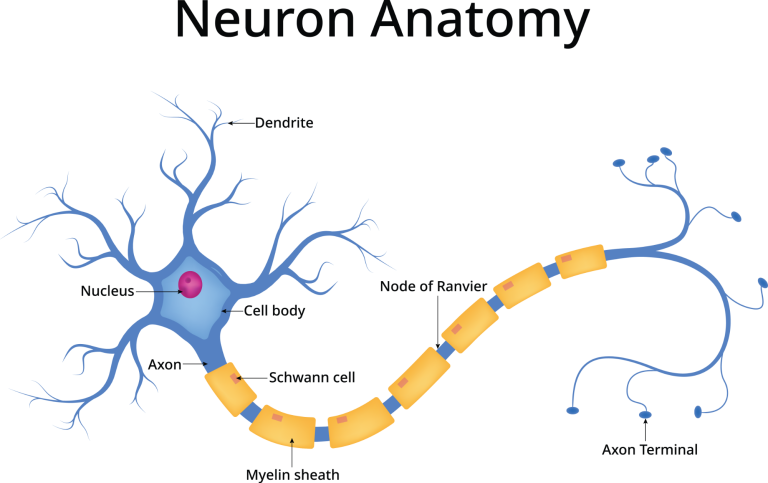
Our brain and nervous system are made up of many different types of cells. The main type is called a neuron, or nerve cell. Every thought, memory, feeling, and movement we experience happens because signals are passed between these neurons.
Each neuron has three main parts: a cell body, dendrites, and an axon. The cell body keeps the neuron working properly. Dendrites branch out from the cell body, a bit like tree branches, and receive messages from other nerve cells. These messages then travel through the cell body and along the axon, which carries the signal onward to another neuron or to a muscle.
Many neurons are supported by special cells that form a protective layer called myelin around the axon. Myelin acts like insulation on a wire, helping signals travel faster and more efficiently over longer distances.
Neurons communicate with each other at tiny gaps called synapses. When a signal reaches the end of an axon, it releases small chemical messengers known as neurotransmitters. These chemicals cross the synapse and attach to receptors on the next cell, allowing the signal to continue.
Neurotransmitters are how brain cells “talk” to each other. Some increase activity in the brain, while others slow it down. Two well-known neurotransmitters are serotonin and dopamine. Serotonin plays a role in sleep, mood, and body regulation, while dopamine is involved in movement, motivation, and mood. Many medications used to support mental health work by changing how these chemicals act in the brain.
Synapse is a type of junction in our brain and nervous system where a signal from a neuron passes to another type of cell, when a signal reaches the end of the axon a tiny sac called a vesicles is released, neurotransmitters are chemicals that are released by these vesicles into the synaptic cleft. These neurotransmitters cross the synapse and attach to receptors on neighbouring cells, if the receiving cell is a neuron, then the signal continues to transmit to the next cell.
Neurotransmitters are chemicals that the brain cells use to talk to each other, some make cells more active (excitatory), and others block or reduce cells activity (inhibitory). Two commonly known neurotransmitters are serotonin and dopamine, serotonin is involved in temperature regulation, constricting blood vessels and inducing sleep, low levels can cause problems with sleep, depression but elevated levels can lead to seizures. Dopamine can excitatory or inhibitory mood and complex movements, many medications used to treat mental health disorders work by modifying dopamine in the brain.
Are you experiencing a mental health crisis?
There is help for you!
Shout: For 24/7 text support, text SHOUT to 85258 or click HERE
NHS 111 Online or Phone: If it's not an emergency but you need urgent help with your mental health, you can access NHS 111 online or by calling 111
Samaritans: Call 116 123 to talk , or email: jo@samaritans.org for a reply within 24 hours or click HERE
CALM - 0800 585 858 or click HERE
Mind - 0300 1233 393 or click HERE
No Panic - 0844 9674 848 or click HERE
National Domestic Abuse - 0808 2000 247 or click HERE