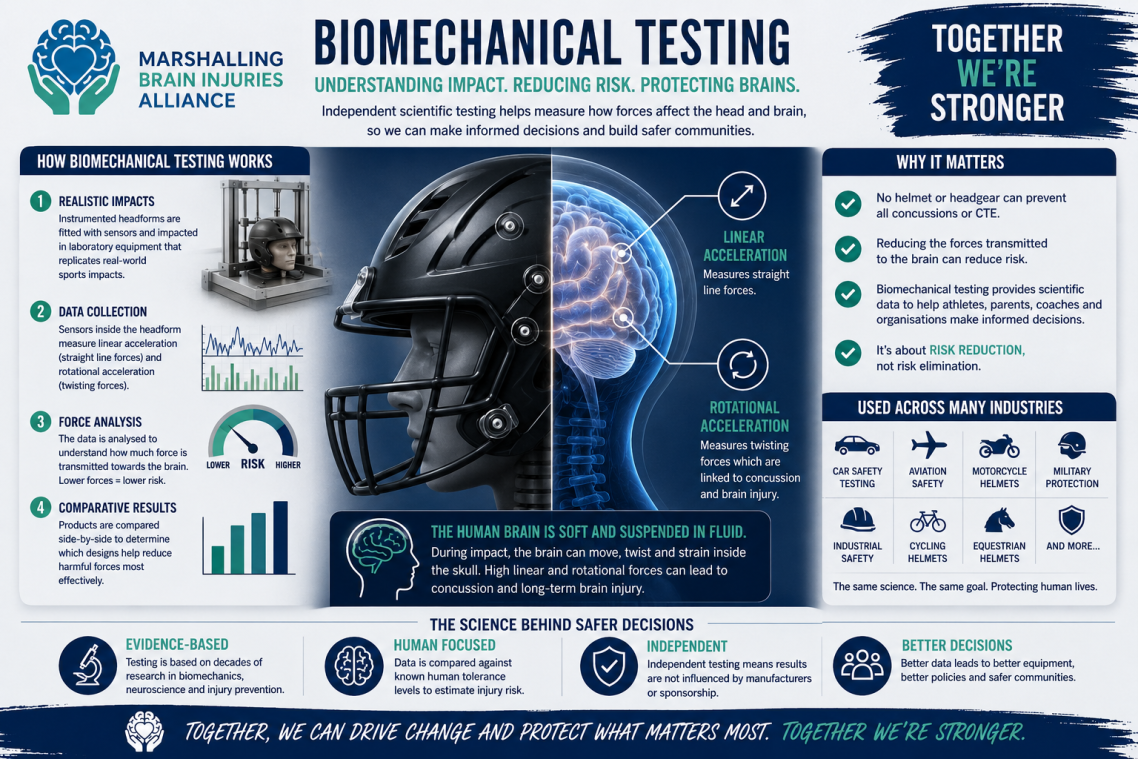
When conversations around concussion and brain injury happen in sport, many people understandably ask the same question:
“How do we actually know if protective equipment works?”
One of the most respected independent research groups attempting to answer that question is the Virginia Tech Helmet Lab in the United States.
Their work has become internationally recognised for scientifically testing helmets and head protection systems used across multiple sports — including American football, rugby, cycling, football/soccer, hockey, equestrian sport, snow sports, and more.
Importantly, their research does not claim that any helmet or headgear can completely prevent concussion or Chronic Traumatic Encephalopathy (CTE). Instead, their testing focuses on one key principle:
How well helmets reduce the forces (linear and rotational head accelerations) transmitted to the human brain during impact.
What Is the Virginia Tech Helmet Lab?
The Virginia Tech Helmet Lab is comprehensive and independent injury biomechanics research laboratory based within Virginia Tech University.
The lab combines:
- Biomechanics
- Injury
- Engineering
- Neuroscience
- Impact physics
- Real-world sports data
Their goal is to evaluate how effectively protective equipment reduces the likelihood of head injury during impacts. They do this by supplementing the pass/fail certifications with real-world sport specific helmet ratings.
Unlike marketing claims from manufacturers, the lab performs standardised independent testing that mimic real-world head impacts and publishes comparative ratings that athletes, parents, schools, and organisations can review publicly – the STAR Ratings.
Biomechanical Testing Is Already Widely Used in Other Industries
One important thing to understand is that the type of biomechanical testing used by Virginia Tech Helmet Lab is not new, experimental, or unique to sport. The lab’s research started in early 2000 and the STAR ratings started in 2011 – 15 years ago.
In fact, very similar testing principles have been used for decades across multiple industries where human safety is critical.
The goal is always the same:
Measure the forces experienced by the human body during impact and assess how safety equipment reduces injury risk.
Car Safety Testing Uses the Same Principles
Perhaps the best-known example is the automotive industry.
Vehicle safety organisations around the world use crash test dummies fitted with advanced sensors to measure:
- head acceleration
- neck movement
- chest compression
- rotational forces
- overall impact energy during collisions
Organisations such as:
- Euro NCAP
- National Highway Traffic Safety Administration
- Insurance Institute for Highway Safety
all use biomechanical data to evaluate vehicle safety performance.
These crash tests do not use real humans during impacts. Instead, they use scientifically designed test devices that simulate how the human body responds to force.
The data collected helps engineers understand:
- likely injury severity
- how force travels through the body
- and whether safety systems reduce injury risk
This is fundamentally the same scientific principle used in modern sports headgear testing.
Seatbelts and Airbags Were Developed Using Biomechanics
Many of the safety features now considered completely normal — including:
- seatbelts
- airbag
- crumple zones
- child car seat,
- head restraints
were developed and refined using biomechanical impact testing.
Researchers measured how forces affected the body and then engineered systems to reduce harmful acceleration and movement.
Importantly:
- airbags do not guarantee survival
- seatbelts do not prevent all injurie
- five-star safety ratings do not mean crashes are harmless
Instead, they indicate that the vehicle performs better at reducing dangerous forces and lowering injury risk.
That is very similar to what sports equipment researchers are attempting to achieve with protective headgear.
Biomechanical Testing Is Used Beyond Cars
The same approach is also used in:
- military blast protection
- aviation safety
- cycling helmets
- motorcycle helmets
- industrial hard hats
- equestrian helmets
- construction safety equipment
- amusement ride safety assessments
Across all of these industries, researchers use:
- instrumented dummies/headforms
- sensors
- acceleration measurements
- rotational force analysis
- injury prediction models
to better understand how impacts affect the human body.
Why This Matters in Sport
Sometimes biomechanical sports testing is misunderstood because people assume:
“It’s just a dummy head — not a real person.”
But this is exactly how many established safety industries work.
The purpose of biomechanical testing is not to perfectly recreate every aspect of human injury.
It is to create:
- representative
- repeatable
- measurable
- scientifically controlled conditions
that allow researchers to compare how well different safety systems reduce potentially harmful forces.
Without this kind of testing:
- car safety ratings would not exist
- aviation safety improvements would be far harder
- many modern protective technologies may never have been developed
A Tool for Risk Reduction — Not Proof of Safety
Just as a five-star car safety rating does not mean a crash is harmless, sports headgear testing does not prove a sport is safe or eliminate the possibility of concussion or long-term brain injury.
What biomechanical testing can do is provide evidence about whether certain products may reduce:
- linear acceleration
- rotational acceleration
- overall force transferred toward the brain
That evidence can then help:
- athletes
- parents
- schools
- clubs
- governing bodies
- insurance companies
- researchers
make more informed decisions about safety and risk reduction.
The Science Behind the Testing Is Well Established
The key point is that biomechanical impact testing is already an internationally accepted scientific approach used throughout safety engineering.
The methods used by Virginia Tech Helmet Lab are part of a much broader field of injury biomechanics that has been used for decades to improve human safety in many environments — not just sport.
How Do Virgina Tech Test Headgear?
The testing process is far more advanced than simply dropping a helmet onto the floor.
Researchers recreate realistic sports impacts using:
- Instrumented headforms (scientific dummy heads)
- Impact rigs
- Accelerometers
- Rotational sensors
- High-speed video collection systems
These systems specifically measure:
- Linear acceleration (straight-line force)
- Rotational acceleration (twisting force)
Both are important, but modern brain injury science increasingly recognises that rotational acceleration may be especially damaging to the brain.
Why Rotational Force Matters
The human brain is soft tissue suspended inside the skull in cerebrospinal fluid.
When the head is struck:
- the skull can stop or move suddenly
- but the brain continues moving momentarily inside the skull
This movement can create:
- stretching
- twisting
- shearing
- strain
on delicate brain tissue and nerve fibres.
Rotational movement is particularly concerning because it may contribute to:
- diffuse axonal injury
- concussion symptoms
- long-term neurological damage
- potentially neurodegenerative disease processes
This is why many modern researchers now focus not only on whether equipment absorbs impact energy, but whether it helps reduce rotational motion transferred to the brain.
How Does Biomechanical Testing Relate to Real Human Brains?
This is where Virginia Tech’s research becomes especially important.
Their testing is based on decades of:
- concussion data
- laboratory biomechanics
- impact reconstructions
- athlete monitoring
The lab uses a bivariate risk of concussion model developed from over 2 million real-world head impacts to estimate how likely certain impact forces relate to concussion risk.
In simple terms:
- the testing measures linear and rotational head accelerations on the headform
- compares these values to what is known about human brain injury thresholds
This does not mean researchers can perfectly predict whether a person will get a concussion.
Every human brain is different.
Factors such as:
- previous concussion history
- genetics
- neck strength
- age
- sex
- fatigue
- hydration
- and cumulative exposure
can all influence injury risk.
However, biomechanical testing provides an evidence-based way to compare whether one product reduces dangerous forces more effectively than another.
Why Independent Testing Matters
One of the biggest challenges in sports safety is separating:
- evidence
- marketing
- assumption
Independent labs like Virginia Tech Helmet Lab help provide objective analysis rather than relying solely on manufacturer claims.
This is particularly important because:
- no equipment should be advertised as “concussion-proof”
- no helmet can fully stop the brain moving inside the skull
- and reducing risk is not the same as eliminating risk
The science is about risk reduction, not complete elimination.
What This Means for Contact Sports
The existence of protective equipment testing should not be interpreted as proof that contact sports are “safe.”
Instead, it reflects a growing understanding that:
- repetitive head impacts matter
- sub-concussive impacts may matter
- rotational forces matter
- prevention strategies are urgently needed
Protective equipment is only one part of brain safety.
Other critical factors include:
- rule changes
- improved coaching
- safer training methods
- reducing repetitive contact exposure
- proper concussion management
- longer recovery periods
- education
- long-term monitoring of athletes
Important Limitations
Even the best laboratory testing has limitations.
Laboratory impacts cannot fully recreate:
- complexity of live sport
- unpredictable collisions
- player positioning
- cumulative trauma over years
- individual biological differences
Therefore:
- highly rated product does not guarantee protection
- lower measured force does not guarantee a person will avoid concussion or long-term effects
What the testing can do is provide scientifically grounded evidence about whether certain designs appear better at reducing dangerous impact forces.
The Bigger Picture
The growing focus on biomechanics and rotational force represents an important shift in how sport approaches brain health.
For many years, concussion discussions focused mainly on symptoms after an injury occurred.
Modern research increasingly asks:
“How can we reduce the force reaching the brain in the first place?”
Independent biomechanical testing laboratories such as Virginia Tech Helmet Lab are helping advance that conversation through data, engineering, and evidence-based evaluation.
While no equipment can eliminate risk entirely, understanding how force interacts with the human brain is an important step toward improving athlete safety at all levels of sport.
Understanding Virginia Tech Helmet Lab Testing for Sports Headgear — And Why It Matters for the Human Brain
Are you experiencing a mental health crisis?
There is help for you!
Shout: For 24/7 text support, text SHOUT to 85258 or click HERE
NHS 111 Online or Phone: If it's not an emergency but you need urgent help with your mental health, you can access NHS 111 online or by calling 111
Samaritans: Call 116 123 to talk , or email: jo@samaritans.org for a reply within 24 hours or click HERE
CALM - 0800 585 858 or click HERE
Mind - 0300 1233 393 or click HERE
No Panic - 0844 9674 848 or click HERE
National Domestic Abuse - 0808 2000 247 or click HERE