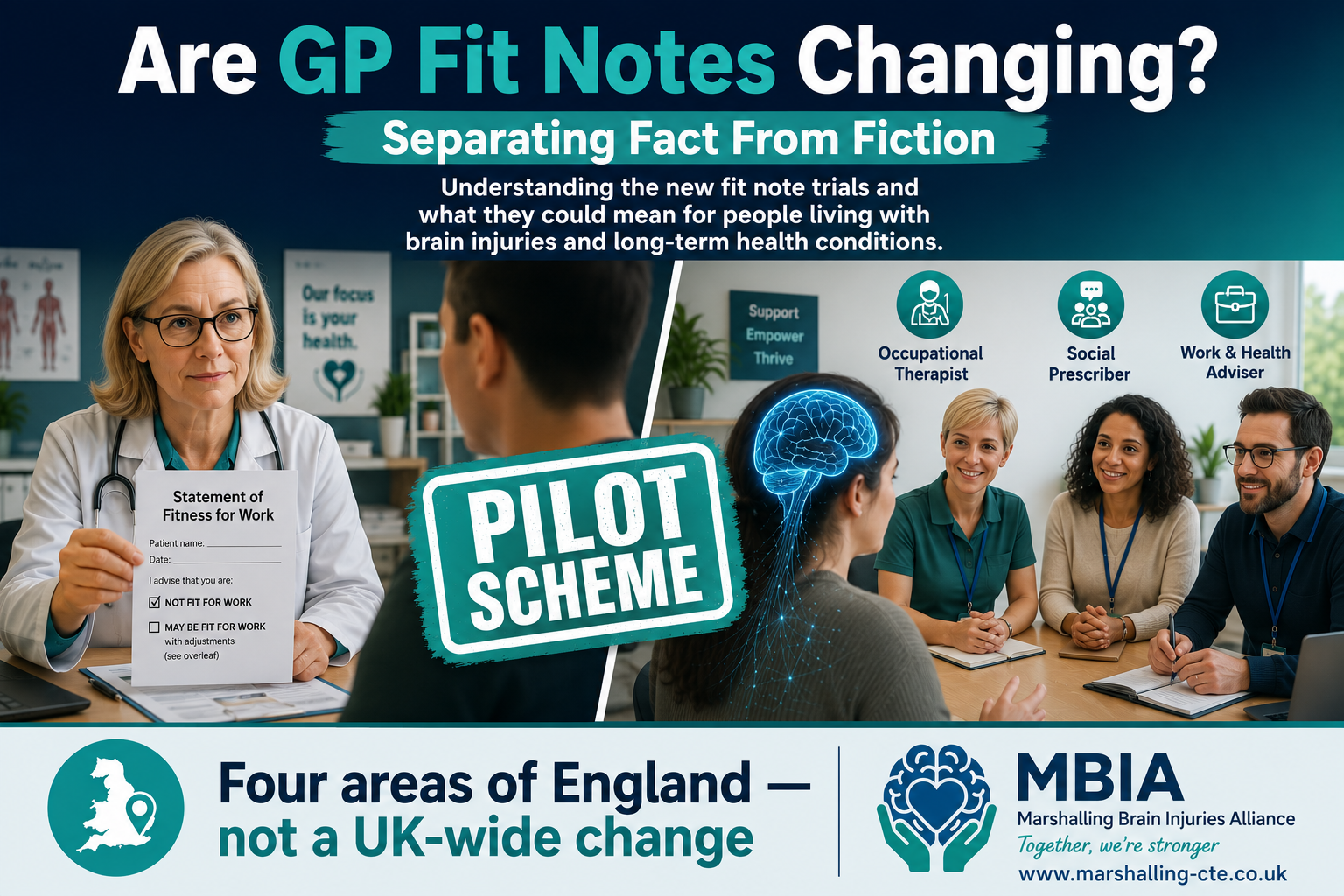
Are GP Fit Notes Changing? Separating Fact From Fiction
Understanding the new fit note trials and what they could mean for people living with brain injuries and long-term health conditions
Over the past few weeks there has been a significant increase in media coverage, social media posts and online discussions about proposed changes to GP fit notes (previously known as "sick notes").
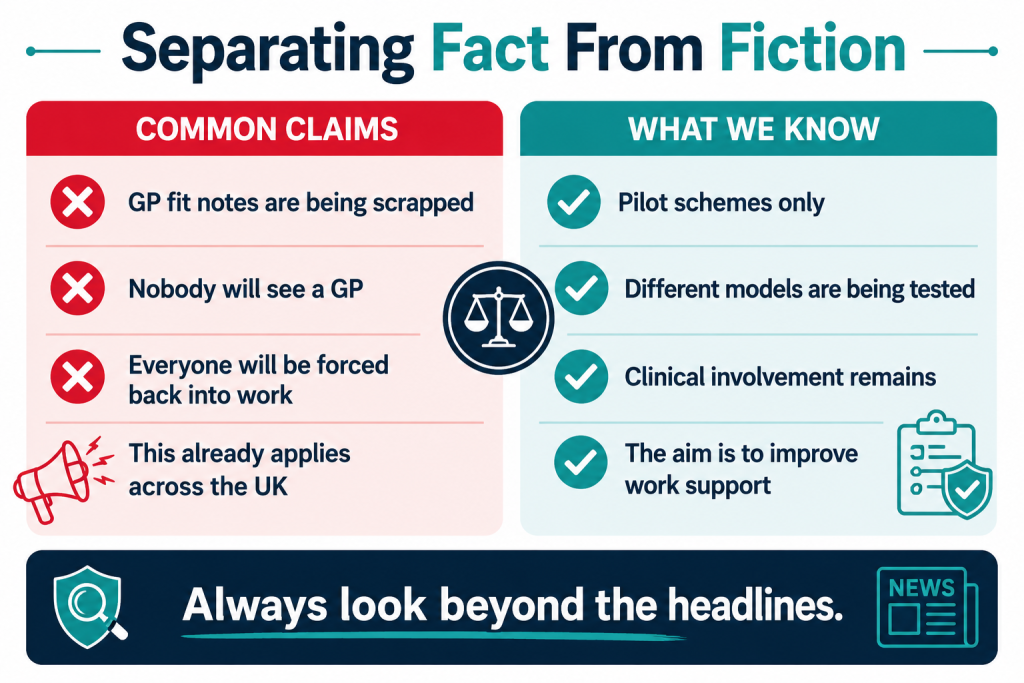
Some headlines have suggested that:
- GP fit notes are being abolished.
- Doctors will no longer decide who is fit for work.
- People who are off sick will be forced back into employment.
- Non-medical staff will decide whether someone is genuinely ill.
- The changes are already happening across the whole UK.
As often happens on social media, the reality is far more nuanced.
Some posts contain accurate information but leave out important context. Others simplify complex policy proposals into attention-grabbing headlines, while some contain information that is simply incorrect or misleading.
For people living with brain injuries, post-concussion syndrome, cognitive impairment, chronic neurological fatigue and other invisible disabilities, these headlines can understandably create anxiety.
Many people have contacted organisations like ours asking questions such as:
- Will my GP still be able to issue a fit note?
- Could someone without medical training decide I'm fit for work?
- Will I be forced back into work before I'm ready?
- Will this affect my benefits?
- Does this apply everywhere in the UK?
- What happens if my employer can't make the adjustments I need?
These are important questions.
The purpose of this article is to separate fact from fiction, explain what is actually being tested, explore why the Government is trialling changes to the current system, and discuss what these proposals could mean—particularly for people living with brain injuries and other long-term or fluctuating health conditions.
As with many areas of health and disability policy, it is important to look beyond the headlines and understand both the potential opportunities and the potential risks.
Why Misinformation Matters
Health and disability policy can be complex.
Unfortunately, social media algorithms often reward short, dramatic headlines rather than detailed explanations.
That can leave people believing that major changes have already happened, when in reality they may only be proposals, pilot schemes or consultations.
For people already living with uncertainty because of a brain injury, inaccurate or incomplete information can create unnecessary worry and confusion.
At MBIA, our aim is always to:
- explain the evidence;
- provide balanced, evidence-based information;
- acknowledge where questions remain unanswered;
- separate established facts from speculation;
- help people make informed decisions.
This article follows that same approach.
What is a fit note?
A fit note is the official document previously known as a “sick note”. Its formal name is the Statement of Fitness for Work.
Employees normally self-certify sickness for the first seven calendar days. An employer can generally require a fit note when an employee has been absent for more than seven consecutive days, including weekends and non-working days.
A fit note can currently be issued by an appropriately qualified:
- doctor;
- registered nurse;
- occupational therapist;
- pharmacist; or
- physiotherapist.
This has been the law since 2022, so fit notes have not been exclusively issued by GPs for several years.
The healthcare professional can state that the person is:
- not fit for work; or
- may be fit for work, provided certain support or changes are available.
Possible recommendations include:
- a phased return;
- temporarily reduced or altered hours;
- amended duties;
- working from home;
- avoiding driving, machinery or safety-critical tasks;
- taking additional rest breaks;
- reducing physical demands;
- changes to the workplace or equipment.
A fit note is medical advice rather than an instruction that an employer can simply override. When someone is recorded as “may be fit for work”, but the employer and employee cannot agree suitable changes, government guidance says the person should be treated as not fit for work for the period covered by the note.
Why does the Government want to change the system?
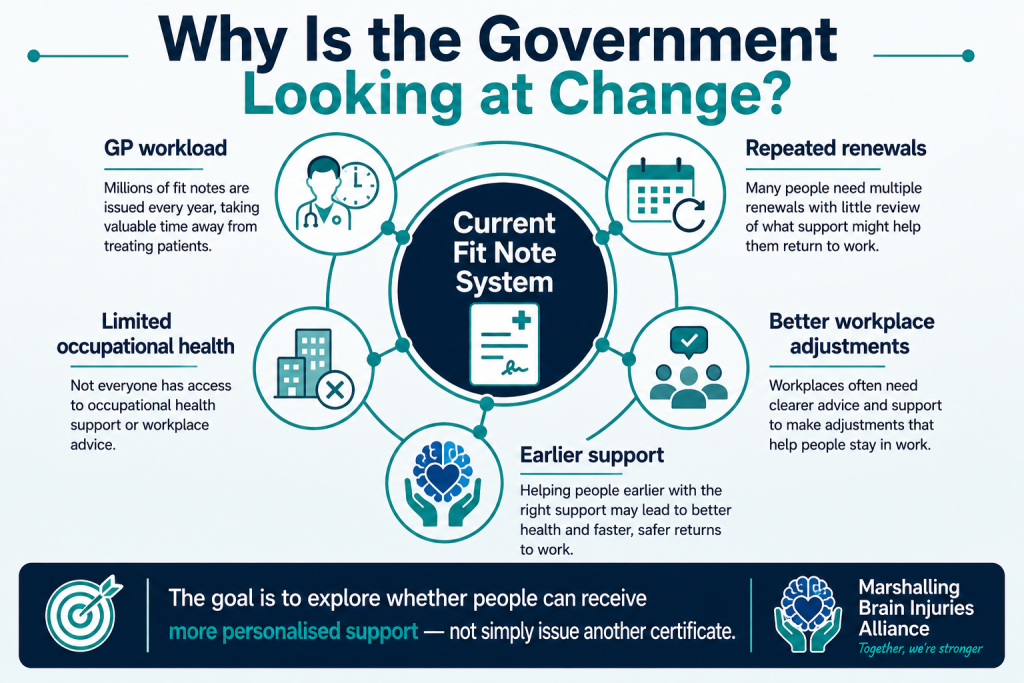
The Government argues that the current process frequently ends after a document has been issued.
Around 11 million fit notes are issued annually, and approximately 93% record that the person is not fit for work. Ministers argue that the system does not always lead to meaningful discussions about:
- rehabilitation;
- occupational health;
- workplace adjustments;
- phased returns;
- changes to duties;
- financial or housing difficulties;
- mental-health support;
- keeping in appropriate contact with the workplace.
The Government’s call for evidence also found that only 29% of primary-care staff considered issuing fit notes a good use of GP time. Employers reported that “may be fit” notes were sometimes too vague to help them understand what changes were needed.
However, the evidence collected by the Government also identified significant concerns. Some respondents said that vague “may be fit” wording could result in workers being treated as fully fit and returning before they had recovered. Others reported that employers did not always have the resources, flexibility or willingness to implement recommended adjustments.
This is an important distinction:
A lack of workplace support is not the same as a lack of willingness to work.
Someone may be capable of performing part of their role under carefully controlled conditions while remaining unable to manage their normal workload, hours, environment or responsibilities.
What exactly is being tested?
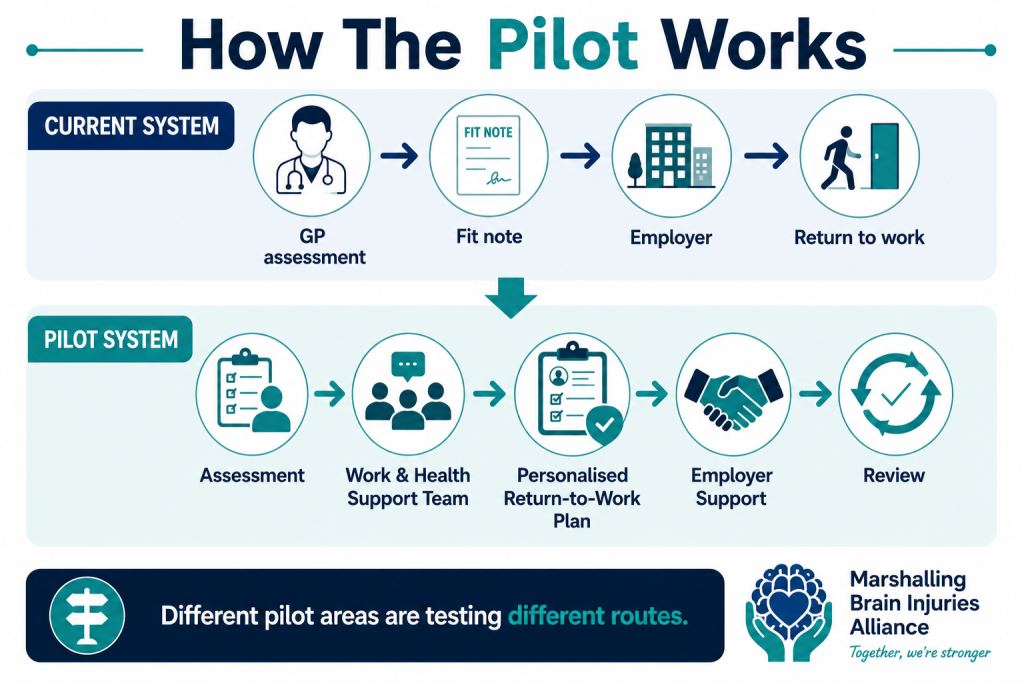
The four areas are testing different routes.
Birmingham and Solihull
A GP can issue the initial fit note where needed. Patients are then referred to a new service led mainly by non-clinical staff, including social prescribers and work-and-health coaches.
Coventry and Warwickshire
A GP issues the initial fit note. The patient may then be referred to a team containing both clinical and non-clinical practitioners.
Cornwall and the Isles of Scilly
The GP refers the person directly to a non-clinical support service without first issuing a traditional fit note.
Lancashire and South Cumbria
The GP refers the person to a service containing clinical and non-clinical practitioners without first issuing the traditional fit note.
These teams may include occupational therapists, social prescribers, work-and-health coaches and other health or employment-support professionals.
The intention is to create a personalised workability, stay-in-work or return-to-work plan, rather than relying only on repeated certificates.
Does this mean a non-medical work coach can decide that someone is medically fit?
This is one of the most important unanswered questions.
The Government says the new services will be staffed by combinations of clinical and non-clinical practitioners and that the schemes will have clinical oversight. It has also described the programme as voluntary and stated that people who require time away to recover will still be able to take it.
However, the exact safeguards, escalation procedures and division of responsibility will be crucial.
A social prescriber or employment coach may be well placed to help with:
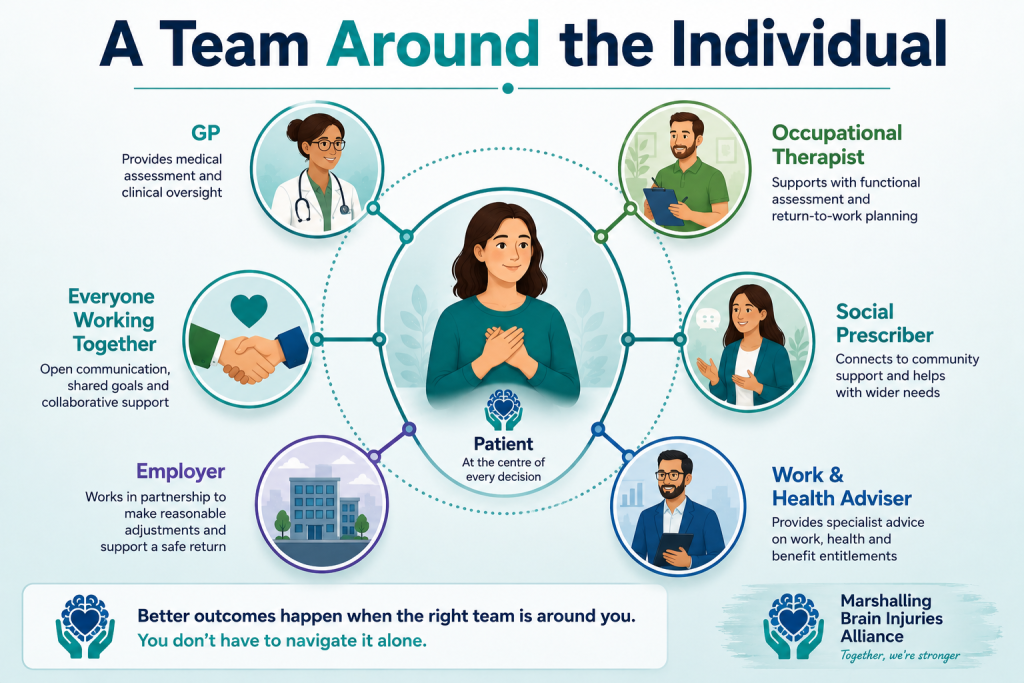
- communication with an employer;
- workplace barriers;
- phased-return planning;
- debt or housing advice;
- accessing community services;
- identifying suitable adjustments;
- referrals to employment or wellbeing support.
They are not automatically qualified to diagnose neurological injury, assess clinical risk or determine whether symptoms such as seizures, cognitive fatigue, impaired judgement or sensory overload make a particular job unsafe.
The British Medical Association has said the pilots must have suitable training, clinical oversight, occupational-health input and clear governance. The Royal College of General Practitioners has similarly warned that reform must prioritise patient wellbeing rather than economic targets and must not become punitive.
What could be positive about the changes?
There are genuine weaknesses in the current system.
For some people, a ten-minute GP appointment and a brief fit note do not produce the help required to return to employment safely.
A properly resourced multidisciplinary service could potentially provide:
Earlier occupational-health support
Many workers, especially those employed by small businesses, do not have access to an occupational-health department.
Better communication about function
Instead of simply recording a diagnosis, a workability plan could explain what the person can and cannot safely manage.
For example:
- able to work for two hours but not an eight-hour shift;
- able to complete quiet administrative tasks but not customer-facing work;
- unable to drive or operate machinery;
- unable to manage competing demands;
- requires regular rest periods;
- needs reduced screen exposure;
- needs written rather than verbal instructions;
- requires a gradual increase in hours.
More individualised return-to-work plans
Returning to work is rarely a simple choice between working normally and not working at all.
A graduated plan may prevent someone from attempting too much, deteriorating and having to leave work again.
Help addressing non-medical barriers
Housing, transport, caring responsibilities, financial stress and workplace relationships can all affect a person’s recovery and ability to remain employed.
Reduced GP administration
Moving some employment-related planning to suitably trained occupational-health professionals could allow GPs to spend more time diagnosing and treating patients.
The RCGP supports exploring multidisciplinary models, particularly for longer-term cases, but says GPs should normally retain the ability to provide short-term fit notes where clinically appropriate.
Why might this concern people with brain injuries?
Brain injuries are not always visible, stable or easily measured.
A person may look physically well while experiencing disabling problems with:
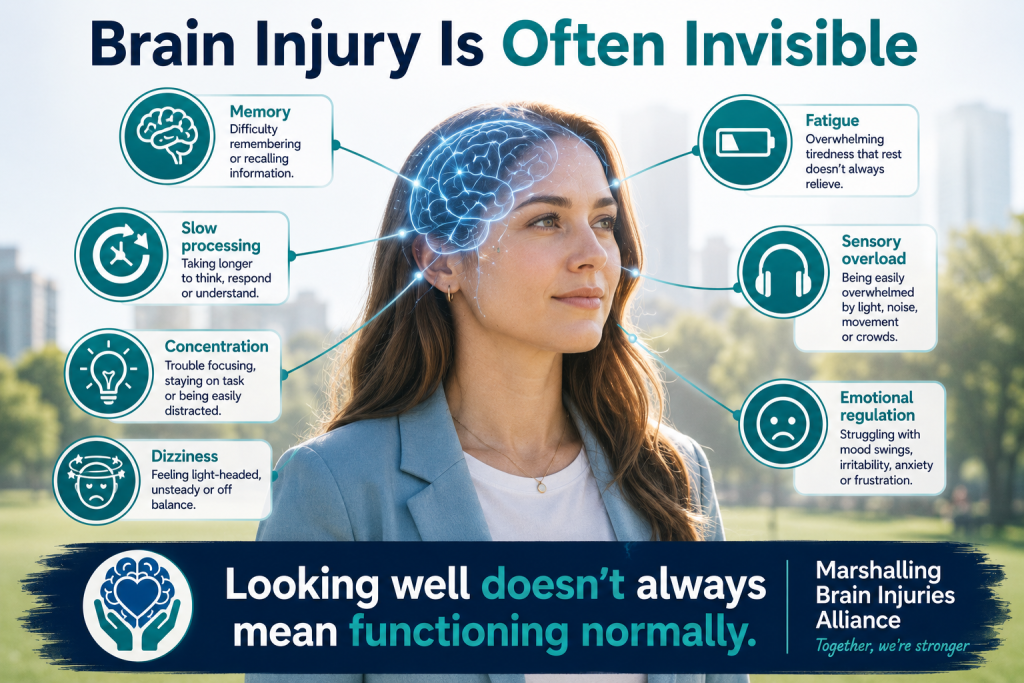
- concentration;
- memory;
- planning;
- decision-making;
- processing speed;
- communication;
- emotional regulation;
- balance;
- headaches;
- light and noise sensitivity;
- sleep;
- neurological fatigue;
- impulsivity;
- anxiety;
- sensory overload.
Some people can complete a brief conversation or appointment but cannot sustain safe, reliable work over several hours.
This is sometimes described as the difference between capacity at one moment and sustainable functional capacity.
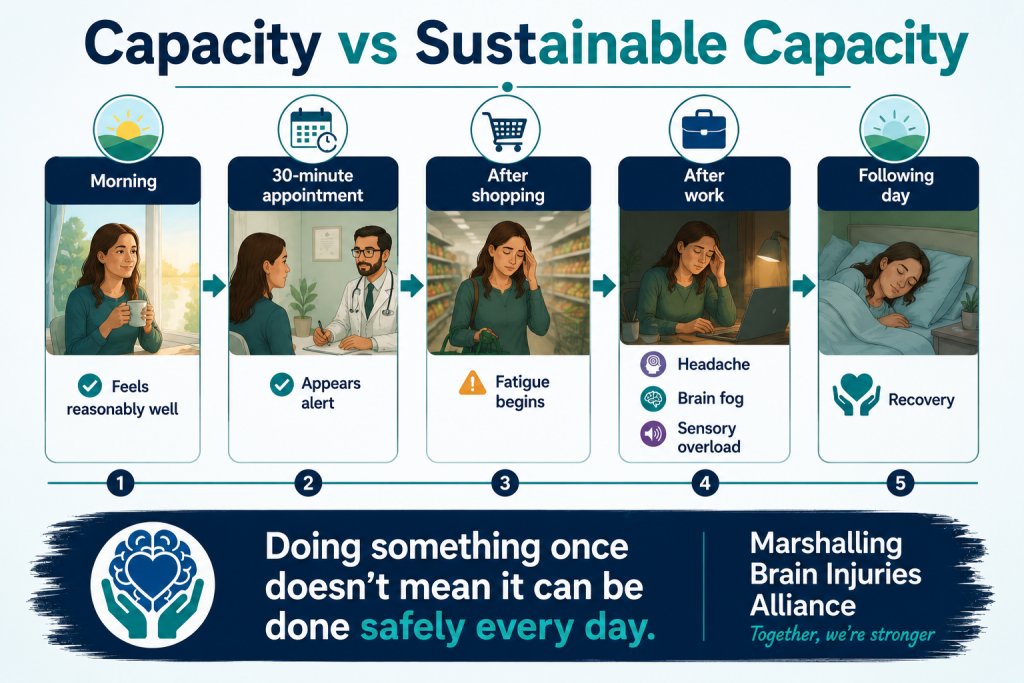
Brain injury fatigue is not ordinary tiredness
A person might appear alert during a 30-minute assessment and then require several hours or days to recover.
Workability should therefore be assessed over time, not from appearance during one appointment.
Symptoms can fluctuate
Someone may function reasonably one day and be severely impaired the next. A plan based only on the person’s best day can create unrealistic expectations.
Cognitive impairment can affect self-advocacy
People with memory, communication or executive-function difficulties may struggle to:
- explain their symptoms;
- remember examples;
- challenge an inaccurate assessment;
- understand proposed conditions;
- organise supporting evidence;
- recognise when they are becoming overwhelmed;
- negotiate directly with an employer.
People should be allowed to have a family member, advocate or support worker involved where necessary.
Returning too early can cause deterioration
An unsuccessful return may lead to worsening symptoms, loss of confidence, increased absence and, in some cases, loss of employment.
The question must not simply be:
“Can this person do any work?”
It should be:
“Can this person perform this work safely, reliably, repeatedly and sustainably, without causing a significant deterioration in their health?”
Safety-critical occupations require particular caution
A generic work-coaching approach may be inappropriate where symptoms could place the worker or others at risk.
Examples include:
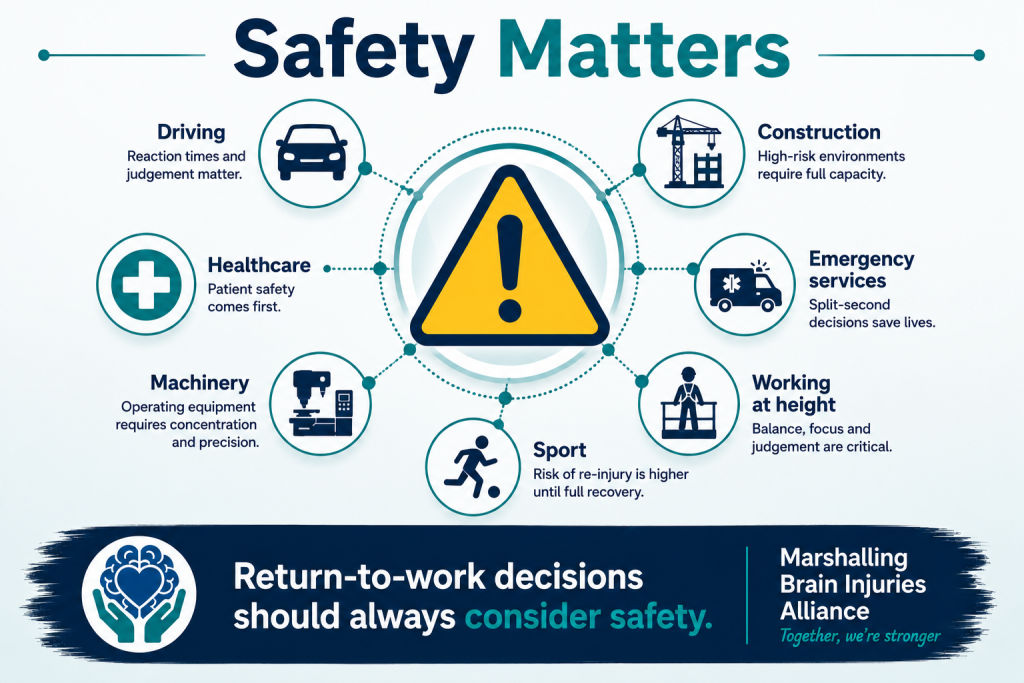
- driving;
- operating machinery;
- working at height;
- emergency-service duties;
- construction;
- healthcare;
- working with vulnerable people;
- handling dangerous substances;
- professional sport;
- jobs requiring rapid decisions;
- roles involving weapons or security;
- lone working.
Someone with dizziness, slowed processing, impaired attention, unpredictable fatigue, seizures or episodes of confusion may be able to perform some tasks but remain unsafe in their normal role.
Any return-to-work plan must consider the actual demands and risks of the job, not merely whether the person can complete basic activities at home.
A diagnosis alone does not determine fitness for work
Two people with the same diagnosis may have entirely different work capacities.
Equally, a normal CT or MRI scan does not necessarily demonstrate normal neurological function after concussion or mild traumatic brain injury.
A meaningful assessment should consider:
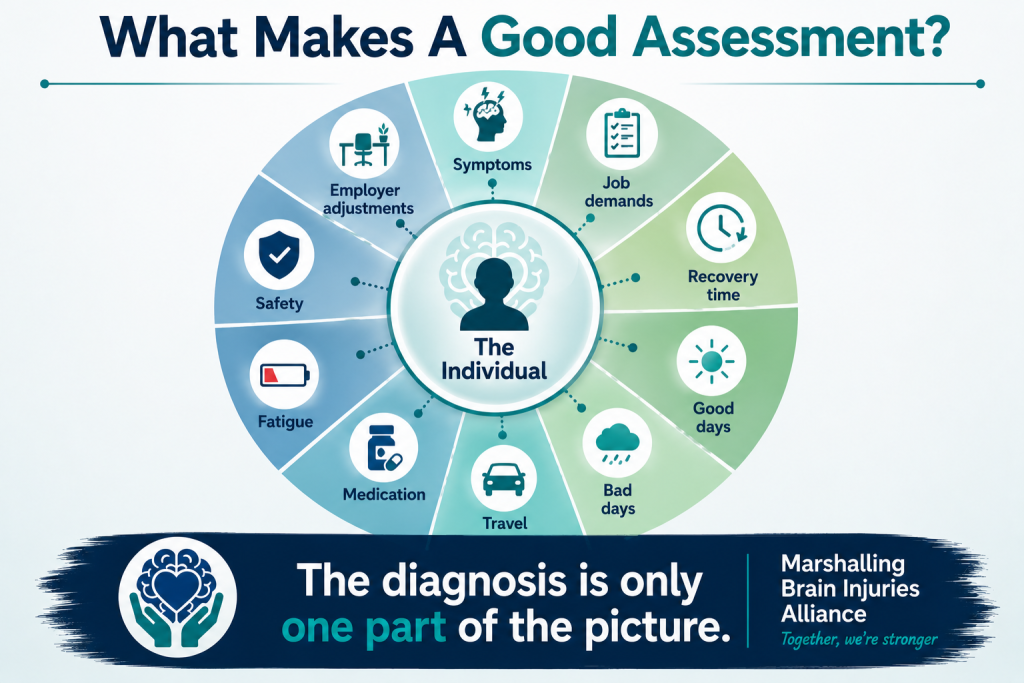
- the person’s symptoms;
- functional limitations;
- job demands;
- length and intensity of shifts;
- commuting;
- sensory environment;
- cognitive load;
- safety risks;
- recovery time after activity;
- medication effects;
- whether adjustments are genuinely available;
- whether performance can be sustained repeatedly.
The aim should be a safe and lasting return—not the fastest possible return.
Could employers be involved in the conversation?
The pilots envisage three-way discussions between the individual, the support service and the employer.
This may be helpful when the worker agrees and the employer is supportive. It could allow practical adjustments to be discussed directly.
However, it raises important questions about:
- informed consent;
- medical confidentiality;
- how much information is shared;
- whether declining employer involvement affects access to certification;
- how workplace disputes are handled;
- whether the employee feels able to speak freely;
- what happens when the employer is part of the problem.
An employer normally needs information about the functional effect of a condition, not access to an employee’s full medical history.
For example, it may be appropriate to state:
“The employee experiences cognitive fatigue and requires regular breaks, reduced hours and a quiet working environment.”
It may not be necessary to provide detailed medical records, trauma history or unrelated diagnoses.
Can an employer force someone back to work?
A pilot service does not remove employers’ legal responsibilities.
Employers must make reasonable adjustments where a worker is disabled within the meaning of the Equality Act 2010 and would otherwise be placed at a substantial disadvantage. Government guidance confirms that this duty can apply to physical and mental health conditions and to all workers covered by the legislation.
Possible brain-injury adjustments could include:
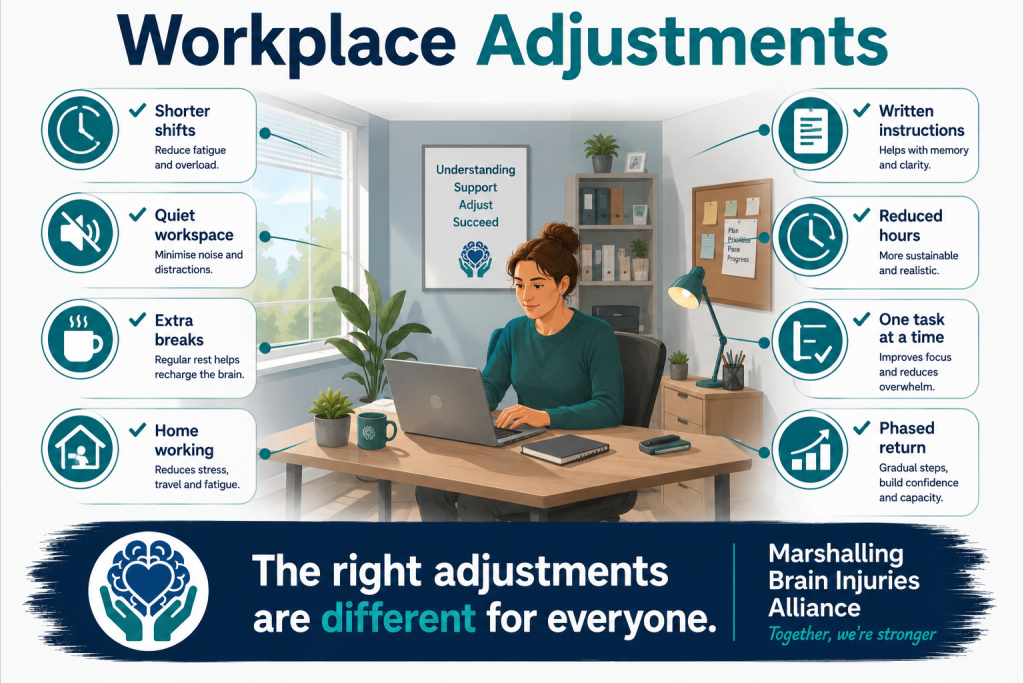
- a phased return;
- shorter shifts;
- later starting times;
- home or hybrid working;
- additional rest breaks;
- reduced screen exposure;
- a quiet workspace;
- one task at a time;
- written instructions;
- extra time to complete work;
- reduced targets;
- temporary removal of safety-critical duties;
- reduced travel;
- avoiding night shifts;
- a named workplace contact;
- time for rehabilitation and medical appointments.
What is “reasonable” depends on factors such as effectiveness, practicality, cost, employer resources and the nature of the role.
An employer cannot make an unsafe or unsuitable proposal reasonable merely by describing it as support.
What if the employer cannot provide the recommended changes?
Under the current system, where a fit note says a person “may be fit” but the employer cannot agree or provide the required changes, the employee should be treated as not fit for work for the period of the note.
The new pilots must clarify how this principle will operate when traditional fit notes are replaced by workability plans.
A worker should not lose sick-pay protection simply because:
- suitable alternative work does not exist;
- the employer refuses an adjustment;
- occupational-health support is delayed;
- the workplace cannot be made safe;
- the proposed role is incompatible with the person’s limitations.
Does this change PIP, Universal Credit or the Work Capability Assessment?
Not automatically.
A fit note is not the same as:
- a Personal Independence Payment assessment;
- an Adult Disability Payment assessment;
- a Universal Credit Work Capability Assessment;
- an Employment and Support Allowance decision;
- an Access to Work assessment;
- an occupational-health report;
- a formal finding that someone is capable of employment.
The Government says the initial fit-note pilots focus principally on people who are employed. It is still exploring how future reforms might interact with the benefits system.
People claiming Universal Credit or Employment and Support Allowance may still be asked to supply medical evidence while waiting for a Work Capability Assessment. The existence of a fit note does not itself guarantee a particular benefits decision, and a work coach cannot simply treat a fit note as proof that someone has no restrictions.
Similarly, being able to attempt limited, supported or therapeutic work does not necessarily mean someone can manage ordinary full-time employment.
Is the scheme voluntary?
The Government announcement describes the support model as voluntary and states that nobody who is unable to work should be pressured into doing so.
However, important practical questions remain:
- Can a patient decline work coaching and still obtain the evidence needed for sick pay?
- Can they request a clinical assessment?
- What happens if they disagree with a non-clinical practitioner?
- Is there an appeal or review process?
- Can they return to their GP if symptoms worsen?
- Will refusing employer contact affect their case?
- Who is accountable for an unsafe return-to-work recommendation?
These questions should form part of the pilots’ formal evaluation.
What should a safe brain-injury workability assessment include?
A high-quality assessment should document:
The person’s actual role
Not merely their job title, but the duties, pace, hazards, environment and cognitive demands.
Functional effects
For example:
- loses track during multi-step tasks;
- cannot retain verbal instructions;
- develops severe headache after screen use;
- becomes disorientated in noisy environments;
- cannot sustain attention safely;
- requires prolonged recovery after exertion;
- has unpredictable episodes of dizziness;
- cannot reliably wake for early shifts because of sleep disturbance.
Reliability
Can the activity be completed:
- safely;
- to an acceptable standard;
- repeatedly;
- within a reasonable time;
- without significant symptom deterioration?
Fluctuation
Assessments should consider bad days, recovery periods and delayed symptoms—not just the person’s presentation during the appointment.
Commuting
Someone may be able to undertake a short task at home but be unable to drive, use crowded public transport or complete a long commute.
Combined conditions
Brain injuries frequently coexist with pain, migraine, PTSD, depression, anxiety, hearing loss, vestibular problems or physical injuries.
Each condition should not be assessed in isolation.
Workplace reality
A recommendation for quiet duties, reduced hours or home working has little value unless the employer can genuinely provide it.
What can patients in pilot areas do?
People approached through one of the four pilots should ask:
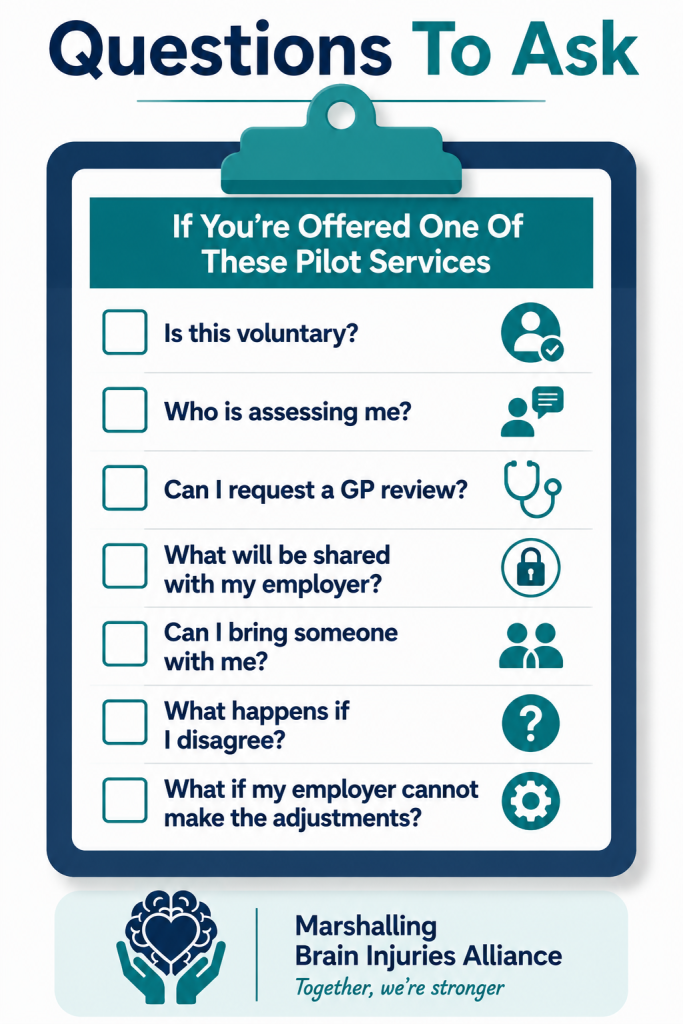
- Am I being seen under the fit-note pilot?
- Is participation voluntary?
- Who is carrying out the assessment, and what are their qualifications?
- Who has clinical responsibility for the decision?
- Can I request a GP or other clinical review?
- Will I receive a written copy of my workability plan?
- Will the document be accepted for Statutory Sick Pay?
- What information will be shared with my employer?
- Will my consent be obtained before employer contact?
- How can I challenge factual errors or an unsafe recommendation?
- Can I bring an advocate, family member or support worker?
- What happens if my employer cannot provide the adjustments?
Keep copies of all documents, emails and plans.
It may also help to prepare a brief symptom and function diary showing:
- how long activities can be sustained;
- what triggers symptoms;
- what happens afterwards;
- how long recovery takes;
- examples of errors or safety difficulties;
- differences between good and bad days.
What should employers understand?
A return-to-work plan should be developed collaboratively, not imposed.
Employers should avoid assuming that:
- looking well means being well;
- working from home removes all disability-related barriers;
- completing one task means someone can sustain an entire shift;
- a phased return guarantees full recovery by a fixed date;
- cognitive fatigue can be overcome through motivation;
- all brain injuries recover according to the same timeline;
- an employee must disclose their full diagnosis to obtain support.
Regular reviews are important because adjustments may need to increase, decrease or continue longer than originally expected.
What must the Government measure?
The success of these pilots should not be judged simply by whether fewer fit notes are issued or whether people return to work more quickly.
A credible evaluation should examine:
- health outcomes;
- sustained employment at six and twelve months;
- failed returns to work;
- symptom deterioration;
- patient satisfaction;
- complaints and appeals;
- employer compliance with adjustments;
- clinical safety incidents;
- safeguarding concerns;
- effects on GP workload;
- delays in receiving sick-pay evidence;
- outcomes for people with invisible and fluctuating disabilities;
- differences between large and small employers;
- equality impacts;
- whether patients felt pressured;
- whether data was shared appropriately.
A person returning for two weeks and then becoming too unwell to continue should not be recorded as a simple success.
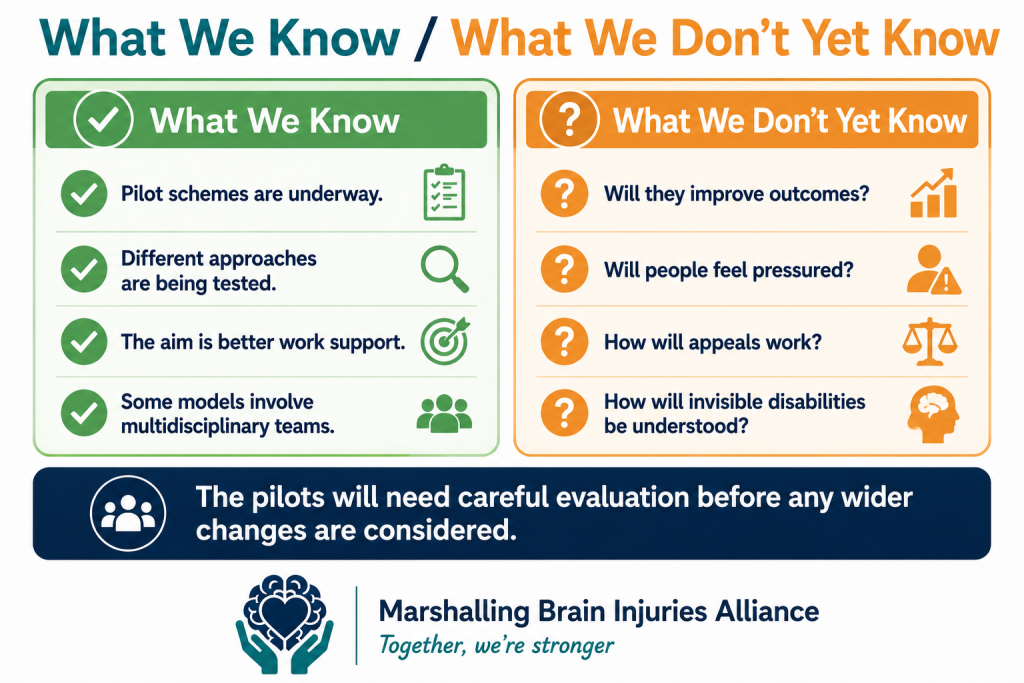
What we know—and what we do not yet know
What we know
✔ Four fit-note reform pilots began in selected areas of England from July 2026.
✔ They are backed by £3 million in their first year.
✔ They may cover up to 100,000 appointments.
✔ Some areas retain an initial GP-issued fit note.
✔ Other areas refer patients directly to a new work-and-health service.
✔ Teams may contain both clinical and non-clinical staff.
✔ The stated aim is personalised support, adjustments and sustainable return to work.
✔ The findings may influence future legislation.
What we do not yet know
✘ Whether the models will improve long-term health outcomes.
✘ How consistently clinical oversight will operate.
✘ Whether patients will experience pressure to return too soon.
✘ How disagreements will be reviewed or appealed.
✘ How well the system will understand brain injury and fluctuating disability.
✘ Whether employers will actually implement recommendations.
✘ How any future national model would interact with disability benefits.
✘ Whether the reforms will eventually be extended beyond England.
The MBIA view
Earlier access to occupational health, personalised adjustments and practical support could help some people remain in employment or return safely.
However, reform must never begin from the assumption that a person who is off sick simply needs greater encouragement to work.
People living with brain injuries often want to return to meaningful employment. The barriers are frequently neurological, environmental and organisational—not motivational.
Any future system must therefore be:
- patient-centred;
- clinically safe;
- trauma-informed;
- informed by neurological expertise;
- accessible to people with cognitive and communication difficulties;
- based on sustainable function rather than appearances;
- protected from targets that reward rapid but unsafe returns;
- supported by meaningful employer accountability;
- clear about consent, confidentiality and appeal rights.
Good work can support identity, financial security, connection and wellbeing.
But unsuitable work, attempted too soon or without adequate adjustments, can damage recovery and push people further away from employment.
The goal should not be to produce fewer fit notes at any cost.
The goal should be to help people recover, protect their health and participate in appropriate work whenever it is genuinely safe and sustainable.
Final message
Fit notes have not been abolished across the UK.
Four areas of England are testing alternative approaches. Some patients will still receive an initial GP fit note, while others may be referred directly to a multidisciplinary support service.
These trials could provide better occupational-health and workplace support, but they also require close scrutiny—particularly for people with brain injuries, cognitive impairments, fluctuating symptoms and invisible disabilities.
No one should be pushed back into work simply because their condition is difficult to see, difficult to measure or poorly understood.
A safe return to work is not just about what someone can do once. It is about what they can do safely, reliably, repeatedly and sustainably.
This article provides general awareness and information and should not be treated as individual medical, employment or benefits advice.
Together, we’re stronger.
Marshalling Brain Injuries Alliance