Brain Damage Doesn't Start at the Professional Level: Why Contact Sports Must Protect Grassroots Players
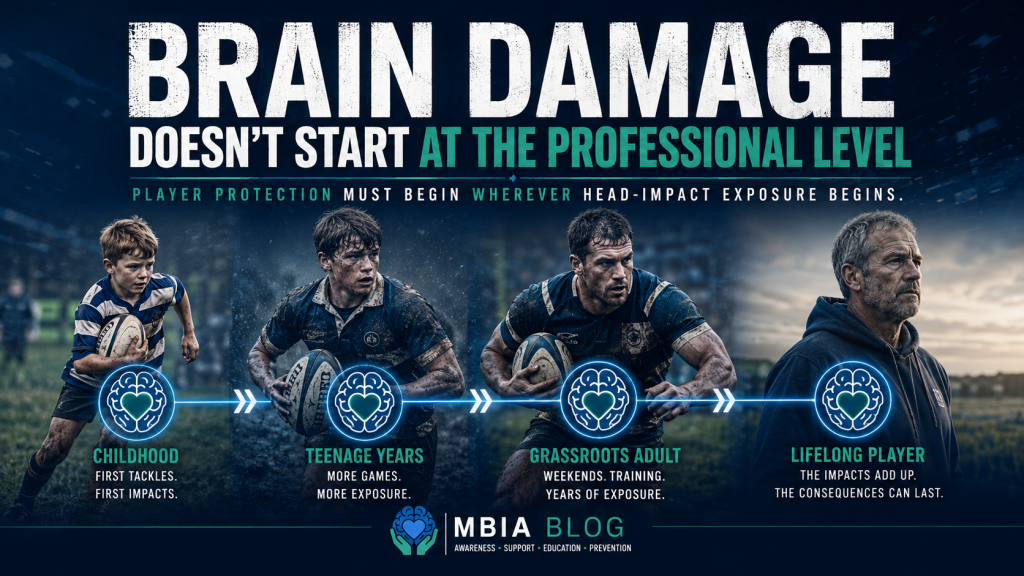
If cumulative exposure to repetitive head impacts matters, protecting professional athletes is not enough. Brain-health prevention must begin in childhood, school and grassroots sport.
For years, much of the public conversation about Chronic Traumatic Encephalopathy (CTE), concussion and long-term brain damage in sport has centred around professional athletes.
Former internationals. Professional rugby players. NFL stars. Elite footballers. Boxers.
They are often the people whose diagnoses make headlines, whose stories appear in documentaries and whose deaths prompt investigations into the long-term consequences of contact sport.
But there is a fundamental problem with framing the issue this way.
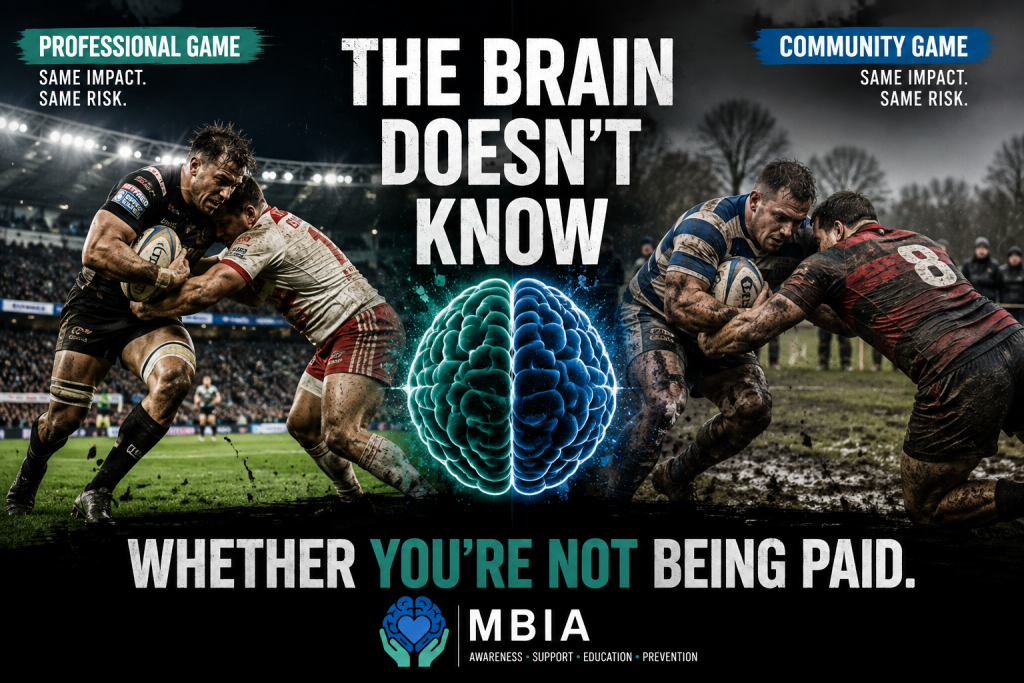
A tackle at a community rugby club does not become biologically harmless because there are no television cameras watching it.
A collision during school rugby does not disappear from someone's exposure history when they turn 18.
And a player who spends 25 or 30 years playing grassroots rugby may accumulate substantial exposure to head impacts without ever signing a professional contract.
Emerging research is giving us another reason to question whether our focus on elite athletes has been far too narrow.
The question should no longer simply be:
How do we protect professional athletes from concussion?
It needs to become:
How do we reduce unnecessary head-impact exposure across an entire sporting lifetime?
The Research That Should Change the Conversation
A recent ABC News investigation examined the controversy surrounding Australian Rules footballer Jake Kolodjashnij and an agreement he signed concerning the risks associated with future concussion.
The case raised difficult questions about informed consent.
Can professional athletes knowingly accept the possibility of long-term brain injury?
Can a player meaningfully consent to neurological consequences that might not become apparent for decades?
And, even where risks are acknowledged, does that reduce the responsibility of sporting organisations to make their sport as safe as reasonably possible?
Those are important questions.
But buried within the discussion was a research finding that may have much wider implications for contact sport.
Professor Alan Pearce and colleagues studied 113 retired male professional athletes from Australian rules football, rugby league and rugby union.
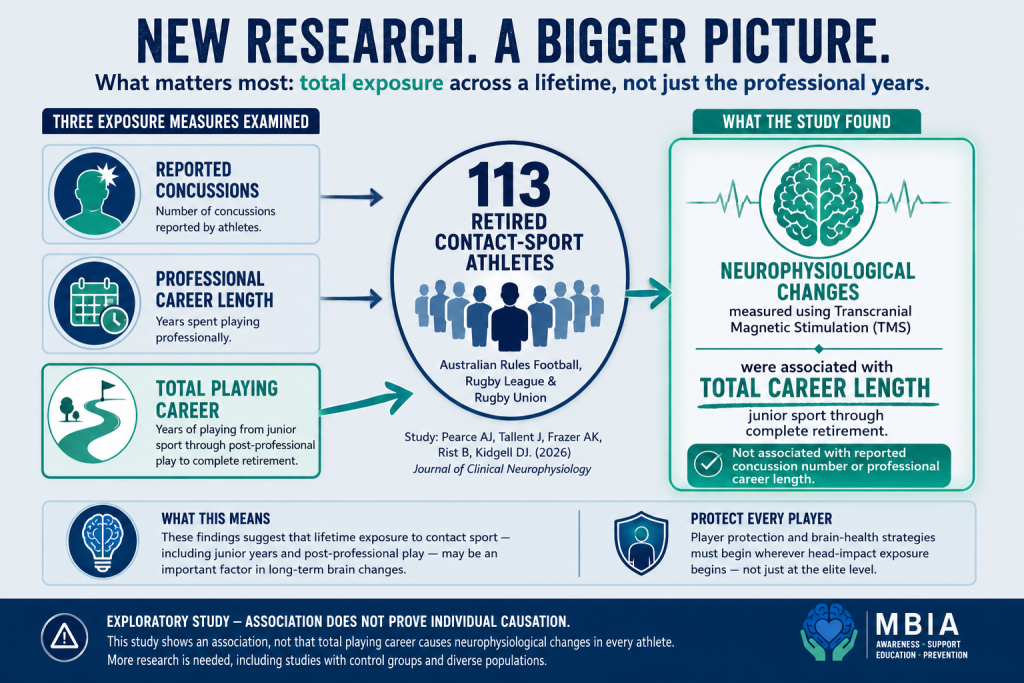
The researchers used transcranial magnetic stimulation (TMS) to investigate cortical neurophysiology and compared their findings with several measures of sporting exposure.
These included:
- reported concussion history;
- length of professional career;
- and total playing career — from junior sport through to complete retirement from playing.
What they found deserves attention.
The neurophysiological changes they measured were associated with total career length.
They were not significantly associated with the length of the player's professional career or their reported number of concussions.
This was an exploratory study and it does not prove that every person who plays contact sport for many years will develop neurological disease.
But it raises an extremely important question:
What if the years we have traditionally paid the least attention to are part of the exposure that matters?
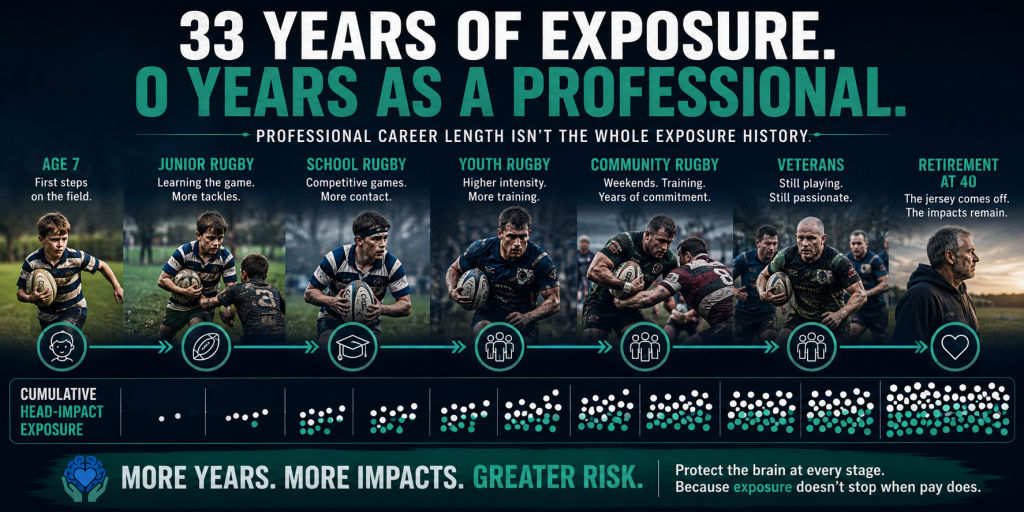
A Rugby Career Does Not Begin With a Professional Contract
Consider two players.
One starts rugby at seven.
He plays junior rugby, school rugby and youth rugby before entering an academy. At 20, he becomes professional and retires from professional rugby at 32.
Another starts at seven.
He plays junior rugby, school rugby, youth rugby and then spends more than two decades playing for community clubs.
He eventually hangs up his boots at 40.
The second player never earns a living from rugby.
Yet he has experienced approximately 33 years of rugby participation.
Matches.
Training.
Tackle practice.
Rucks.
Mauls.
Accidental collisions.
Head-to-head contacts.
Falls.
And potentially concussions that were never recognised, diagnosed or recorded.
The first player will probably have had greater intensity of exposure during his professional years and access to a very different training environment.
But we cannot simply assume the second player's exposure is irrelevant.
Because:
The brain keeps an exposure history. It does not keep a wage slip.
CTE Is Not Exclusively a Disease of Professional Athletes
There is already compelling evidence that CTE pathology is not restricted to people who reach professional sport.
A major study published in JAMA Neurology examined the brains of 152 deceased contact-sport athletes who had been exposed to repetitive head impacts and died before the age of 30.
CTE was identified in 63 of the 152 brain donors.
Almost all of the CTE cases were early-stage disease.
But one finding is particularly important when discussing grassroots sport.
Of the 63 athletes diagnosed with CTE:
45 — 71.4% — had played only at amateur level.
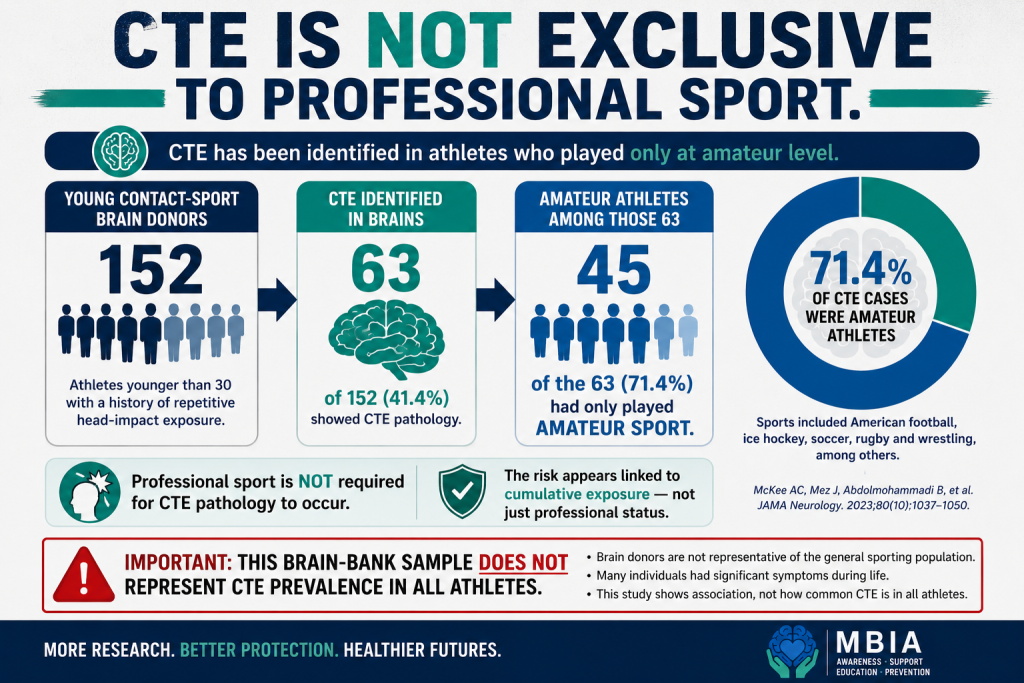
The sports represented among the young athletes included American football, ice hockey, soccer, rugby and wrestling.
That finding should permanently challenge the idea that someone has to reach professional sport before CTE becomes relevant.
However, there is an essential scientific warning.
These figures do not mean that 41% of young contact-sport athletes develop CTE.
This was a selected brain-bank population. Families donating brains for CTE research are not representative of the entire sporting population, and the individuals studied were highly symptomatic.
The study therefore cannot tell us the prevalence of CTE among ordinary grassroots athletes.
But it demonstrates something extremely important:
Professional sport is not required for CTE pathology to occur.
That distinction matters.
Rugby Already Has Evidence of Long-Term Neurological Risk
CTE is only part of the wider discussion about neurological health after contact sport.
A landmark Scottish study followed 412 former male international rugby union players and compared them with 1,236 people from the general population matched for age, sex and socioeconomic status.
Over the follow-up period, former international rugby players had approximately 2.7 times the risk of being diagnosed with a neurodegenerative disease.
The researchers concluded that strategies to reduce exposure to head impacts and head injuries in sport should be promoted.
Again, this does not mean every rugby player will develop dementia, Parkinson's disease, motor neurone disease or CTE.
Most will not.
But when this evidence is considered alongside emerging research on cumulative exposure, an increasingly important principle appears:
We should not wait until we know precisely which individual will develop disease before reducing unnecessary exposure.
Grassroots Rugby Is Not a Low-Exposure Environment Simply Because It Is Amateur
One of the most revealing studies comes from New Zealand.
The NZ-RugbyHealth study surveyed 470 former athletes:
- 127 former elite rugby players;
- 271 former community rugby players;
- 72 former non-contact-sport athletes.
Reported history of concussion was:
Elite rugby — 94%
Community rugby — 82%
Non-contact sports — 26%
More than four out of five former community rugby players therefore reported experiencing concussion during their playing careers.
That is not an elite-sport problem.
It is a rugby problem.
And diagnosed concussion is only one part of the exposure picture.
Concussion Is Not the Same Thing as Repetitive Head-Impact Exposure
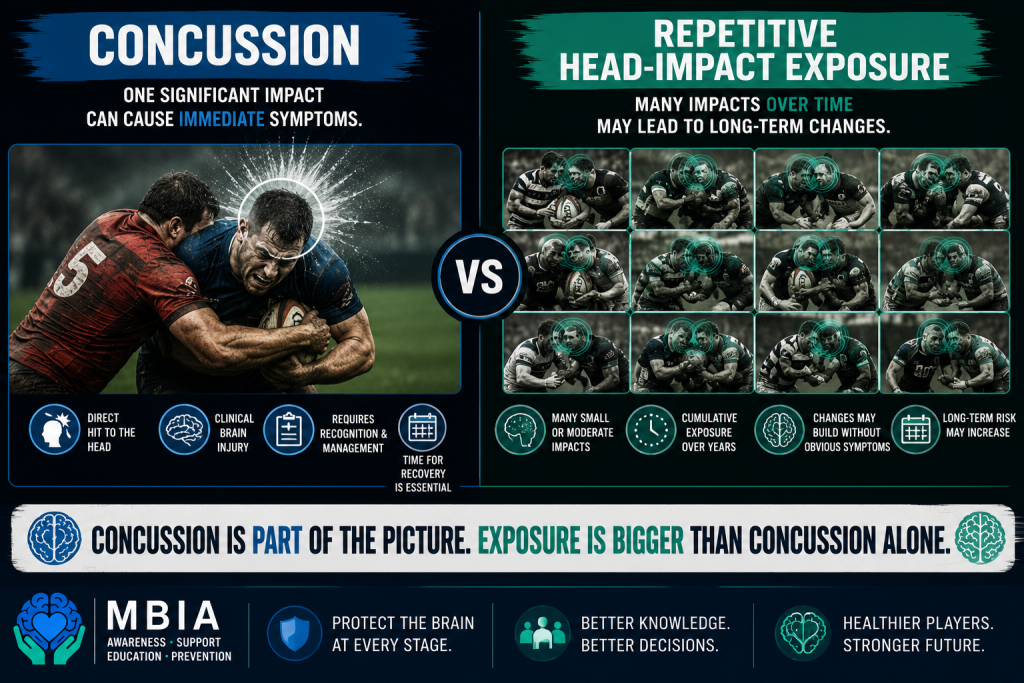
This distinction may be one of the most important changes needed in the conversation about brain health in sport.
A concussion is a clinical brain injury.
But players can experience many impacts that do not result in an immediately recognisable concussion.
These are often described as sub-concussive or repetitive head impacts.
Not every head impact damages the brain.
Not every sub-concussive impact produces permanent neurological change.
And science has not established a simple threshold where a particular number of impacts inevitably results in CTE.
But research increasingly suggests that focusing only on diagnosed concussion may fail to capture an athlete's complete exposure.
That matters enormously for prevention.
Because traditional concussion policy is largely reactive.
A player develops symptoms.
We recognise them.
We remove the player.
We allow recovery.
We gradually return them to sport.
That remains essential.
But it occurs after a suspected brain injury has happened.
CTE prevention requires us to ask another question:
Can we reduce unnecessary repetitive head impacts before symptoms appear?
Concussion Management Is Not CTE Prevention
The UK has made important progress in grassroots concussion management.
The UK-wide grassroots guidance introduced the straightforward message:
“If in doubt, sit them out.”
Players suspected of concussion should be removed from sport and managed through a graduated recovery and return process.
The guidance is particularly important because trained medical professionals are far less likely to be routinely present in grassroots environments.
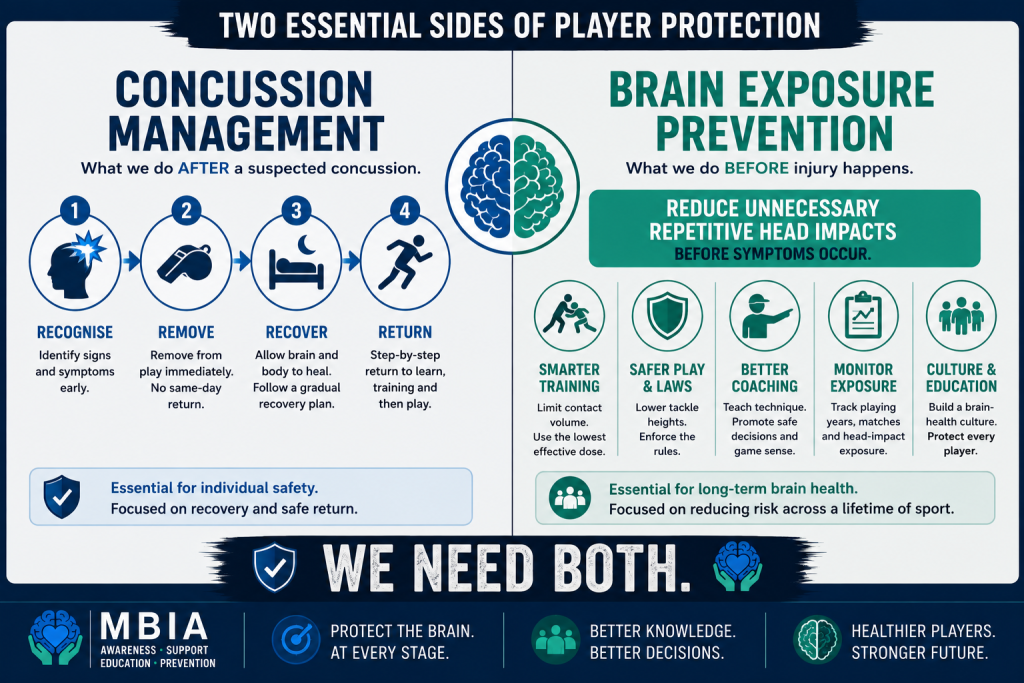
But recognising concussion and reducing cumulative exposure are not the same thing.
We need both.
Concussion management
Recognise → Remove → Recover → Return
Brain exposure prevention
Reduce unnecessary repetitive head impacts before injury becomes clinically apparent.
If cumulative exposure contributes to long-term neurological risk, concussion protocols alone cannot represent the entirety of CTE prevention.
Grassroots Players May Actually Have Fewer Protections
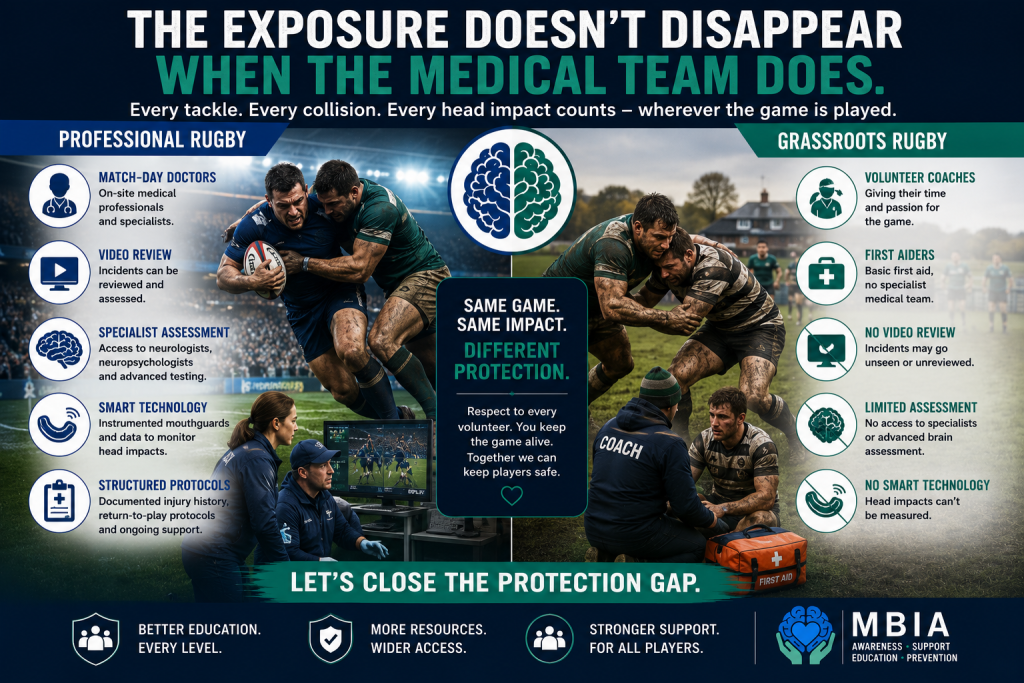
Professional players can have access to resources most community athletes could never expect.
Doctors.
Physiotherapists.
Video review.
Specialist concussion assessment.
Neurologists.
Neuropsychologists.
Instrumented mouthguards.
Structured return-to-play programmes.
Detailed medical records.
Formal injury surveillance.
Now picture a community match.
There may be no doctor.
No neurologist.
No video replay.
No smart mouthguard.
No independent concussion spotter.
Perhaps there is a trained first aider and a volunteer coach doing their best while also trying to manage an entire team.
This is precisely why grassroots protection matters.
The absence of a professional contract should never mean the absence of meaningful brain-health protection.
The Problem Begins Before Adult Rugby
If cumulative exposure matters, childhood sport becomes impossible to exclude from this discussion.
Someone beginning rugby at seven and stopping at 37 has experienced three decades of participation.
That lifetime exposure may include thousands of training sessions and matches.
Children are also fundamentally different from professional adults when we discuss informed consent.
An adult professional athlete may be presented with information about the risks associated with their career and make a decision.
An eight-year-old cannot meaningfully understand or consent to a neurological risk that might potentially emerge decades later.
That places greater responsibility on adults and sporting organisations.
The appropriate question is not:
“Do parents accept that rugby carries risks?”
The more useful question is:
How much head-impact exposure is actually necessary for a child to learn, enjoy and benefit from rugby?
That is a prevention question.
Protecting the Brain Does Not Mean Ending Contact Sport
This conversation is sometimes presented as though there are only two choices.
Ignore the risk.
Or ban contact sport.
There is a huge space between those positions.
Rugby brings physical activity, friendships, identity, confidence, discipline, teamwork and community to millions of people.
The objective should be to preserve those benefits while reducing avoidable neurological exposure.
And rugby has already demonstrated that the game can change.
From July 2026, World Rugby formally lowered the legal tackle height in community rugby, allowing unions to use either the waist or base of the sternum as the legal tackle line.
The decision followed trials involving more than 150,000 tackles.
World Rugby reported that lower tackle heights reduced upright tackling — a position associated with avoidable head impacts — while maintaining the fundamental shape of the game.
Later analysis covering more than 170,000 tackles across 11 unions reported encouraging reductions in head and neck injuries or concussion in settings where injury surveillance was available.
This matters because it demonstrates something fundamental:
Head-impact exposure is not completely unavoidable or unchangeable.
Rules, coaching and behaviour can influence it.
Training Must Become Part of the Conversation
Matches receive most of the attention because that is where visible concussions often occur.
But players also accumulate contact during training.
World Rugby's own contact-training guidance recognises that contact training creates head-impact risk and recommends identifying the lowest dose of contact training necessary to prepare players adequately.
Although developed primarily around elite rugby, World Rugby states that the underlying principles are appropriate below the professional game too.
That concept could become extremely important in grassroots prevention.
Players need to learn safe tackling.
Eliminating contact practice entirely could leave players technically unprepared and potentially increase risk.
But that does not mean every contact session needs to involve repeated full-intensity collisions.
Coaching can make greater use of:
- tackle bags and shields;
- controlled technique sessions;
- progressive contact intensity;
- touch and limited-contact training;
- lower-speed repetitions;
- video coaching;
- strict recovery periods;
- and carefully planned full-contact sessions.
The question becomes:
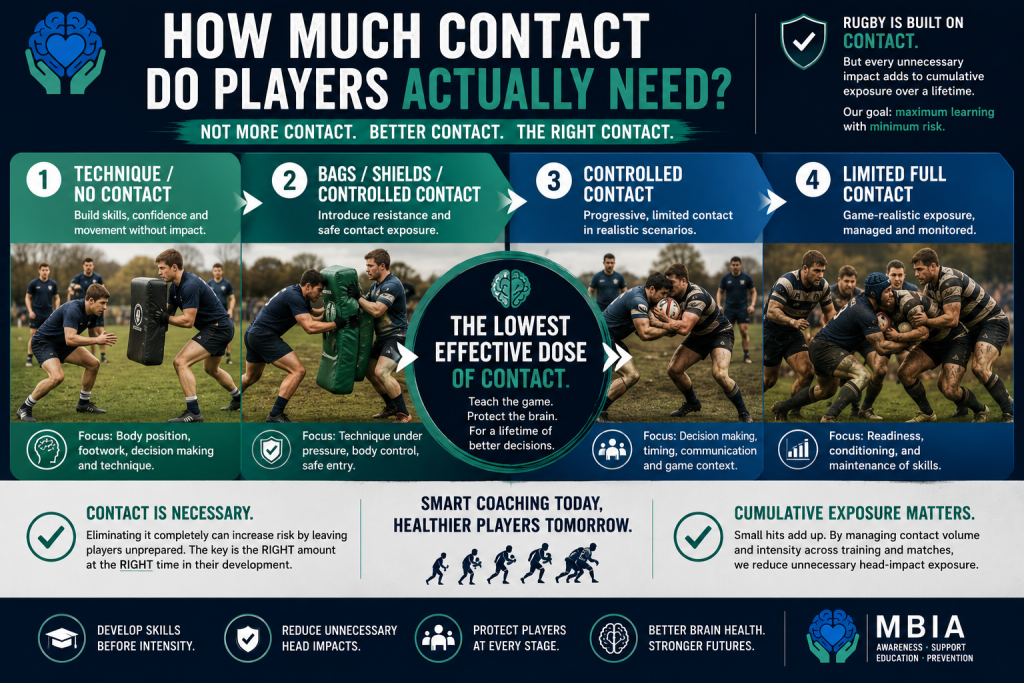
What is the minimum effective dose of contact required to teach rugby safely?
Every unnecessary collision removed from training is one less exposure without necessarily removing anything valuable from the sport.
We Need to Start Thinking in Terms of Lifetime Exposure
Sports medicine is very good at counting injuries.
We need to become better at understanding exposure.
A player's brain-health history could potentially include:
Age contact sport began
Number of seasons played
Level and position played
Match exposure
Training exposure
Known concussions
Suspected or undocumented concussions
Periods playing for multiple teams
Other contact sports
Recovery time following injury
Total years of repetitive head-impact exposure
We do not yet know exactly how these factors interact.
But building better exposure histories would allow researchers to answer the questions we urgently need answered.
Because asking:
“How many diagnosed concussions have you had?”
may eventually prove far less informative than asking:
“What has your lifetime exposure to repetitive head impacts looked like?”
There Is Another Uncomfortable Question for Rugby
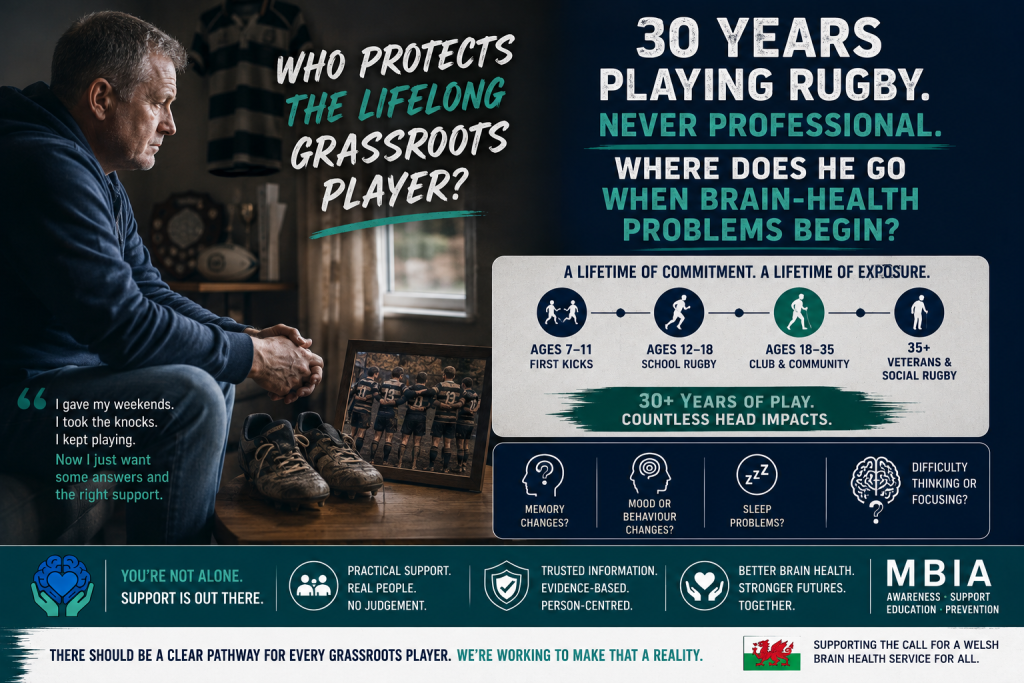
In Wales, the WRU, Welsh Rugby Players' Association and World Rugby have established a Brain Health Service for former elite players.
That is a positive and important development.
Eligible former players can receive brain-health assessment, advice and onward referral where warning signs are identified.
But eligibility is focused on former international, professional and elite-level players.
That creates an important question.
What happens to the person who:
started rugby at seven;
played through school;
played youth rugby;
spent 20 or 25 years playing senior community rugby;
trained twice a week;
played hundreds of matches;
experienced multiple concussions;
and now, in their fifties, develops significant cognitive, behavioural or neurological symptoms?
They may have accumulated more than 30 years of contact-sport exposure.
But because they were never elite, they may not qualify for the specialist pathway created for former players.
If emerging evidence tells us that total playing career may matter more than professional career length, we must eventually ask whether access to brain-health support should be determined by sporting status at all.
Perhaps the better criteria are:
Clinical need and exposure history.
This Is Bigger Than Rugby
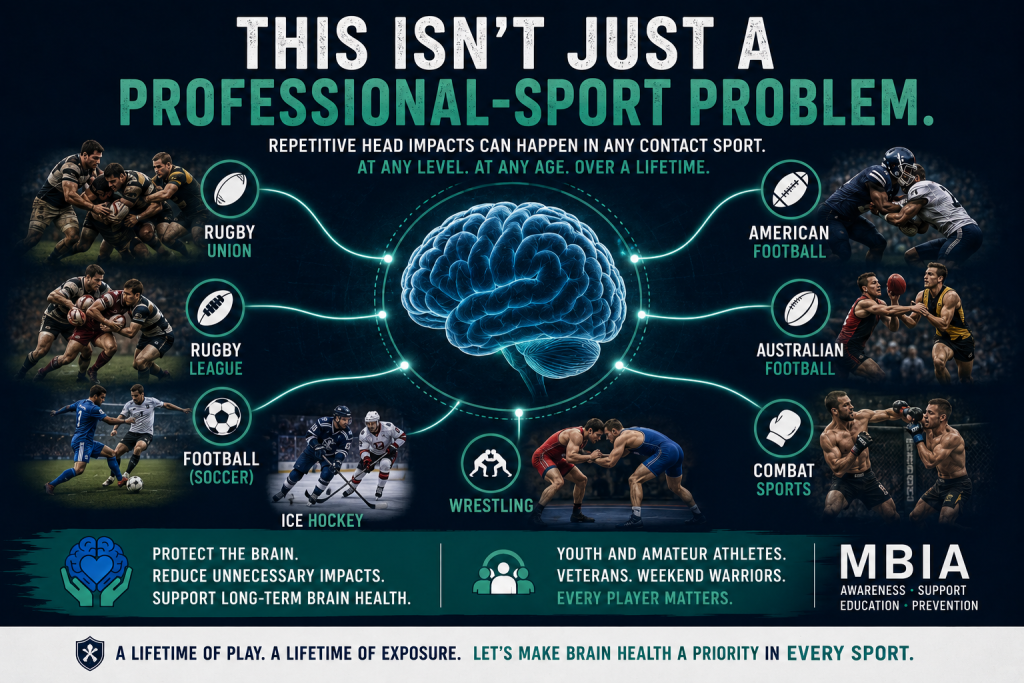
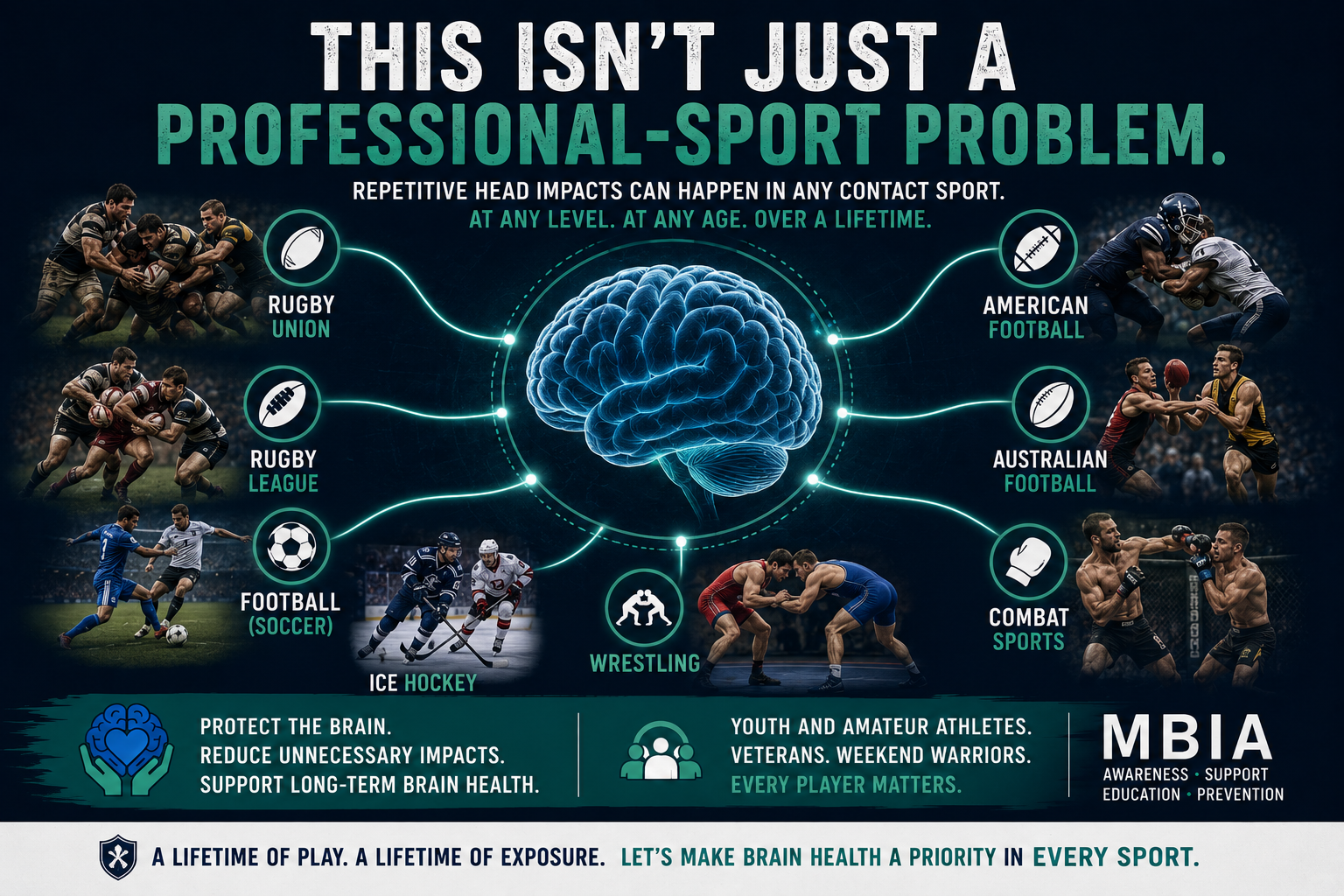
Although rugby is particularly important to this discussion, the principle applies across contact and collision sport.
Rugby league.
American football.
Australian rules football.
Football.
Ice hockey.
Combat sports.
Wrestling.
And other activities involving repeated head impacts.
Each sport has different mechanisms, frequencies and magnitudes of exposure.
The solutions therefore will not be identical.
But the underlying principle should be universal:
Protect the brain wherever the exposure occurs.
Not only when the athlete becomes famous.
Not only when the sport becomes professional.
Not only when someone suffers a spectacular concussion.
And not only after former players begin developing symptoms.
What We Know — And What We Still Don't
Responsible brain-injury advocacy requires acknowledging uncertainty.
We do not currently know:
- the precise amount of repetitive head-impact exposure required to produce CTE;
- why some heavily exposed athletes develop neurological disease while others apparently do not;
- how genetics and other biological factors alter individual vulnerability;
- the relative importance of impact magnitude, frequency and recovery interval;
- exactly how risk differs between childhood, adolescence and adulthood;
- or the prevalence of CTE among the general grassroots sporting population.
CTE still cannot currently be definitively diagnosed during life; neuropathological confirmation remains post-mortem.
Those uncertainties matter.
But uncertainty does not mean absence of risk.
We do know that CTE has been identified in amateur athletes.
We know community rugby players report substantial histories of concussion.
We know former elite rugby players have demonstrated increased rates of neurodegenerative disease in epidemiological research.
We know repetitive head impacts can occur without diagnosed concussion.
And we now have research suggesting that total playing career — including junior and post-professional participation — may be an important marker of chronic neurophysiological change.
That is enough evidence to justify precaution.
What Should Change?
We believe the next stage of player welfare should move beyond simply improving concussion recognition.
Contact sports should increasingly consider:
Reducing unnecessary contact in training.
Continuing to improve tackle technique and enforcement.
Monitoring cumulative exposure rather than counting diagnosed concussion alone.
Recording concussion and head-impact histories from junior sport onwards.
Ensuring grassroots coaches receive meaningful brain-health education.
Giving parents clear, balanced information about repetitive head impacts as well as concussion.
Developing age-appropriate approaches to contact exposure.
Investing in independent research across grassroots populations.
Providing pathways for former grassroots players who develop neurological symptoms.
And perhaps most importantly:
Stop treating professional status as the boundary at which brain health becomes important.
Protecting Rugby Means Protecting Its Players
This is not an argument against rugby.
It is an argument for its future.
Rugby has changed repeatedly throughout its history when evidence has shown that players can be better protected.
It can change again.
The objective should never be to remove every possible risk from sport. That is impossible.
The responsibility is to identify avoidable risk and reduce it wherever reasonably possible.
For decades, many of the people whose brain injuries became visible were retired professionals.
That understandably focused attention on elite sport.
But the science is forcing us to widen the lens.
The child playing their first season matters.
The teenager playing for their school matters.
The woman playing community rugby matters.
The man who spends 30 years turning out every Saturday for his local club matters.
The retired professional matters.
They are not separate brain-health problems.
They exist along the same continuum of exposure.
Brain damage doesn't begin when someone signs a professional contract.
Neither should player protection.
At Marshalling Brain Injuries Alliance, we believe the future of contact sport must include a shift from simply managing concussion after it happens towards reducing unnecessary lifetime exposure to repetitive head impacts.
We don't need to wait for every scientific question to be answered before making sensible changes.
We can protect the sport.
We can preserve everything that makes grassroots rugby special.
And we can do far more to protect the brains of the people who play it.
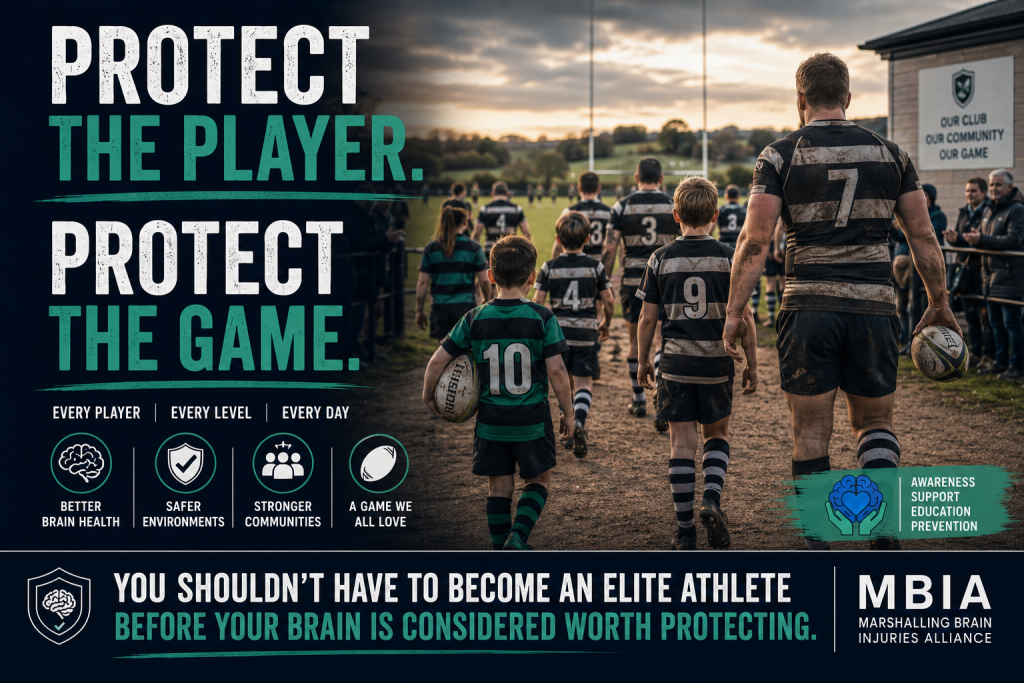
Because you should never have to become an elite athlete before your brain is considered worth protecting.
MBIA is not claiming all repetitive head impacts cause permanent brain injury, that all long-term players develop CTE, or that the prevalence of CTE in grassroots rugby is currently known
References
Pearce AJ, Tallent J, Frazer AK, Rist B, Kidgell DJ. (2026).The Effect of Playing Career on Chronic Neurophysiologic Changes in Retired Male Football Players: An Exploratory Study Using Transcranial Magnetic Stimulation. Journal of Clinical Neurophysiology. DOI: 10.1097/WNP.0000000000001155. The study included 113 retired professional contact-sport athletes and distinguished total career exposure from professional career length.
PubMed – Pearce et al. studyMark D. (2026). ABC News.Long careers in contact sports increase risk of brain damage, but is informed consent enough? This is the article that prompted the blog and reports Pearce's interpretation of the study alongside the Kolodjashnij controversy.
Read the ABC News articleMcKee AC, Mez J, Abdolmohammadi B, et al. (2023).Neuropathologic and Clinical Findings in Young Contact Sport Athletes Exposed to Repetitive Head Impacts. JAMA Neurology, 80(10), 1037–1050. Of 152 young brain donors, 63 had CTE; 45 of those 63 were amateur athletes. Importantly, this was a convenience brain-bank sample and cannot establish population prevalence.
JAMA Neurology studyRussell ER, Mackay DF, Lyall D, et al. (2022).Neurodegenerative disease risk among former international rugby union players. Journal of Neurology, Neurosurgery & Psychiatry, 93, 1262–1268. Among 412 former Scottish international rugby players versus 1,236 matched controls, incident neurodegenerative disease risk was elevated (HR 2.67, 95% CI 1.67–4.27). NZ-RugbyHealth Study. The study included 127 former elite rugby players, 271 former community players and 72 former non-contact athletes. Self-reported concussion history was 94%, 82% and 26%, respectively.
NZ-RugbyHealth studyUK Government / Sport and Recreation Alliance (2023).UK Concussion Guidelines for Non-Elite (Grassroots) Sport — “If in doubt, sit them out”. The guidance specifically recognises the grassroots problem of trained medical professionals being less likely to be routinely present.
UK grassroots concussion guidanceWorld Rugby. Contact Load Guidelines. World Rugby states that contact training creates head-impact risk and recommends reducing cumulative contact to the lowest level compatible with adequate preparation. Crucially, it says the load-management principles are appropriate below professional rugby too. World Rugby (2026).World Rugby lowers legal tackle height in community rugby. From July 2026, unions can set the community tackle height at the waist or base of the sternum following trials initially involving more than 150,000 tackles.
World Rugby tackle-height announcementWorld Rugby (2026), follow-up analysis. The expanded dataset involved more than 170,000 tackles across 11 unions. World Rugby reports reductions in upright tackling and encouraging injury results where surveillance data were available, including substantial head/neck injury reductions in France.
World Rugby analysis of the community tackle-height evidenceWRU / WRPA / World Rugby — Brain Health Service. The Welsh service currently targets eligible former international, professional and elite players and provides assessment and onward referral where warning signs are identified. That eligibility distinction is what makes the grassroots-access question in the blog particularly relevant.
WRU Brain Health Service information