It’s Not Just Concussions: What the Science Is Telling Us About Years of Repetitive Head Impacts
For decades, conversations about brain injury have largely centred around one question:
How many concussions have you had?
But research into chronic traumatic encephalopathy (CTE) is increasingly forcing us to ask a different question:
How much repetitive head-impact exposure has your brain experienced over a lifetime?
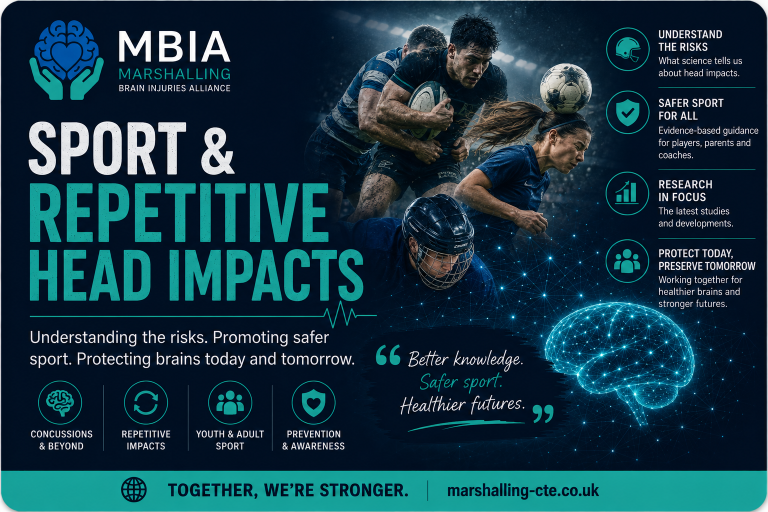
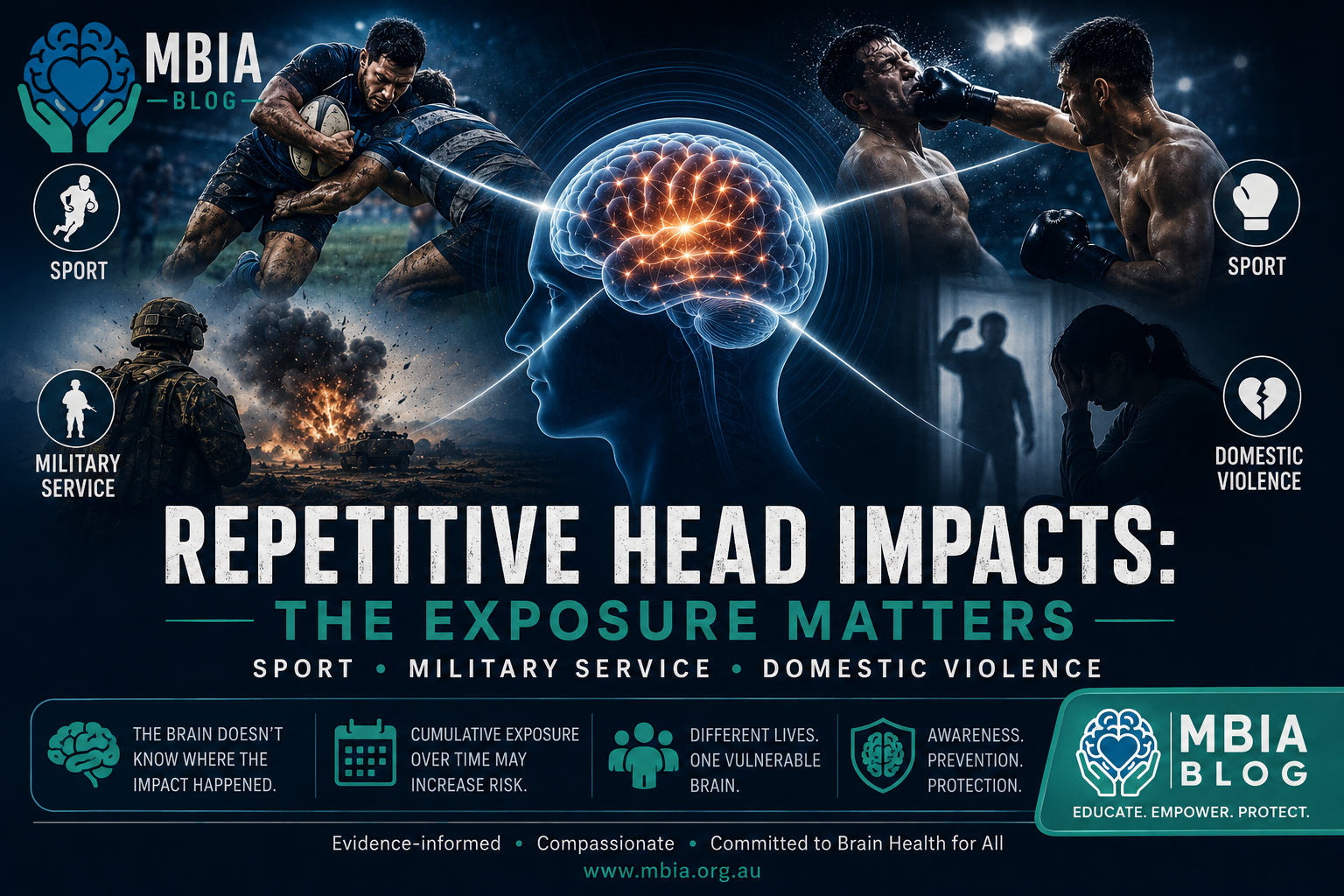
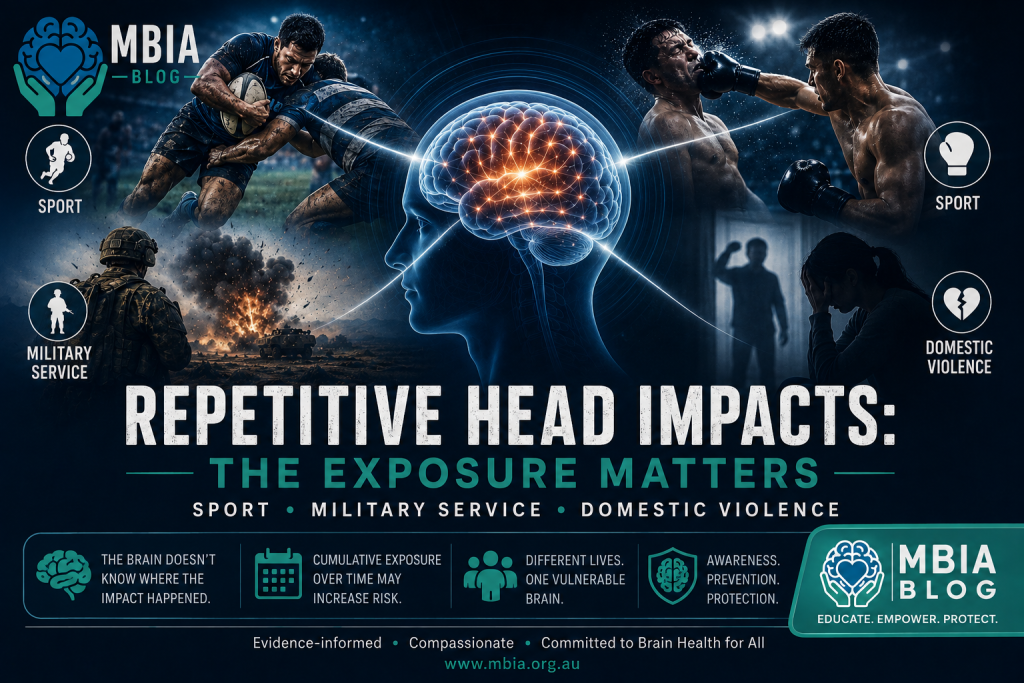
That might mean years of tackles, collisions, scrums and rucks in rugby.
It could mean heading a football thousands of times.
It could mean boxing, martial arts, ice hockey or American football.
It could mean repeated blast exposure or head impacts during military service.
And, outside sport altogether, it could mean years of assaults, blows to the head and strangulation experienced by someone living with domestic abuse.
These circumstances are extraordinarily different.
But the brain does not know whether an impact happened on a rugby pitch, in a boxing ring, during military service or behind the closed doors of someone's home.
It experiences the forces placed upon it.
And an increasingly important area of research suggests that the accumulation of those exposures over time matters.
CTE is not simply a disease of concussion
CTE is a progressive neurodegenerative disease associated with exposure to repetitive head impacts.
Its characteristic pathology involves an abnormal accumulation of phosphorylated tau protein around small blood vessels, particularly at the depths of the brain's cortical sulci.
At present, CTE can only be definitively diagnosed by examining brain tissue after death.
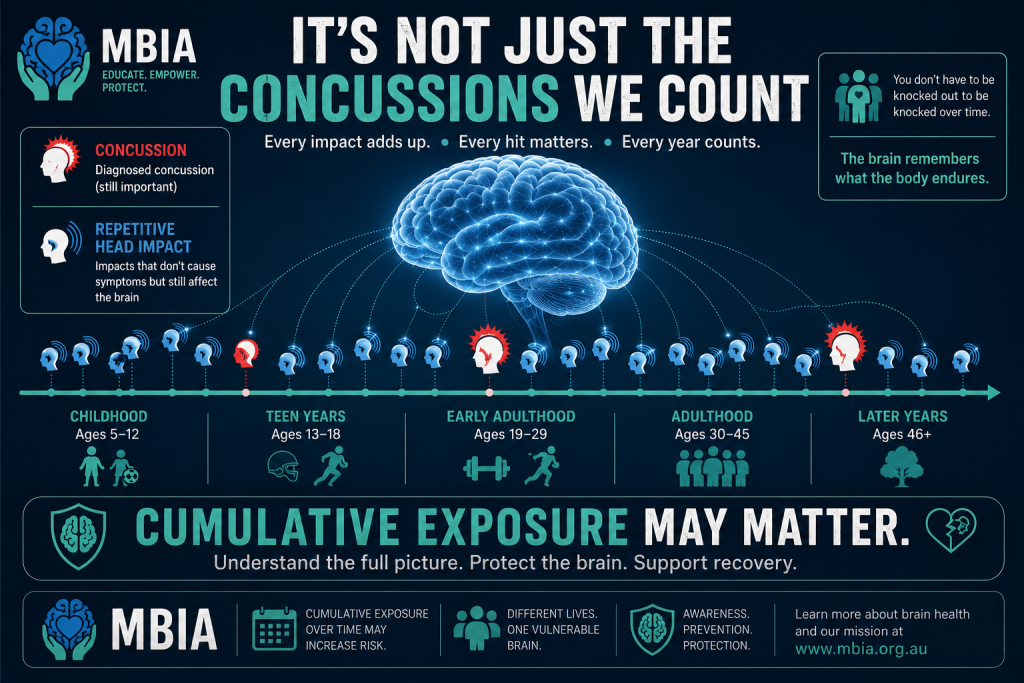
One of the biggest changes in our understanding of CTE has been the move away from thinking exclusively about diagnosed concussion.
A person does not need to lose consciousness for their brain to experience substantial mechanical forces.
They do not even necessarily need to experience symptoms.
In contact sports, athletes can experience hundreds or thousands of impacts that never result in a clinical diagnosis of concussion.
These are often described as subconcussive head impacts.
Increasingly, researchers are interested in the cumulative burden of these repetitive head impacts rather than concussion count alone.
That distinction could have enormous implications.
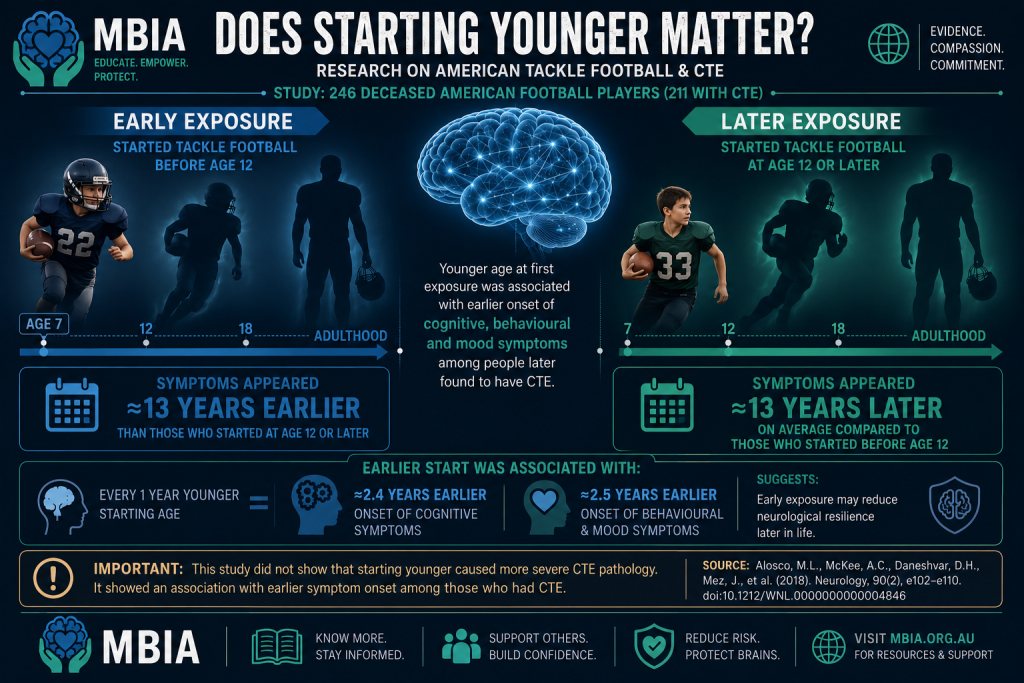
In 2018, researchers from Boston University and collaborating institutions examined the brains and histories of 246 deceased American tackle-football players.
Of those players, 211 had neuropathologically confirmed CTE.
Researchers investigated whether the age at which someone first began playing tackle football was associated with their CTE pathology or the age at which neurological and behavioural symptoms appeared.
The findings were fascinating—and frequently misunderstood.
Starting football at a younger age was not associated with greater CTE pathological severity.
However, among players who had CTE, younger exposure was strongly associated with symptoms appearing earlier in life.
For every year younger that someone began tackle football, cognitive symptoms were reported approximately 2.4 years earlier, while behavioural and mood symptoms appeared approximately 2.5 years earlier.
Players who began before age 12 experienced cognitive and behavioural/mood symptoms approximately 13 years earlier than those who started at 12 or older.
The researchers suggested that exposure during the developing brain's formative years might potentially reduce what could be described as neurological resilience later in life.
But this study did not demonstrate that starting younger makes someone a particular number of times more likely to develop CTE.
That distinction is important.
Study Two: The number of years may matter enormously
A subsequent study asked another question.
Rather than concentrating primarily on the age someone started playing, researchers looked at how long they played.
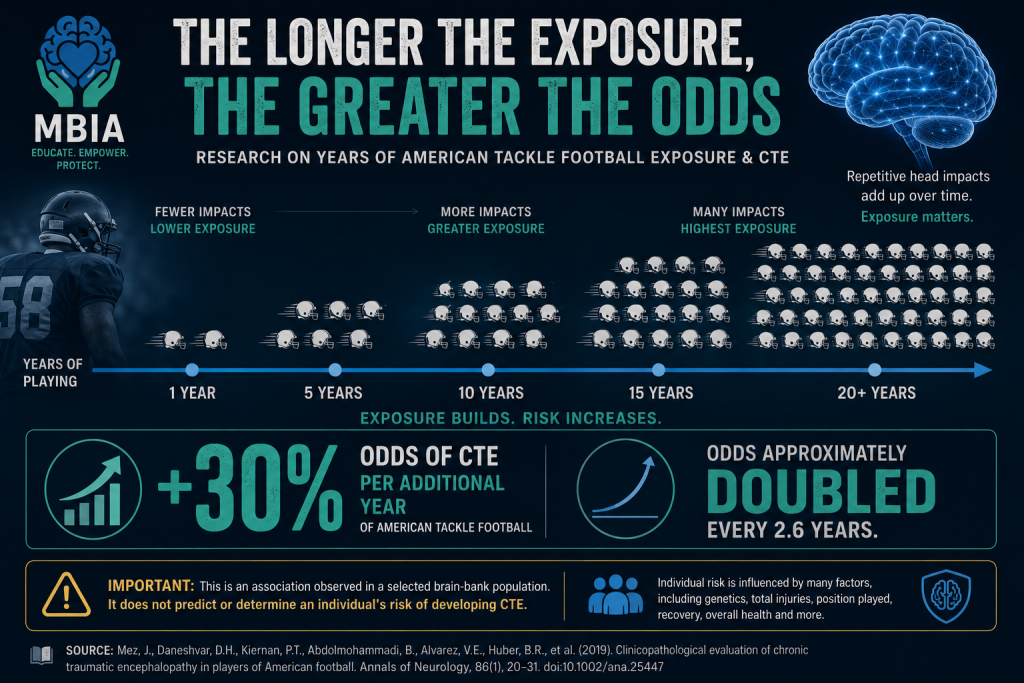
The study examined 266 deceased American-football players.
Of those, 223 had CTE.
Researchers found a striking dose-response relationship.
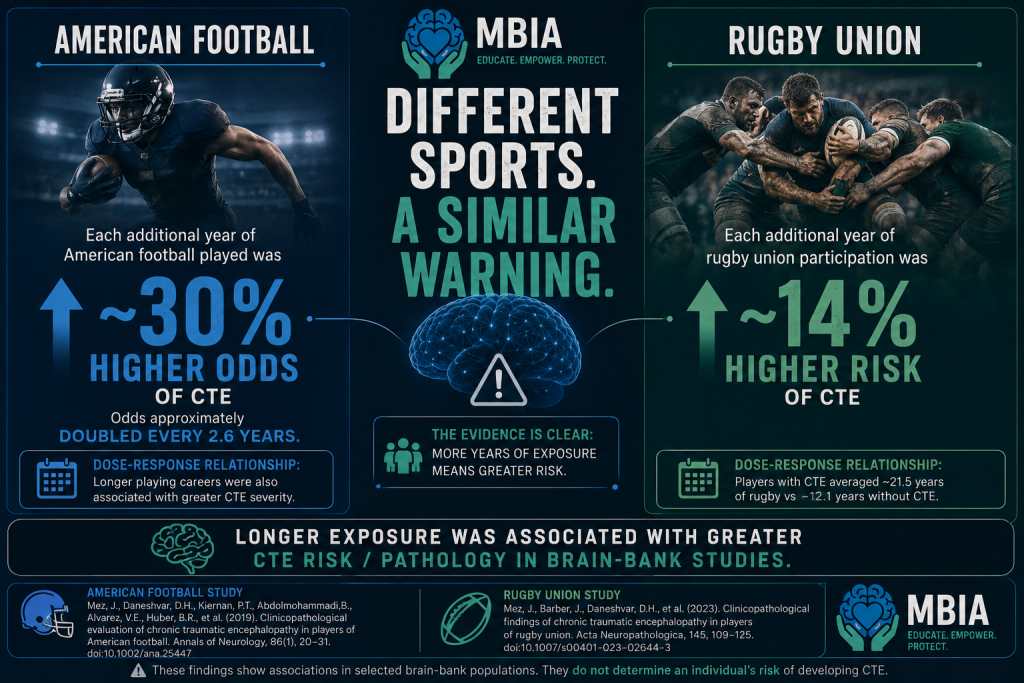
Every additional year of American football played was associated with approximately 30% higher odds of having CTE.
The odds approximately doubled for every 2.6 additional years played.
Longer playing careers were also associated with greater CTE severity.
This doesn't mean that everybody playing for a particular number of years will develop CTE.
Some people with relatively short playing histories had the disease.
Some people with long careers did not.
There is almost certainly much more to individual susceptibility than duration alone.
But when viewed across the group, the direction of the relationship was clear:
More years of exposure were associated with greater odds of disease.
That is what researchers call a dose-response relationship.
And that concept becomes particularly important when we look beyond American football.
Rugby tells a remarkably similar story
In 2023, researchers from brain banks in the United Kingdom, United States and Australia examined the brains of 31 former rugby union players.
CTE was identified in 21 of the 31 brains—68%.
This percentage should not be interpreted as meaning 68% of rugby players will develop CTE.
Brain banks are highly selected populations. Families may be more likely to donate a brain when someone experienced neurological symptoms during life, meaning these samples cannot establish the prevalence of CTE among all rugby players.
But researchers discovered something else that is much harder to ignore.
The players with CTE had played rugby for an average of approximately 21.5 years.
Those without CTE had played for approximately 12.1 years.
And researchers calculated that:
Every additional year of rugby participation was associated with approximately a 14% increase in CTE risk.
Again, we see the same fundamental pattern.
Exposure matters.
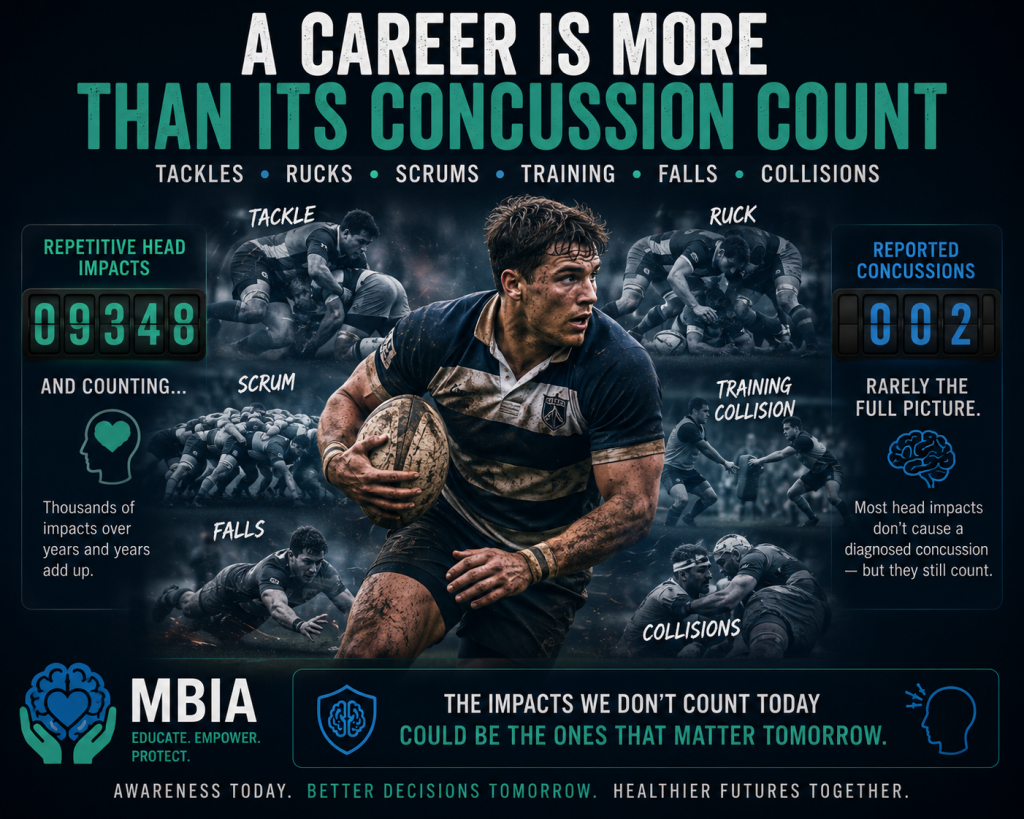
That is particularly relevant to rugby because repetitive head impacts don't occur only when someone is diagnosed with concussion.
They occur during tackles.
Rucks.
Mauls.
Scrums.
Falls.
Training.
Accidental collisions.
And throughout seasons of repeated contact.
A player could therefore accumulate an enormous lifetime exposure while having relatively few formally documented concussions.
The question shouldn't only be "How many concussions?"
Imagine two rugby players.
One reports six diagnosed concussions during a 20-year playing career.
Another reports eight during a ten-year career.
If we simply count concussions, we might assume the second player experienced the greater exposure.
But we don't actually know that.
The first player may have experienced tens of thousands of lower-level repetitive impacts during twice as many years of rugby.
This is why concussion history alone provides an incomplete picture.
Researchers are increasingly trying to understand something far more complicated:
the cumulative dose of brain trauma.
That potentially includes the number of impacts, their magnitude, rotational forces, direction, frequency, recovery time between impacts, age when exposure occurred and the total number of years exposed.
We still don't know exactly how all of those factors interact.
But duration of exposure is emerging as an important piece of the puzzle.
This is bigger than rugby—and bigger than sport
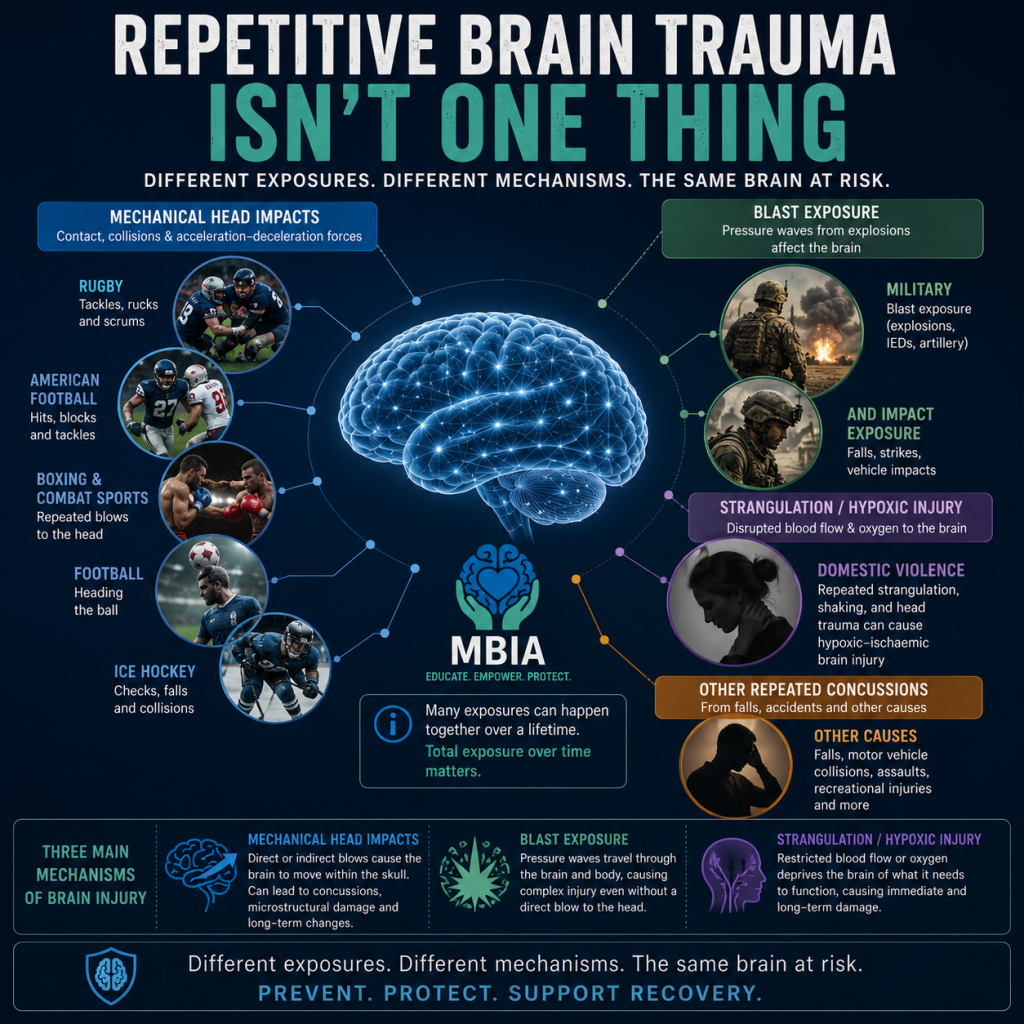
One danger of discussing CTE primarily through famous athletes is that we can accidentally create the impression that repetitive brain trauma is an occupational hazard unique to professional sport.
It isn't.
The biological processes involved don't require a stadium, professional contract or cheering crowd.
There are other populations whose brains can also experience repetitive trauma.
And some of them have historically received a fraction of the attention afforded to professional athletes.
Domestic abuse: the hidden population experiencing repetitive brain injury
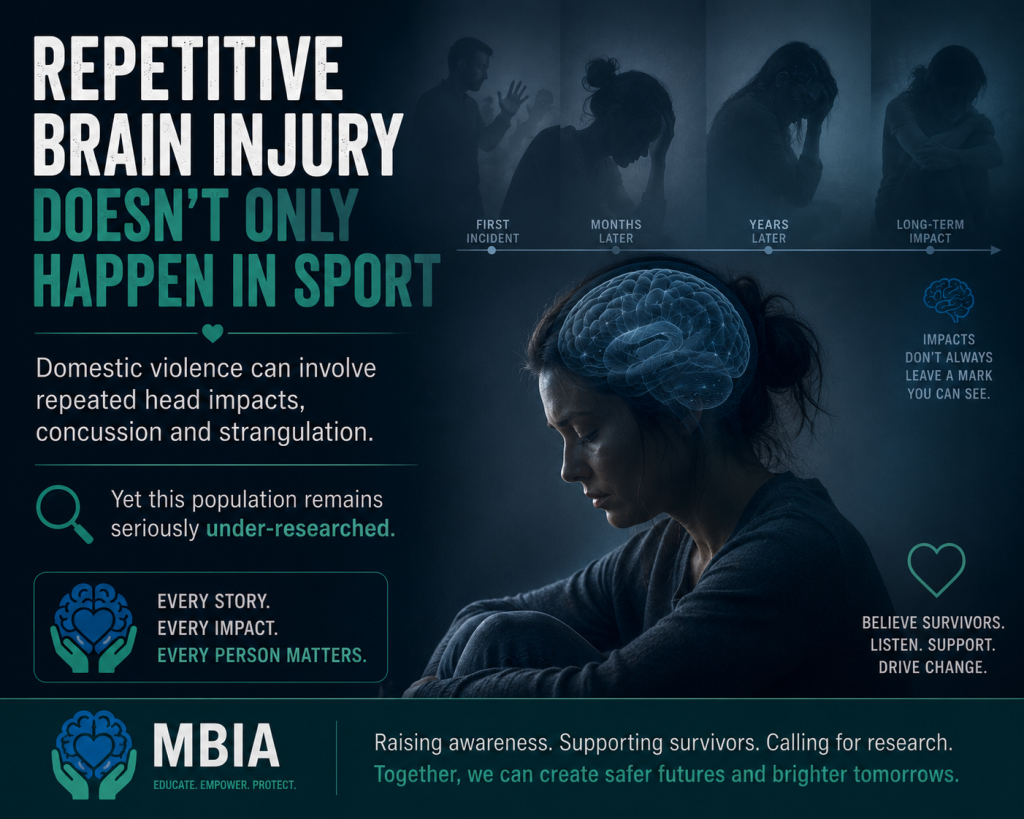
This may be one of the most neglected areas in the entire conversation about repetitive brain trauma.
People experiencing domestic and intimate-partner violence can sustain repeated:
- blows to the head
- punches
- kicks
- impacts against walls, floors or furniture
- falls
- shaking
- strangulation
- loss of consciousness
- repeated untreated concussions
And these injuries may continue for months or years.
Unlike an athlete, there may be no team doctor.
No concussion protocol.
No mandatory removal from play.
No neurological assessment.
No prescribed recovery period.
Sometimes nobody even knows the injury happened.
There is another major complication.
Strangulation can injure the brain through a different mechanism: oxygen deprivation and disruption of blood flow.
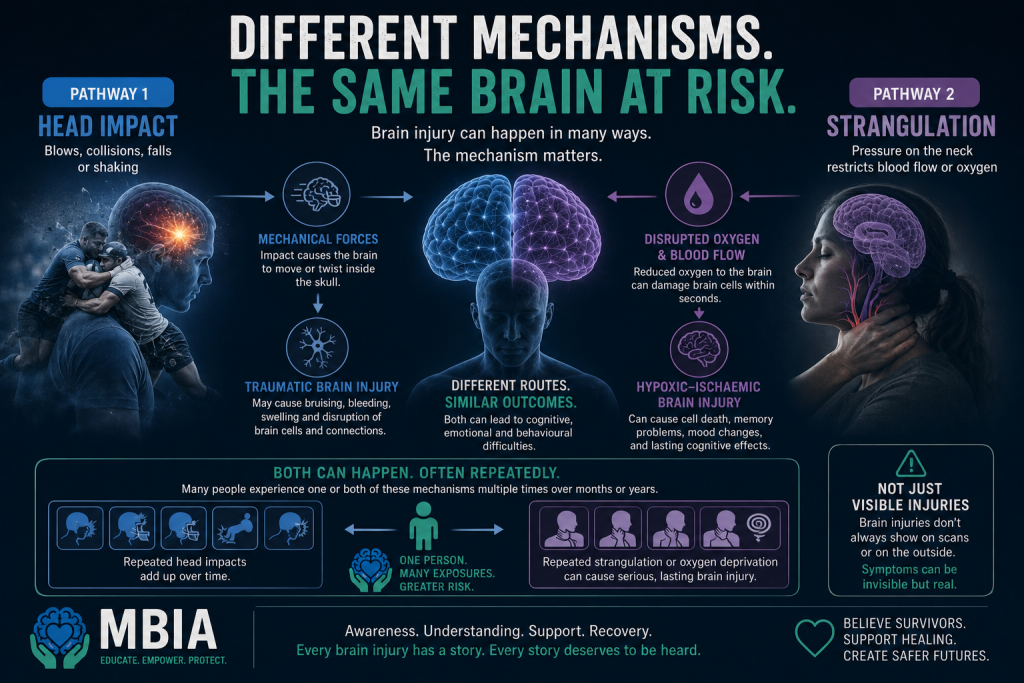
That means someone experiencing domestic violence may be exposed to repeated traumatic brain injuries and repeated hypoxic-ischaemic insults.
The long-term consequences of that combination remain seriously under-researched.
CTE has now been found following longstanding domestic violence
In 2024, researchers in Australia reported CTE in two women with histories of longstanding intimate-partner violence.
Both had experienced repeated head trauma.
These were significant cases because the overwhelming majority of CTE research historically involved male contact-sport athletes.
Two cases cannot tell us how common CTE is among survivors of domestic violence.
They certainly don't establish prevalence or allow us to calculate someone's individual risk.
But they demonstrate something extremely important:
CTE pathology is not confined to athletes.
And they raise a deeply uncomfortable question.
If we have spent decades studying the brains of athletes exposed to repetitive impacts, how many people exposed to repetitive violence have simply never been investigated?
The answer is currently unknown.
That is precisely why more research is needed.
Military service: repetitive impacts, blasts and a much more complicated picture
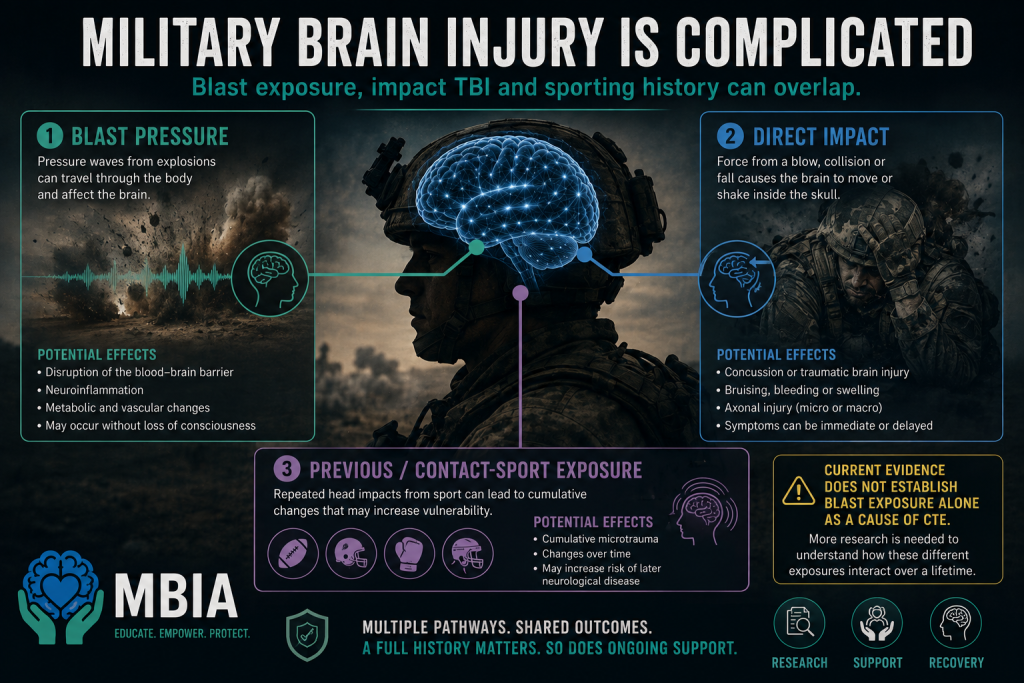
Military personnel represent another population where repetitive brain trauma can occur.
Potential exposures include:
- blast waves from explosions
- breaching and weapons training
- vehicle incidents
- falls
- direct impacts
- combat-related head injuries
- repeated mild traumatic brain injuries
- and, for many personnel, contact sports played before or during military service.
Blast exposure is particularly complicated because it isn't identical to being tackled or punched.
A blast can expose the brain to rapid pressure changes and potentially several interacting mechanisms of injury.
Researchers have therefore investigated whether repeated military blast exposure might contribute to CTE.
But this is an area where we need to be particularly careful not to overstate the evidence.
A major military brain study produced a surprising result
In 2022, researchers examined 225 brains from deceased US military service members.
CTE was found in 10—approximately 4.4%.
Among 45 people with a history of blast exposure, three had CTE.
However, researchers did not find convincing evidence that blast exposure alone explained the CTE cases.
In fact, every individual with CTE had also participated in contact sports.
Non-sport traumatic brain injury was also associated with CTE in this sample.
The researchers concluded that CTE was uncommon in this particular military brain-bank series and that the small number of cases prevented firm causal conclusions about blast exposure.
That doesn't mean blast exposure is harmless.
Far from it.
Blast-related traumatic brain injury can cause significant and persistent neurological problems.
But it tells us something essential about responsible CTE communication:
Not every form of brain trauma should automatically be assumed to carry exactly the same CTE risk.
We need research capable of separating overlapping exposures.
A veteran might have played rugby or American football for 15 years, experienced several concussions, sustained blast exposure during deployment and later experienced another TBI.
Determining which exposure—or combination of exposures—contributed to later neurological disease is extraordinarily difficult.
Different lives. Similar question.
Think about these four people:
A rugby player begins playing at seven and retires at 35.
A boxer trains and competes for 20 years.
A military veteran experiences repeated blast and impact exposures during training and deployment.
A survivor of domestic violence sustains repeated blows to the head and episodes of strangulation over many years.
Their circumstances could hardly be more different.
But neurologically, there is a question connecting all four:
What happens to the brain when it is repeatedly injured or exposed to damaging mechanical forces over many years?
We don't yet have all the answers.
But it is increasingly difficult to justify looking only at individual concussions while ignoring lifetime exposure.
We need to stop thinking of brain injuries as isolated events
Traditionally, brain injuries are recorded as events.
Concussion number one.
Then recovery.
Concussion number two.
Then recovery.
And so on.
But biology may not work in such neat compartments.
An apparently recovered person may still have experienced changes at cellular, vascular, metabolic or inflammatory levels.
Another impact occurs.
Then another.
Then hundreds of smaller impacts.
Over years or decades, the question becomes not simply whether each individual injury "resolved", but what repeated exposure may have done cumulatively.
This is one reason the dose-response findings in American football and rugby are so important.
They suggest that time exposed to repetitive head impacts may itself carry information about risk.
This has major implications for children's sport
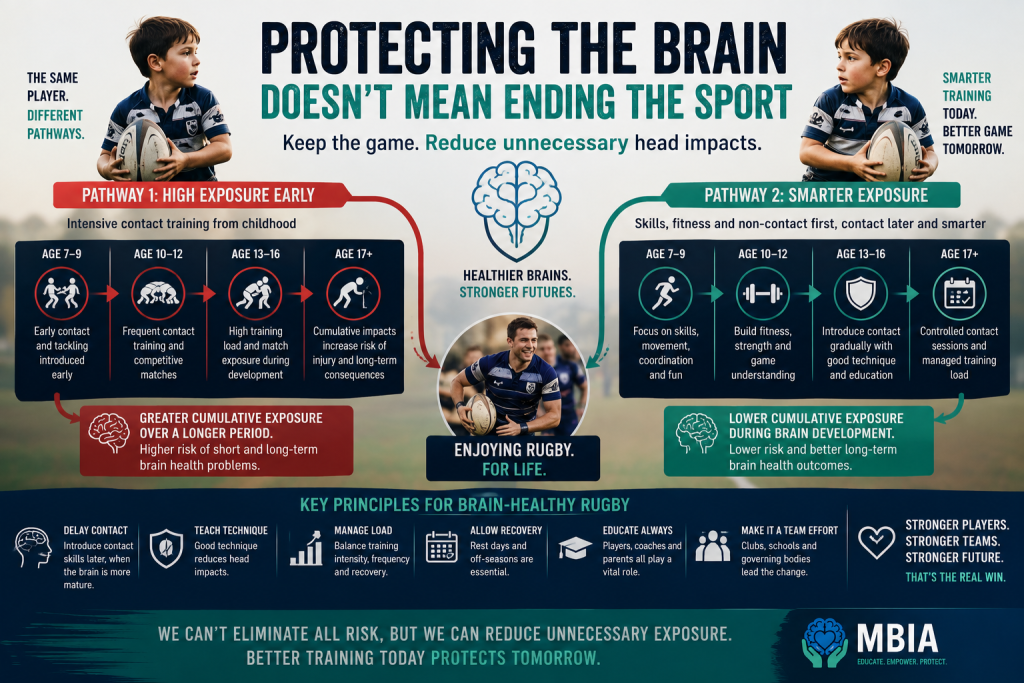
None of this means children should stop exercising or participating in sport.
The physical, psychological and social benefits of sport can be enormous.
The question is whether children need to accumulate repetitive head impacts in order to receive those benefits.
If cumulative exposure matters, delaying unnecessary head-impact exposure could potentially reduce a player's lifetime dose without removing them from the sport they love.
Similarly, reducing contact during training could remove hundreds or thousands of impacts over a playing career without eliminating competitive rugby.
The objective doesn't have to be:
Stop sport.
It can be:
Keep the sport. Reduce unnecessary brain trauma.
That is a very different conversation.
And prevention must extend beyond sport
The same principle should influence how we think about other vulnerable populations.
Someone presenting to healthcare after domestic violence should not simply be asked whether they have visible injuries.
We should be asking about:
head impacts, loss of consciousness, strangulation, memory changes, headaches, dizziness, balance problems, vision changes, sleep, cognition and previous episodes.
Military personnel and veterans need neurological histories that recognise cumulative blast and impact exposure rather than relying solely on whether a single severe TBI was documented.
And former athletes need clinicians to understand that someone can have substantial repetitive head-impact exposure despite reporting surprisingly few diagnosed concussions.
We also need to acknowledge what we don't know
CTE research still has major limitations.
Most of what we know about the pathology comes from brain donation programmes.
That creates unavoidable selection bias.
We still cannot accurately tell an individual athlete—or anyone else exposed to repetitive brain trauma—what their personal percentage risk of developing CTE is.
We don't yet know why some heavily exposed individuals develop extensive disease while others apparently do not.
Genetics may matter.
Cardiovascular health may matter.
Alcohol and substance use may matter.
Other neurological diseases may matter.
Age at exposure may matter.
Recovery between injuries may matter.
The type, magnitude and frequency of impacts may matter.
And biological sex may matter—an especially important question given how historically underrepresented women have been in brain-injury and CTE research.
These aren't reasons to dismiss the evidence.
They are reasons to continue investigating it.
The most important word may be "cumulative"
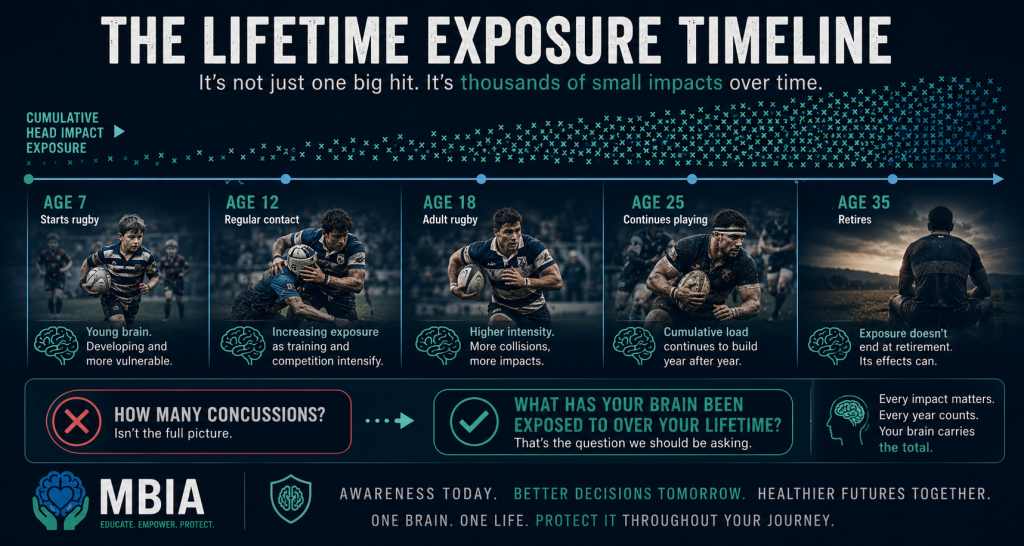
Perhaps the biggest lesson emerging from this research is that we need to change the way we talk about head injury.
Instead of only asking:
"Did you have a concussion?"
we should also ask:
"What has your brain been exposed to over your lifetime?"
How young were you when exposure began?
How many years did it continue?
How frequently were you hit?
What kind of forces were involved?
Were there periods of adequate recovery?
Were there episodes of strangulation or oxygen deprivation?
Were injuries recognised and treated?
Were there exposures outside sport?
Those questions give us a much more complete picture than a concussion count ever could.
The brain doesn't know where the injury happened
There is one final point worth remembering.
CTE doesn't belong to American football.
It doesn't belong to rugby.
It doesn't belong to boxing.
And repetitive brain injury doesn't belong exclusively to sport.
A brain cannot distinguish between an impact received in front of 70,000 spectators and one received where nobody was watching.
The circumstances matter enormously socially, medically and ethically.
But at the level of brain tissue, researchers are trying to understand the consequences of repeated exposure to damaging forces.
The evidence isn't complete.
There are important differences between impacts, blast exposure and oxygen deprivation, and we should never pretend they are biologically identical.
But studies across American football and rugby are giving us an increasingly important clue:
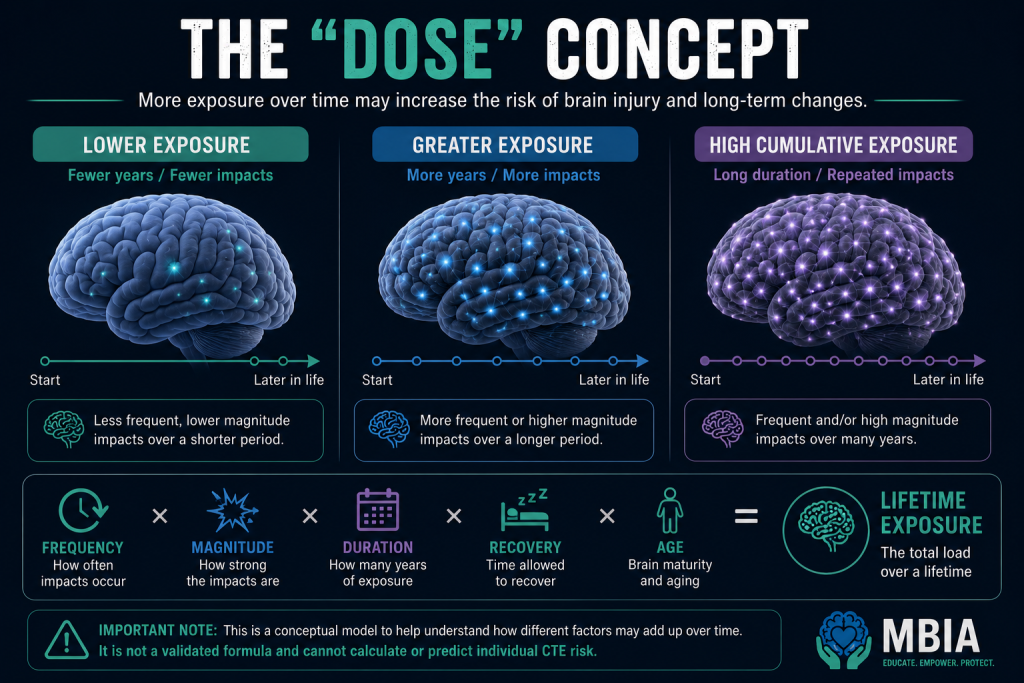
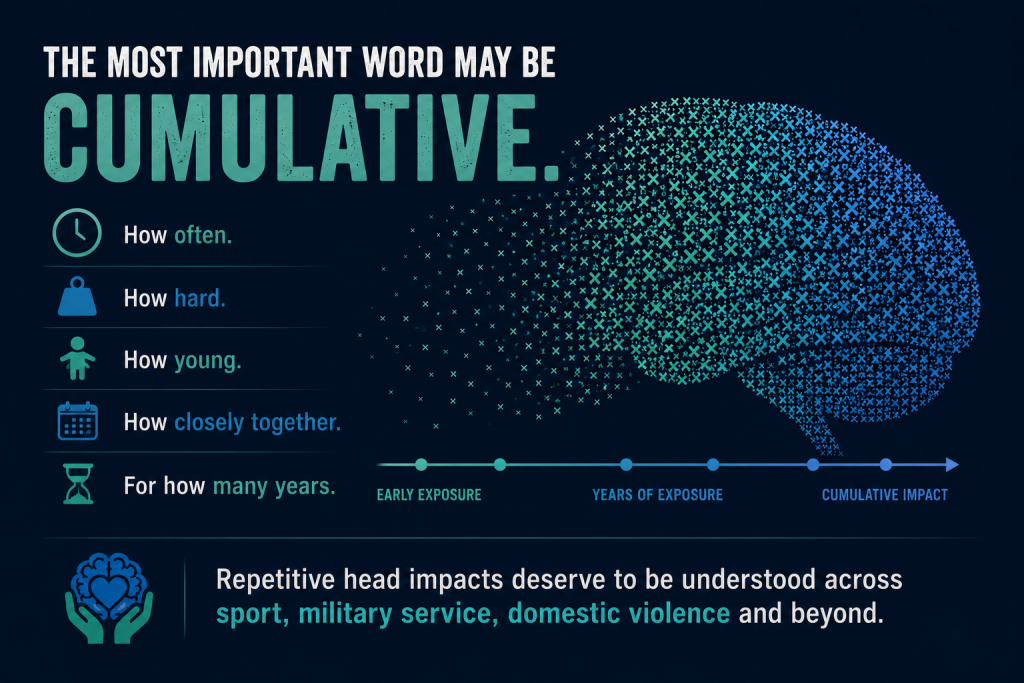
How often.
How hard.
How young.
How closely together.
And for how many years.
If we want to prevent the brain disease of tomorrow, perhaps we need to stop waiting solely for the concussion we can see today.
We need to start thinking about lifetime brain-trauma exposure.
Because when it comes to protecting the brain, every unnecessary impact we can prevent is an exposure that never has to be carried forward.
This article is for education and awareness and does not diagnose CTE or predict an individual's risk. CTE currently requires neuropathological examination after death for definitive diagnosis. Persistent neurological, cognitive, behavioural or psychological symptoms following head injury or strangulation warrant appropriate medical assessment.