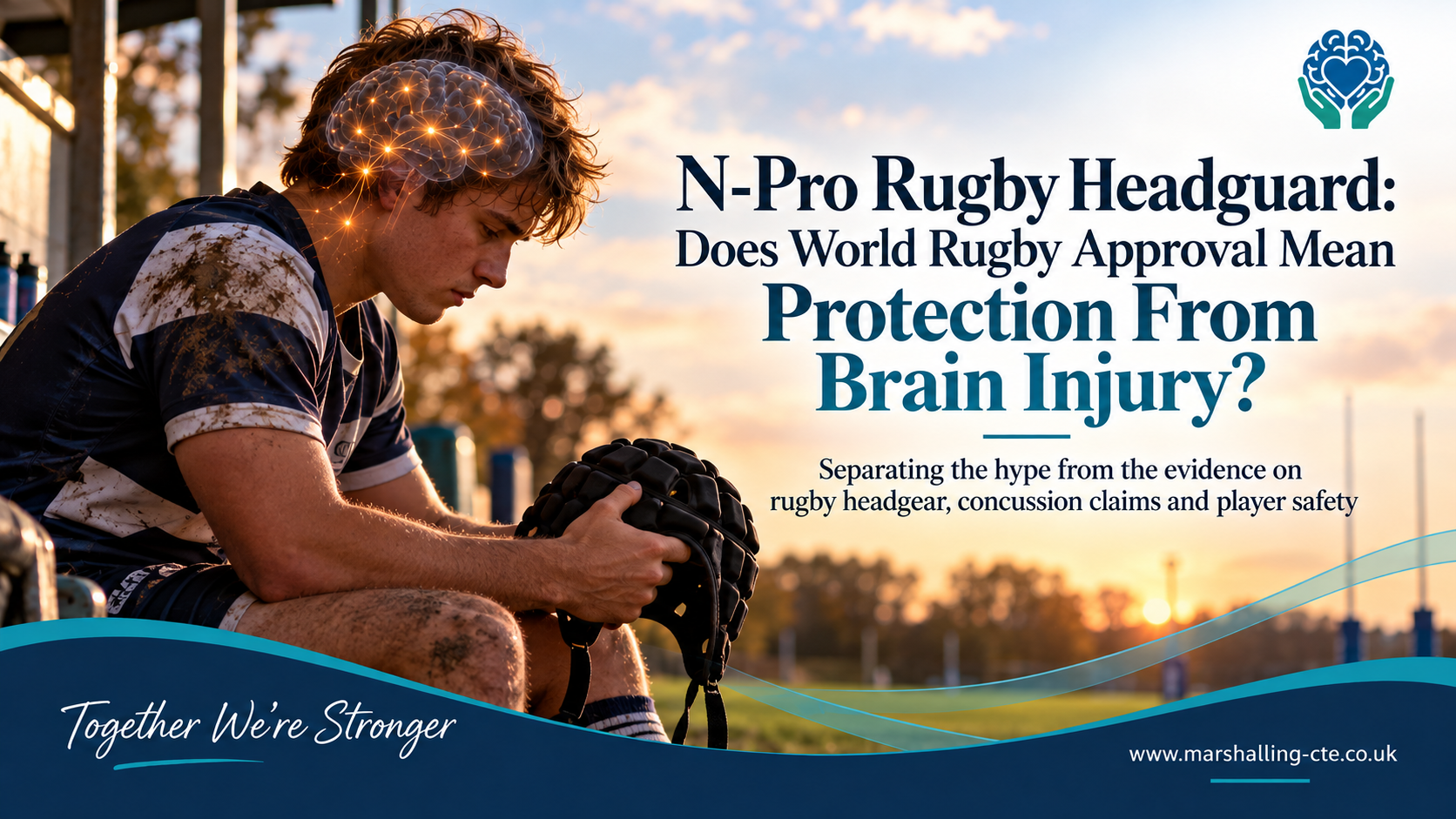
N-Pro Rugby Headguard: Does World Rugby Approval Mean Protection From Brain Injury?
Separating the Hype from the Evidence: Why laboratory results, marketing claims and outdated concussion advice deserve closer scrutiny.
A rugby headguard marketed as offering up to 75% impact reduction and carrying a World Rugby approval badge sounds reassuring. But does that mean it protects players from concussion or long-term brain damage?
For parents watching their children play rugby, few things matter more than their safety.
So when a company advertises a headguard as offering superior impact protection, backed by scientific research and approved by World Rugby, it is understandable that parents might feel reassured.
The N-Pro rugby headguard, developed by Contego Sports, is one such product.
Its website advertises:
- Up to 75% impact reduction.
- Four times better impact protection than other rugby headgear.
- Protection against both linear and rotational impact forces.
- World Rugby Trial Approval.
- Research-backed technology and clinical testing.
These are powerful claims.
And importantly, there is scientific evidence showing that N-Pro can reduce certain impact forces under laboratory conditions.
But reducing measured impact forces and proving that a product prevents brain injury are two very different things.
At Marshalling Brain Injuries Alliance (MBIA), we believe players, parents and coaches deserve to understand that difference before making decisions about protective equipment.
We have examined the published research, World Rugby's approval process and photographs of the safety leaflet supplied with the headguard.
Several important questions deserve answers.
What Does N-Pro Actually Do?
The N-Pro headguard uses layers of specialised viscoelastic materials designed to absorb and distribute some of the mechanical energy generated during a collision.
In simple terms, the padding is designed to reduce the sudden acceleration of the head when an impact occurs.
There are two particularly important types of movement involved in head injuries.
Linear acceleration occurs when the head is suddenly accelerated or slowed in a relatively straight direction.
Rotational acceleration occurs when the head is rapidly twisted or turned.
Both forms of movement can contribute to the deformation and strain experienced by brain tissue.
Researchers are particularly interested in rotational movement because it can produce complex shearing and stretching effects within the brain.
N-Pro has undergone laboratory testing that demonstrates reductions in both types of acceleration.
That is encouraging.
However, not every impact produces a concussion, and concussion cannot be reliably predicted from one acceleration measurement alone. Collision direction, severity, the individual player and other biomechanical factors all matter.
This is why equipment testing must be interpreted carefully.
The 75% Claim: What Did the Researchers Actually Find?
In 2018, researchers published a peer-reviewed study investigating N-Pro's ability to reduce head acceleration.
The researchers compared N-Pro against conventional rugby scrum caps using instrumented headforms and controlled impact tests.
They reported reductions in linear acceleration of up to approximately 75%, depending on the comparison and impact location.
They also reported an average 34% reduction in rotational acceleration across particular laboratory test conditions.
These results provide evidence that the technology can attenuate mechanical impacts.
However, there are important limitations.
First, the headline 75% figure represents performance under particular laboratory conditions. It is not an average reduction across every possible rugby collision.
Second, the highest linear reductions involved comparisons with conventional rugby headguards, while the rotational results used unprotected headforms as the comparison.
Third, this was laboratory research, not a clinical trial demonstrating fewer concussions among rugby players.
The study was also funded by the company developing N-Pro, with company-associated researchers involved. External testing facilities performed aspects of the experiments.
Industry-funded research can be scientifically valuable, but independent replication is especially important when the findings are used to support commercial claims.
The crucial distinction is this: a 75% reduction in a laboratory acceleration measurement does not mean a 75% reduction in concussion risk.
It certainly does not mean a 75% reduction in the risk of CTE, dementia or other long-term neurological conditions.
These outcomes were not demonstrated by the study.
A New 2026 Study Raises Questions About Claims of Superiority
Another important piece of research was published in June 2026.
Researchers at the University of Canterbury compared N-Pro with two GameBreaker softshell headguards and an unprotected headform.
All three products reduced measured acceleration under laboratory conditions.
Across the tested conditions, the researchers reported average reductions of:HeadguardLinear accelerationRotational accelerationN-Pro29.5%37.3%GameBreaker Pro32.3%43.4%GameBreaker prototype30.4%42.2%
These are reductions compared with the unprotected headform, not reductions in concussion rates.
N-Pro performed well, but the GameBreaker designs achieved greater reductions in both composite linear and rotational acceleration in this particular study.
N-Pro performed better on a separate composite measure of rotational velocity.
There is also an important qualification: the GameBreaker products had thicker padding than N-Pro, and their designs did not satisfy the same World Rugby trial thickness constraint.
This means the study does not establish which product is best among headguards currently permitted in rugby matches.
Nevertheless, it demonstrates why broad claims of being the best on the market require qualification.
There is no single laboratory percentage that proves one headguard provides the greatest protection against concussion in real rugby matches.
The real question is not simply which equipment performs best in selected tests.
It is whether those improvements translate into fewer injuries among actual players.
Has N-Pro Been Proven to Prevent Concussion?
Not through published, sufficiently robust human clinical evidence that we could verify as of October 2026.
This does not mean the technology is ineffective.
It means there remains a gap between the promising biomechanical results and the clinical protection that parents and players may believe they are purchasing.
N-Pro has also been investigated through experimental animal research, computer modelling and preliminary player assessments.
A larger Irish rugby research programme involving more than 350 players has reportedly completed its data-collection phase, with analysis following.
That research could provide valuable information about the relationship between wearing the headguard, head-impact exposure, clinical outcomes and potential biomarkers of injury.
However, until the relevant findings have been published and independently scrutinised, we cannot treat them as proof that N-Pro prevents concussion.
Wider clinical evidence also calls for caution.
A systematic review published in 2023 examined randomised trials involving more than 6,300 rugby and football players.
It found no statistically significant reduction in concussion rates associated with the headgear studied.
That review largely concerns other headgear designs and does not settle whether newer technologies such as N-Pro may prove beneficial.
But it reinforces an essential principle:
A product can perform well in laboratory testing without having demonstrated a meaningful reduction in diagnosed concussion among players.
That distinction must not get lost in advertising.
What Does World Rugby's Approval Actually Mean?
This is perhaps the most important issue for parents.
The N-Pro headguard carries a World Rugby Trial Approved logo.
To many consumers, an approval badge from rugby's international governing body could reasonably suggest that the equipment's protective claims have been fully established.
But the actual regulatory position is different.
Under World Rugby's ordinary headgear specification, approved scrum caps are intended to protect against cuts and abrasions. That specification does not claim protection against concussion or other brain injuries.
However, World Rugby introduced a separate Law 4 Headgear Trial in 2020.
This allows innovative headgear designed to offer enhanced protection to be assessed under a different approval process.
N-Pro has entered that process, allowing it to be worn in matches under the trial framework.
This is a legitimate regulatory pathway. The issue is what the approval means to consumers.
On its official website, World Rugby explicitly states:
World Rugby makes no claim as to the ability of the headgear devices to achieve the claims made by the manufacturers.
In other words, World Rugby's trial approval should not be interpreted as confirmation that N-Pro prevents concussion or long-term brain injury.
Responsibility for substantiating the manufacturer's claims remains with the manufacturer.
We welcome innovation intended to make rugby safer.
However, we believe parents and players should be told prominently and clearly that World Rugby Trial Approved is not the same as clinically proven to prevent brain injury.
An approval logo should never create more reassurance than the underlying evidence can justify.
The Safety Leaflet Raises Further Concerns
During our examination, MBIA was provided with photographs of the educational and safety leaflet accompanying an N-Pro headguard.
What concerned us was the age of the concussion information being reproduced.
The leaflet includes material drawn from the fourth International Consensus Statement on Concussion in Sport, developed at the Zurich conference in November 2012 and published in 2013.
It discusses the SCAT3 concussion assessment tool and includes the historical statement that approximately 80–90% of concussions resolve within 7–10 days.
There are two separate problems here.
1. Concussion guidance has moved on
Concussion science and clinical management have developed considerably since 2012.
The sixth International Consensus Statement, published in 2023 following the Amsterdam conference, introduced updated tools including SCAT6 and Child SCAT6.
It also reflects a more individualised understanding of concussion recovery, with recognition that symptoms can persist for weeks or longer.
Persisting symptoms beyond four weeks require appropriate clinical assessment and management.
The older 7–10-day recovery statement should not be presented without contemporary explanation.
For families already navigating persistent symptoms, outdated recovery expectations can be particularly harmful.
They may contribute to the mistaken belief that someone who has not recovered within a short period must be experiencing something unrelated to their injury.
We also recognise that the N-Pro leaflet contains appropriate advice about seeking medical attention after a suspected concussion and not returning to play on the day of a diagnosed concussion.
Our concern is not that every statement in the leaflet is incorrect.
It is that a product marketed using modern protective technology should be accompanied by current, accurate and appropriately contextualised medical information.
2. The involvement of Paul McCrory
The Zurich 2012 statement lists Dr Paul McCrory as its lead author.
McCrory was a highly influential figure in international sports concussion guidance for many years.
However, investigations by BMJ and the British Journal of Sports Medicine subsequently identified serious publication-integrity problems involving some of his work, resulting in multiple retractions and corrections.
These findings were publicly documented, with BMJ announcing the conclusion of its investigation in May 2024.
To be clear, this does not establish that the particular Zurich 2012 consensus statement reproduced in the N-Pro leaflet was retracted or scientifically invalid.
Nor does citing that statement establish any commercial relationship between McCrory and N-Pro.
Nevertheless, given both the controversy surrounding his publication record and the substantial advances in concussion guidance since 2012, we question why this historical material is being supplied without a clear reference to updated guidance.
We do not yet know whether the photographed leaflet represents current production or older stock.
We will be seeking clarification from the manufacturer.
The Risk of False Reassurance
For MBIA, the greatest concern is not that manufacturers are developing better protective equipment.
We strongly support responsible innovation that may reduce the burden of brain injury.
Our concern is the possibility of false reassurance.
Imagine a parent purchasing an expensive headguard after reading that it offers up to 75% impact reduction and carries an official World Rugby approval badge.
They may understandably conclude that their child is now substantially protected against concussion.
A player might similarly feel safer making contact, tackling harder or continuing to play after an impact because they trust the equipment.
That creates a serious potential problem.
If protective equipment changes a player's perception of risk, some of its potential benefits could be undermined by changes in behaviour.
This possibility is recognised within World Rugby's own trial framework, which specifically addresses whether wearing enhanced headgear might alter how players behave.
It is also essential to remember that brain injuries are not limited to collisions that cause obvious concussion symptoms.
Players can experience repeated head impacts without being diagnosed with concussion.
The long-term effects of cumulative exposure remain an important area of research.
At present, there is no sufficient clinical evidence establishing that N-Pro prevents CTE or other long-term neurodegenerative conditions.
We must not assume that a reduction in one laboratory measure automatically means protection against years of repeated head trauma.
What About Other Protective Technologies?
N-Pro is not the only company developing products intended to reduce the mechanical effects of head impacts.
Other emerging technologies have also produced encouraging laboratory results.
But the same scientific standards should apply to every manufacturer.
A product should not be promoted as preventing concussion or CTE unless appropriately designed clinical research supports those claims.
Likewise, rugby's governing bodies should be transparent about how emerging protective technologies are evaluated, approved for trials or excluded from match play.
MBIA believes the regulatory process should be consistent, scientifically robust and open to independent scrutiny.
Player welfare must take priority over commercial competition.
What MBIA Is Investigating
We intend to seek formal clarification from N-Pro, World Rugby and other relevant organisations.
Our investigation will focus on the full evidence behind the marketing claims, whether clinical injury reduction has been demonstrated, the conditions attached to World Rugby's trial approval, and how those conditions are communicated to consumers.
We will also ask why the photographed leaflet reproduces outdated concussion guidance, whether an updated version exists, and what information parents and players receive about the limits of the product's protective capabilities.
We will assess any evidence supplied and welcome corrections, additional studies and responses from the organisations involved.
This investigation is not intended to discredit innovation or suggest that N-Pro provides no benefit.
The published research demonstrates promising biomechanical performance.
Our purpose is to ensure that the claims being made to players and families accurately reflect what the research has, and has not, established.
What Should Parents and Players Know Right Now?
If you are considering purchasing N-Pro or any other protective rugby headgear, please keep the following in mind:
- A reduction in impact acceleration does not equal the same percentage reduction in concussion risk.
- World Rugby Trial Approval does not establish that a product prevents brain injury.
- No currently available headguard has been proven to prevent CTE.
- Protective equipment does not make repeated head impacts harmless.
- A player with a suspected concussion must be removed from play, assessed appropriately and must not return that day if concussion is diagnosed or remains suspected.
- Children and adults should follow appropriate concussion assessment, recovery and return-to-sport guidance, regardless of whether headgear was worn.
Headgear may have a useful role in reducing some mechanical aspects of impacts.
But it must remain an additional precaution, not a replacement for preventing avoidable head impacts, recognising injuries and following appropriate concussion protocols.
Our Position: Innovation Is Welcome. Clear Evidence Is Essential.
At Marshalling Brain Injuries Alliance, we work with people and families living with the consequences of traumatic brain injuries, repeated head impacts and suspected CTE.
We understand how devastating these conditions can be.
We also understand why families want better protection for their children.
If emerging technology can genuinely reduce brain injuries, we want to see it developed, properly investigated and made accessible.
But players and parents deserve more than impressive percentages, professional endorsements and approval badges.
They deserve clear explanations of what those claims actually mean.
They deserve up-to-date medical guidance.
And they deserve to know where the science ends and the marketing begins.
We are not saying N-Pro does not work. We are saying that evidence of reduced impact forces is not yet proof of reduced concussion or long-term brain injury.
Until that distinction is properly communicated, there is a real risk that families will place more confidence in protective headgear than the clinical evidence currently justifies.
Protective technology should be part of safer rugby — never an excuse to underestimate the risks of head injury.
Together We're Stronger.
Research and Sources
- Ganly M, McMahon JM (2018). New generation of headgear for rugby: impact reduction of linear and rotational forces by a viscoelastic material-based rugby head guard. BMJ Open Sport & Exercise Medicine. Read the original N-Pro study.
- Heward-Swale AG et al. (2026). Assessing the Efficacy of GameBreaker Softshell Headgear in Reducing Peak Head Kinematics. Annals of Biomedical Engineering. Read the independent comparative study.
- World Rugby. Law 4 Headgear Trial. Official requirements, approval procedures and limitations. Read the trial framework.
- World Rugby. Headgear Performance Specification. Read the equipment regulations.
- Patricios JS et al. (2023). Consensus statement on concussion in sport: the 6th International Conference on Concussion in Sport — Amsterdam, October 2022. British Journal of Sports Medicine. Read the updated consensus.
- Al Attar WSA et al. (2023). Does Headgear Prevent Sport-Related Concussion? A Systematic Review and Meta-Analysis of Randomized Controlled Trials Including 6311 Players and 173,383 Exposure Hours. Sports Health. Read the systematic review.
- BMJ Group (2024). Journal retracts 6 further articles and corrects 2 others authored by former editor. Read the BMJ research-integrity update.
- N-Pro / Contego Sports. Official N-Pro product website and marketing claims and manufacturer FAQ.
Evidence review: 15 October 2026. This article reflects publicly available evidence and photographs supplied to MBIA. It will be updated if further relevant evidence or clarification becomes available from the manufacturer or World Rugby.