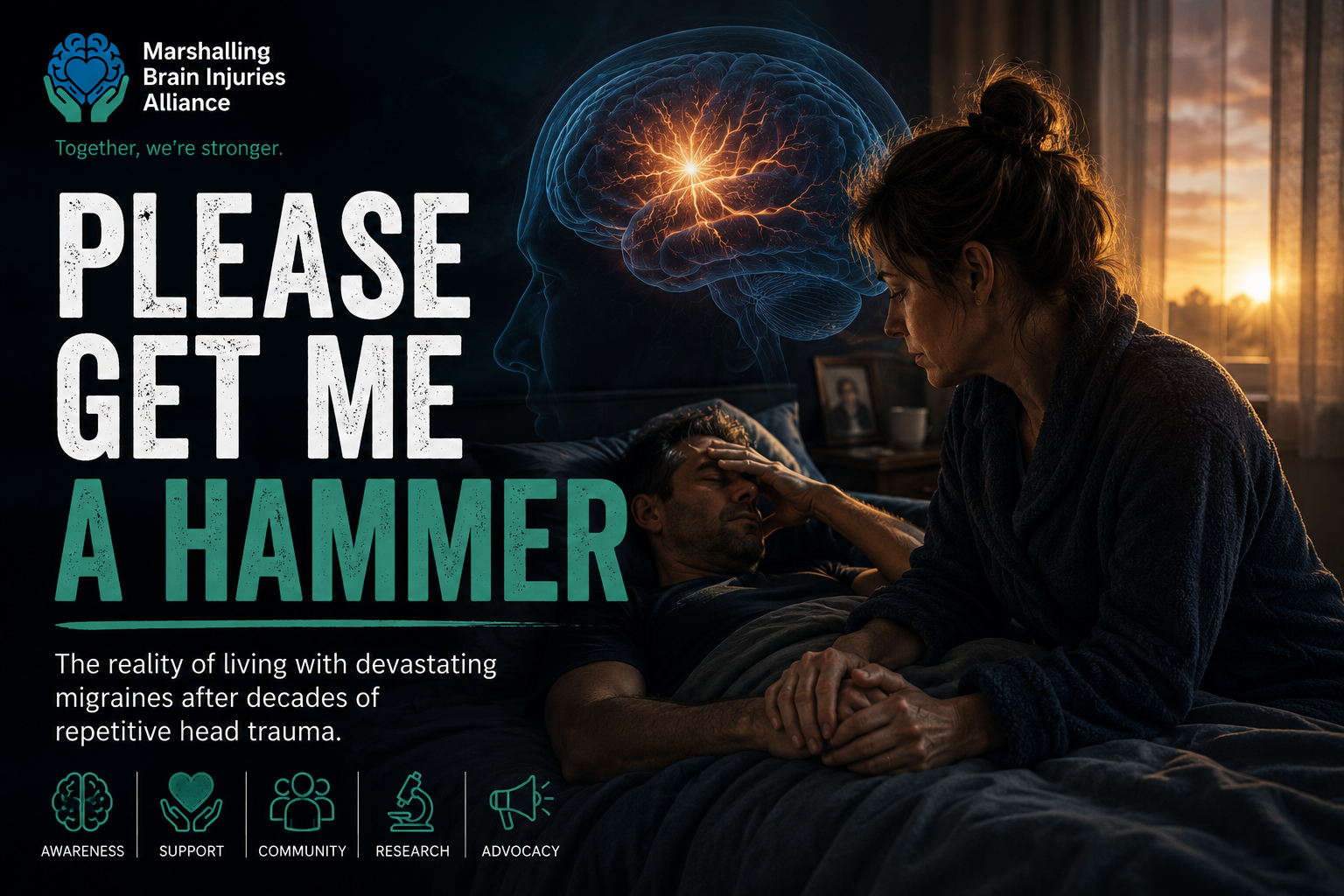
Please Get Me a Hammer
Trigger warning: This article contains descriptions of severe pain and suicidal thoughts caused by a debilitating migraine attack.
Yesterday afternoon my husband, Rich, experienced one of the worst migraine attacks I've ever witnessed.
Rich lives with probable chronic traumatic encephalopathy (CTE), dementia and the long-term effects of decades of repetitive head trauma. We are sharing this story because people need to understand the reality behind the headlines—and because no one living with these symptoms should ever feel alone.
Morning After the Storm
It's the morning after one of the worst migraine attacks I've ever seen Rich endure.
I've had very little sleep. I spent the night looking after him, and now I'm sitting at the kitchen table writing this blog while the house remains as dark and quiet as possible.
I can't switch the television on.
I can't put the radio on.
I'm trying not to make a sound.
After hours of unimaginable pain, Rich has finally fallen into a deep sleep.
I'm sitting here hoping and praying that when he wakes, the migraine has finally lifted.
But I'm also painfully aware that there's a very real possibility it hasn't.
When most people think about brain injury they think about memory loss or dementia.
Those symptoms are devastating.
But for our family, it is the migraines we fear most.
When the Migraine Took Hold
Yesterday afternoon, another migraine started.
At first, neither of us thought it would become one of those attacks.
Rich took the sumatriptan his neurologist had prescribed and hoped it would stop the migraine before it became unbearable.
It didn't.
By around 3pm, he looked at me and quietly said he knew he was in trouble. He went to the bedroom, closed the curtains and climbed into bed, hoping sleep would stop it getting any worse.
Sleep never came.
Instead, the pain continued to build.
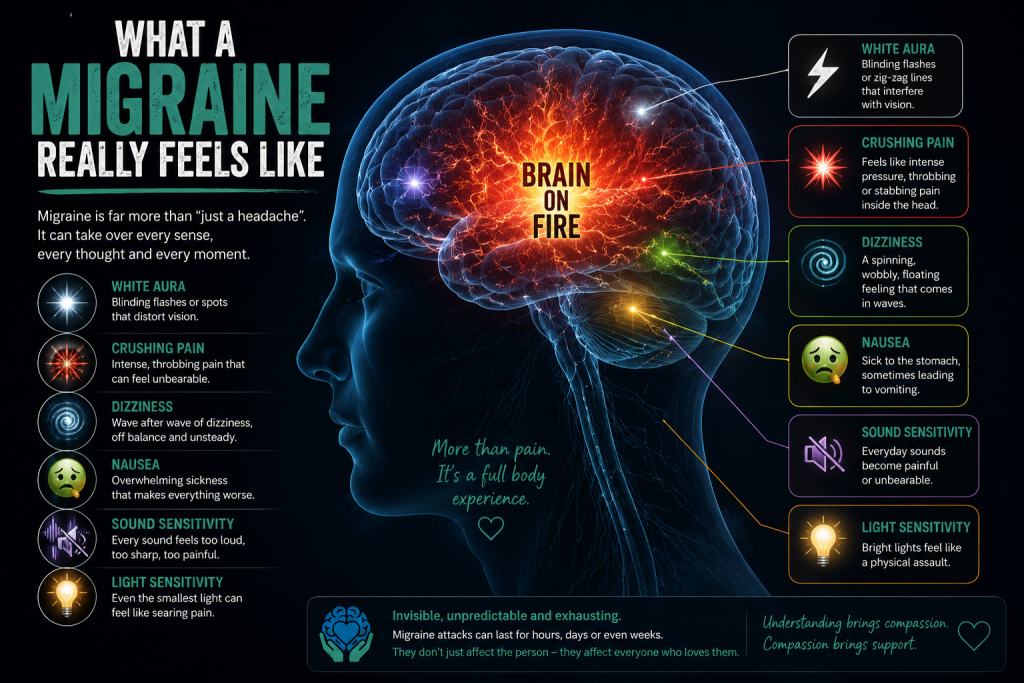
As the hours passed, he became unable to tolerate any light or sound. The room had to remain completely dark and silent. Alongside the crushing pain came blinding white light auras that overwhelmed his vision, wave after wave of dizziness, and relentless nausea that made every movement even more unbearable.
Soon he was alternating between screaming in agony and crying, completely overwhelmed by the intensity of the pain.
Then came the words no wife ever wants to hear.
"Please Get Me a Hammer"
"Please get me a hammer so I can bash my own head in."
Rich wasn't saying he wanted to die.
He was begging for the pain to stop.
There is an important difference.
People who have never witnessed pain at this level may struggle to understand it. But when someone is experiencing agony beyond anything they have ever known, the brain can become completely consumed by escaping that pain. Those desperate words weren't born from a wish to end his life—they came from hours of pain so severe that he couldn't imagine enduring another second of it.
All I could do was hold him.
We spent the entire night together in complete darkness. I couldn't even talk to him because he couldn't cope with hearing my voice. I simply held him as he drifted in and out of consciousness, waking only to cry out in pain again.
Watching someone you love suffer like that is utterly heartbreaking.
You feel completely helpless.
This wasn't the first time.
The last attack of this severity lasted three days. It was then followed by almost an entire week where he was completely exhausted, physically and mentally drained from everything his body had endured.
There is something people often ask me.
The Symptom We Fear Most
"What is the hardest symptom?"
Rich lives with memory problems, personality changes, impulsivity, anger, depression, anxiety, suicidal thoughts and progressive cognitive difficulties associated with probable CTE and dementia.
Every one of those symptoms has changed our lives.
Every one of them is heartbreaking in its own way.
But if I'm honest, they aren't the symptoms we fear the most.
When another migraine begins, a feeling of dread fills our house.
We don't know whether it will be over in a few hours or whether we're about to face another night like the one we've just lived through.
The pain is beyond anything I can describe. It isn't simply a bad headache. It robs Rich of his ability to tolerate light, sound or movement. The blinding white auras take over his vision. Wave after wave of dizziness and nausea leave him unable to do anything except lie in complete darkness and hope it eventually ends.
There is no position that makes it comfortable.
There are no words that make it better.
There is very little I can do to help.
I can't take the pain away.
I can't comfort him with conversation because even hearing my voice is too much.
All I can do is sit beside him, hold him when he'll let me, and wait.
And all Rich can do is try to survive it.
He simply has to endure every minute until, eventually, the attack begins to ease.
That helplessness is something I wouldn't wish on anyone.
It is the symptom our family lives in fear of.
What many people don't see is that this isn't because we haven't sought help.
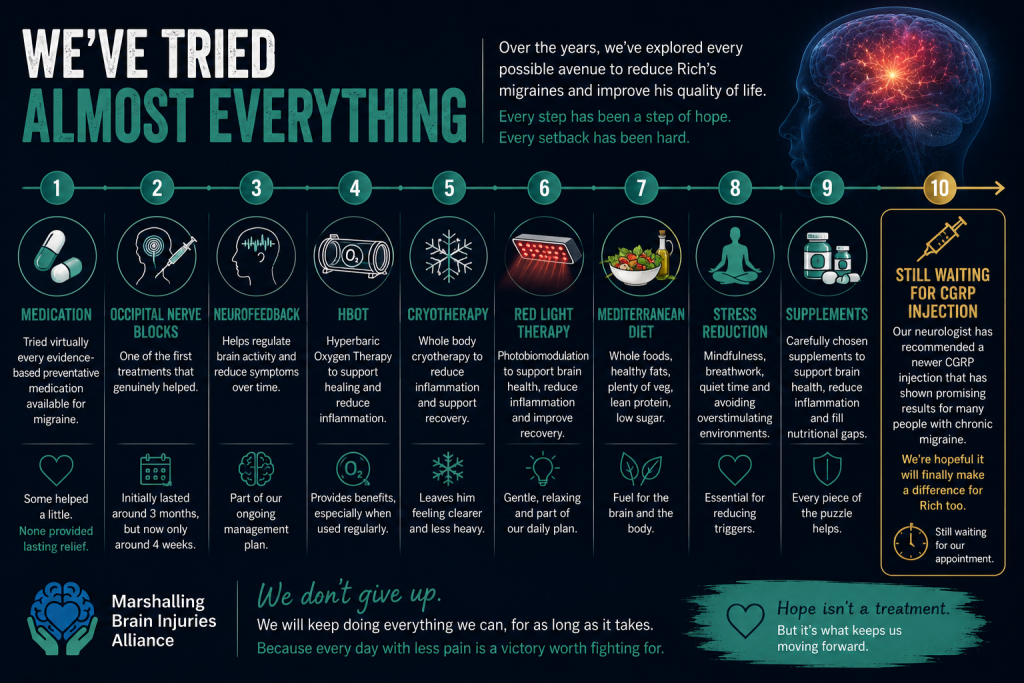
Rich is under the care of a neurologist, and over the years they have tried numerous migraine treatment plans. He has worked through virtually every evidence-based preventative medication his neurologist felt was appropriate.
His sumatriptan can sometimes help, but it is frustratingly unreliable. Sometimes it reduces an attack. Other times, like yesterday, it seems to make no difference at all.
Occipital nerve block injections into the back of his head were one of the first treatments that genuinely helped. Initially they provided relief for around three months, but over time their effectiveness has reduced and they now last only around four weeks before the migraines begin breaking through again.
His neurologist has now recommended a newer injectable treatment that targets CGRP, a protein involved in migraine. For many people with chronic migraine it has been life-changing, and we are hopeful it could make a difference for Rich too. Unfortunately, we're still waiting for that appointment.
But hope doesn't stop the pain while you're waiting.
We are now more than six weeks into that wait, still hoping the appointment comes soon.
Until then, we carry on.
Every new treatment brings hope. Every treatment that fails brings another layer of disappointment.
Why Headaches Matter After Brain Injury
One thing I didn't fully appreciate until we started this journey is just how common headaches and migraines are after a traumatic brain injury.
For many people, they are far more than "just a headache."
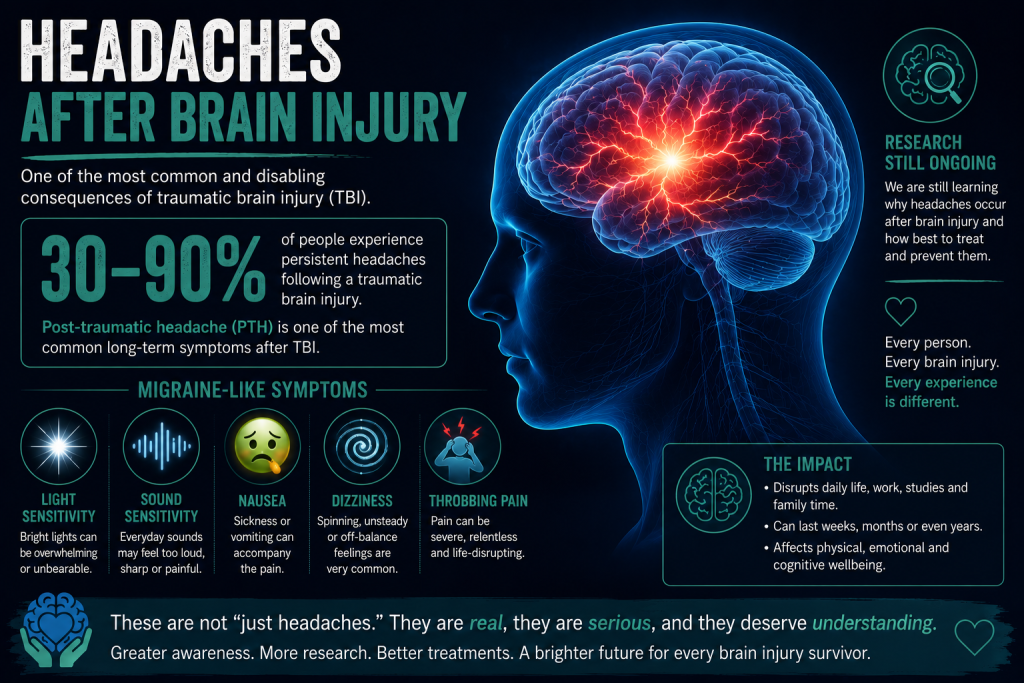
Studies suggest that between 30% and 90% of people experience persistent headaches following a traumatic brain injury, making post-traumatic headache one of the most common long-term symptoms. For some, these headaches settle within weeks or months. For others, they become a chronic, life-changing condition that can last for years.
Many post-traumatic headaches resemble migraine. They can involve severe, throbbing pain alongside extreme sensitivity to light and sound, nausea, vomiting, dizziness, visual disturbances such as flashing lights or white auras, and overwhelming exhaustion.
For people living with repetitive head trauma or suspected CTE, headaches and migraines are also commonly reported. However, researchers are still working to understand exactly why they occur and how they relate to the underlying brain changes seen in CTE. This means it isn't possible to say that migraine is caused by CTE itself, but it is a symptom experienced by many people with a history of repeated brain injuries.
Whatever the underlying cause, the impact can be devastating.
These attacks don't just interrupt someone's day.
They steal days from families.
They stop people working.
They prevent parents from being with their children.
They leave loved ones sitting helplessly in darkened rooms, hoping the person they care about will eventually come through the other side.
That is why research into better treatments for post-traumatic headache and migraine matters so much.
People often think of the long-term effects of repetitive head trauma in terms of memory loss, confusion or changes in mood.
Those symptoms are real.
But so is this.
The nights spent sitting in darkness.
The screams that no amount of love can silence.
The fear that comes every time another migraine begins because we simply don't know how bad it is going to become.
This Is Why Rich Wanted Me to Write This
When we realised yesterday afternoon that this wasn't just another headache, but was turning into one of those devastating migraine attacks, Rich said something to me.
He said he wanted people to know the reality of living with this.
Not the version people see on social media.
Not the brave face he tries to put on when he feels well enough to leave the house.
The real reality.
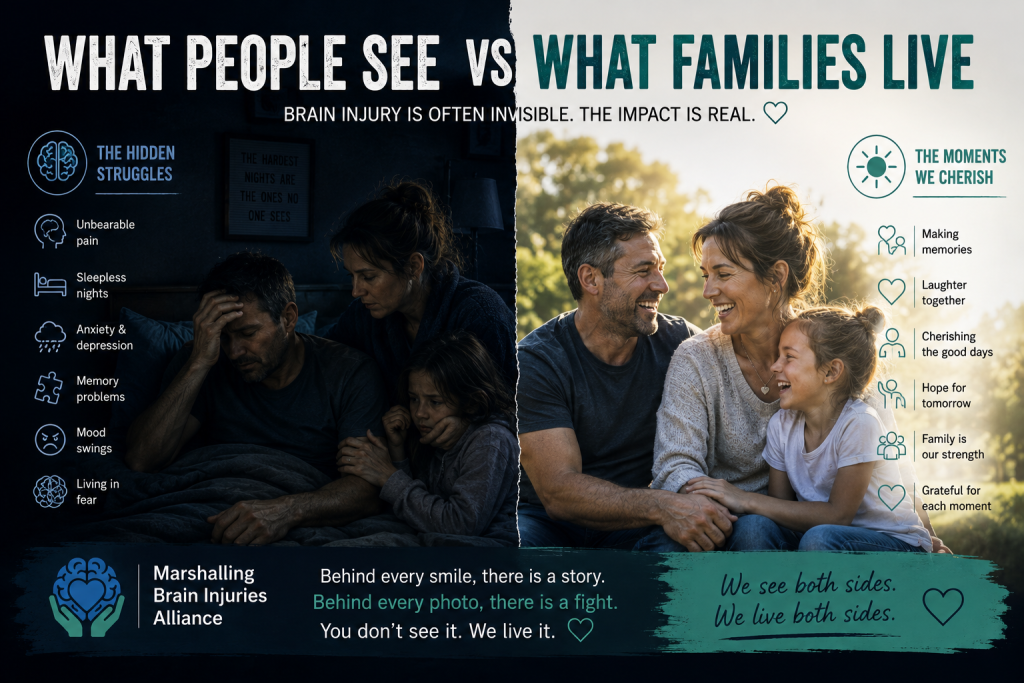
The nights spent screaming in agony.
The hours lying in complete darkness because even the smallest amount of light or sound is unbearable.
The blinding white auras, relentless dizziness and nausea.
The fear that comes every time another migraine begins.
Rich has always been passionate about sharing the good, the bad and the ugly of living with dementia and probable CTE after decades of repetitive head trauma.
Not because he wants sympathy.
Not because he wants people to feel sorry for him.
But because he believes that awareness only comes when people are prepared to speak honestly about what life is really like.
For too long, people living with probable CTE have suffered in silence.
Many have felt dismissed, misunderstood or completely alone.
If sharing our family's most difficult moments helps another person recognise themselves, encourages another family to seek support, or simply lets someone know that they are not alone in their pain and suffering, then being this open is worth it.
This is Rich's way of giving a voice to everyone living with probable CTE and the families who walk beside them every single day.
Because behind every diagnosis, every headline and every research paper is a real person.
And every person deserves to be seen, heard and understood.
Behind every discussion about CTE, concussion or repetitive head trauma is a person living with symptoms that can completely consume their life.
Researchers are still working to understand why some people with histories of repetitive head impacts develop symptoms like these and how best to treat them. There is still so much we don't know.
What we do know is that families are living this reality every single day.
Why We Will Keep Fighting
As I finish writing this, I'm still listening for the first sound from the bedroom.
I'm hoping it will be the sound of relief.
I'm terrified it will be another cry of pain.
If telling our story helps just one family feel less alone, then it will have been worth sharing.
Because no one should have to suffer in silence.
And no one should have to face nights like this without hope that better treatments, better research and better support are on the horizon.
There Is Hope—But There Is No Magic Bullet
Reading this, it would be easy to think that Rich lives like this every week.
Thankfully, he doesn't.
These devastating attacks are now much less frequent than they once were.
That hasn't happened by chance.
Over the past few years, we've spent hundreds of hours reading research, speaking to clinicians, trying different therapies and changing almost every aspect of our lifestyle in the hope of reducing the burden of his symptoms.
Today, Rich follows a Mediterranean-style diet and we've removed almost all ultra-processed foods from our home. We keep his sugar intake as low as possible, he no longer drinks alcohol, and we carefully monitor anything that might trigger inflammation or make his symptoms worse.
Alongside this, he regularly uses red light therapy (photobiomodulation), hyperbaric oxygen therapy (HBOT), cryotherapy and neurofeedback. He takes a carefully considered supplement programme, works hard to reduce stress wherever possible and avoids environments that are noisy, chaotic or overstimulating because we know they can make his symptoms worse.
Looking back, we're convinced these changes have improved Rich's quality of life, even though they haven't removed his illness.
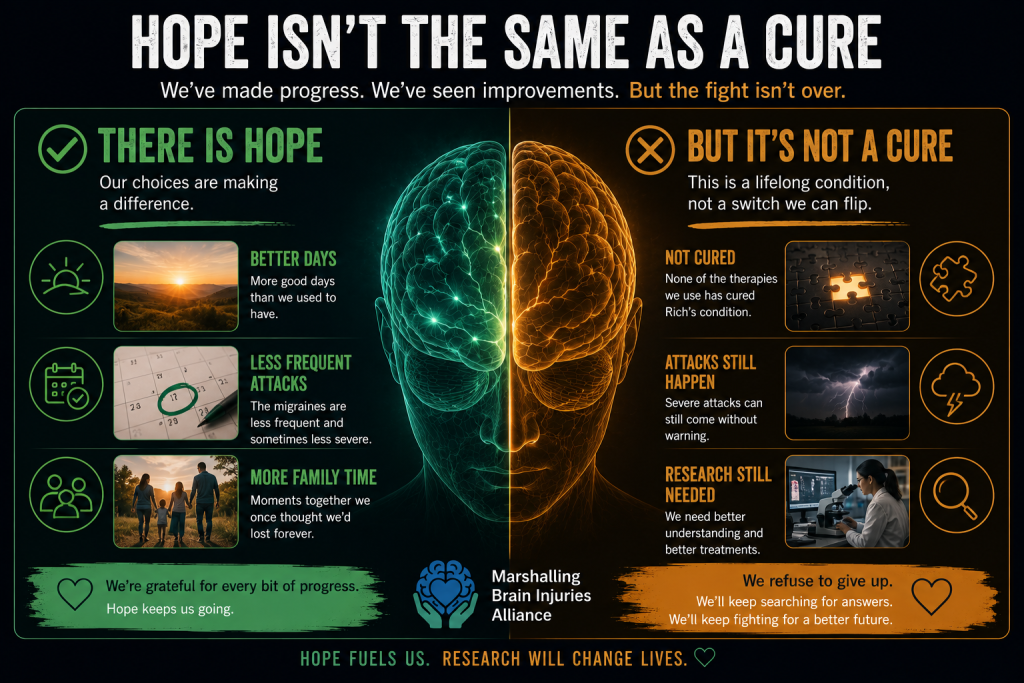
The attacks are less frequent.
He has more good days than he used to.
There are moments where we get to enjoy life together in ways that once felt impossible.
For that, we are incredibly grateful.
But last night was a stark reminder of something we never forget.
None of these therapies is a cure.
None of them guarantees tomorrow will be a good day.
Even after all the changes we've made, after all the treatments we've tried, after everything we've learned, Rich can still be brought to his knees by a migraine so severe that all he can do is endure it.
That's why we are so passionate about supporting research.
Lifestyle changes and supportive therapies may help some people manage symptoms and improve quality of life, but we desperately need better treatments. We need more research into post-traumatic headache, repetitive brain injury and probable CTE. We need to understand why some people develop symptoms like these and, more importantly, how we can prevent and treat them.
Until then, we'll keep doing everything we can.
One day at a time.
Today, Rich is still asleep.
I'm still hoping he wakes up pain free.
I still don't know what the next few hours will bring.
But I do know this.
We will keep searching for answers.
We will keep supporting others.
We will keep telling the truth about what life with probable CTE really looks like.
Because behind every statistic is a person.
Behind every diagnosis is a family.
And until better treatments exist, none of us can afford to stop raising awareness.
If you or someone you love is experiencing thoughts of self-harm or suicide, please don't suffer alone. Reach out to a trusted family member, your healthcare team, or a crisis support service immediately. Severe pain can be overwhelming, and support is available.