What Actually Happens Inside the Brain During a Concussion?
Understanding the Science Behind Brain Injury
Every year, millions of people experience a concussion.
It can happen during sport, military service, a road traffic collision, a fall, an assault, or simply by slipping on an icy pavement.
Most people know concussion involves "hitting your head."
But surprisingly, the brain itself never actually hits the outside world.
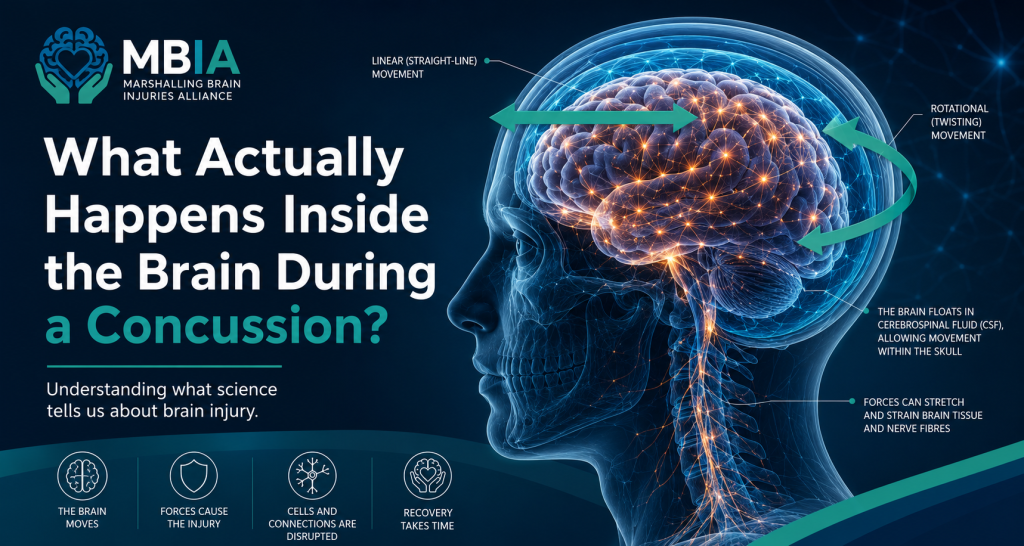
Instead, the injury happens because the brain moves inside the skull.
Understanding this movement helps explain why concussion symptoms can affect thinking, memory, balance, emotions, sleep and so many other aspects of daily life.
Researchers have learned an enormous amount over the last two decades, although many questions remain. This article explains what we currently know in a straightforward, evidence-based way.
The Brain Is Softer Than Most People Realise
Many people imagine the brain is firm.
It isn't.
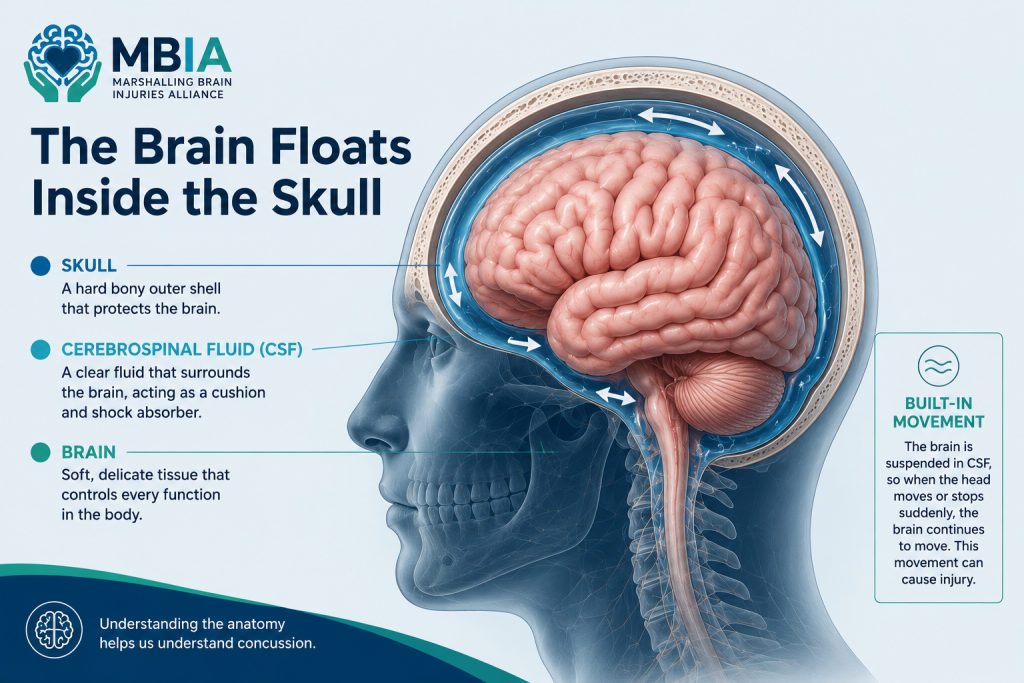
The brain has a soft, jelly-like consistency. It weighs around 1.3–1.4 kg in adults and is made up of billions of nerve cells (neurons), supporting cells (glia), blood vessels and water.
It floats inside the skull in cerebrospinal fluid (CSF). This fluid cushions the brain during normal everyday movement, but it cannot completely protect it from sudden or violent forces.
When the head accelerates or stops suddenly, the brain continues moving because of inertia—the tendency of an object to keep moving until another force acts on it.
That difference between the movement of the skull and the movement of the brain is what creates a concussion.
Concussion Is an Injury Caused by Force
A concussion is not simply a bump to the head.
It is a traumatic brain injury (TBI) caused when forces acting on the head (or sometimes the body) make the brain move rapidly inside the skull.
Importantly, you do not always have to hit your head to sustain a concussion.
For example:
- A rugby tackle
- A boxing punch
- A blast wave
- A whiplash injury in a car crash
- A fall that snaps the head backwards
All of these can generate enough force to move the brain.
Two Main Types of Force
Scientists generally describe two major mechanical forces involved in concussion:
- Linear acceleration
- Rotational acceleration
Both often occur together.
Linear Forces
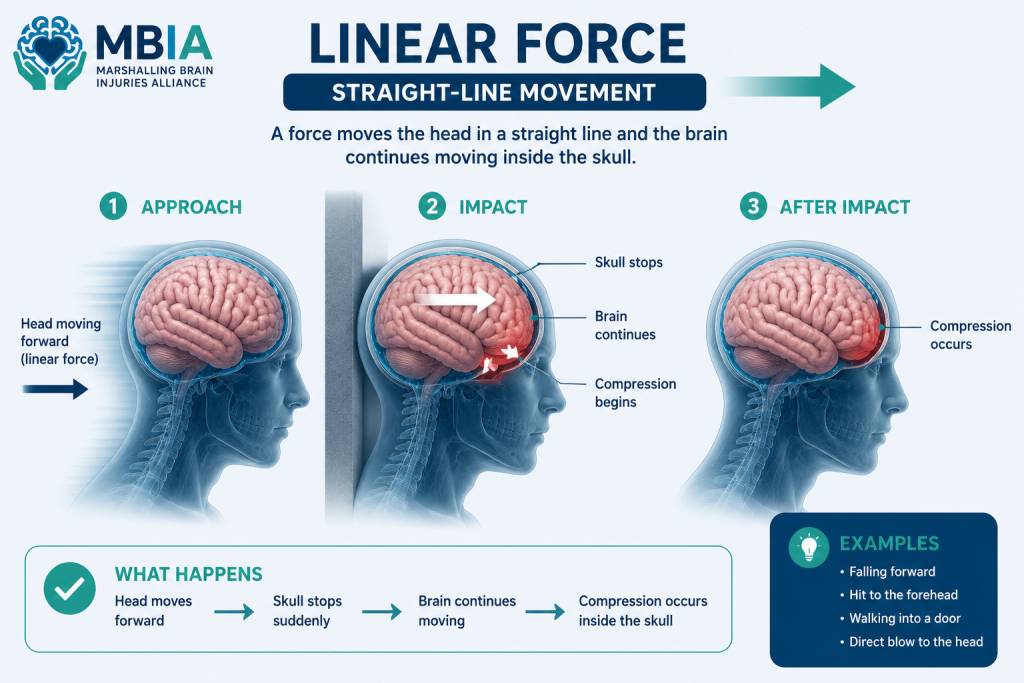
Linear forces occur when the head moves in a straight line.
Imagine dropping a tennis ball onto the floor.
It travels directly downward and then suddenly stops.
The head can behave similarly.
Examples include:
- Falling forwards
- Being hit directly on the forehead
- Walking into a doorframe
- A heavy object striking the head
When this happens:
- the skull stops suddenly
- the brain continues moving
- the brain presses against the inside of the skull
This compression can temporarily disturb normal brain function.
Rotational Forces
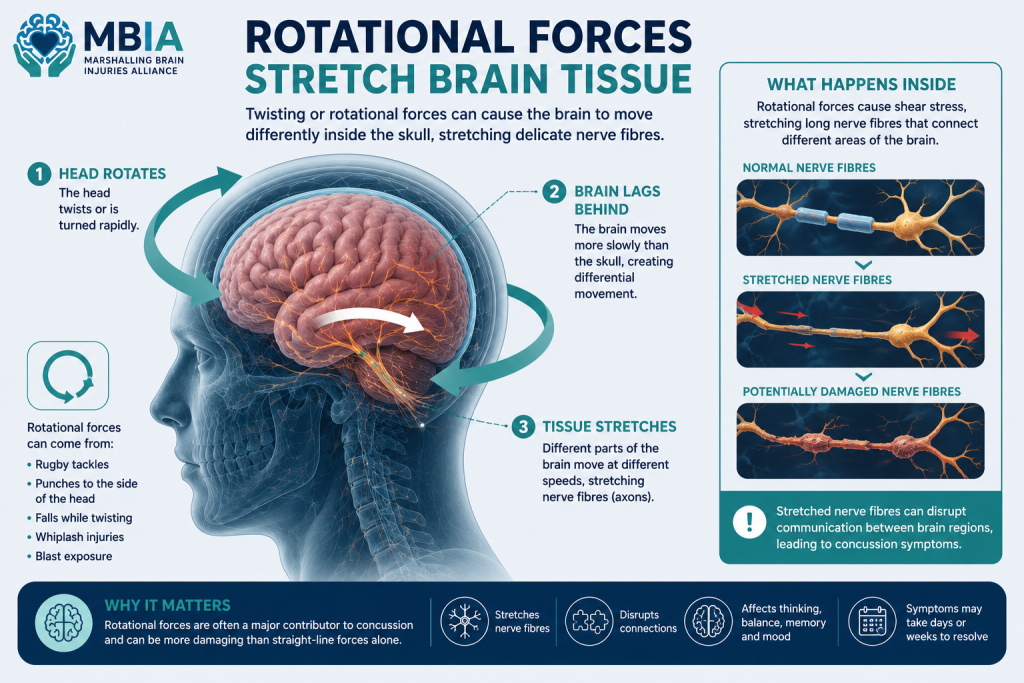
Modern concussion research increasingly shows that rotational forces are often more damaging than purely linear forces, especially when it comes to stretching nerve fibres.
Instead of moving in a straight line, the head twists rapidly.
Imagine holding a bowl of jelly and suddenly twisting your hands.
The jelly lags behind and deforms.
The brain behaves in a similar way.
Examples include:
- A rugby tackle causing the head to spin
- A punch to the side of the jaw
- Falling awkwardly and twisting the neck
- Boxing uppercuts or hooks
- Whiplash injuries
- Blast exposure
During rotation:
different parts of the brain move at different speeds because the brain is not a rigid object.
This creates stretching forces deep within the brain tissue.
These stretching forces are called shear forces.
Why Rotational Forces Matter
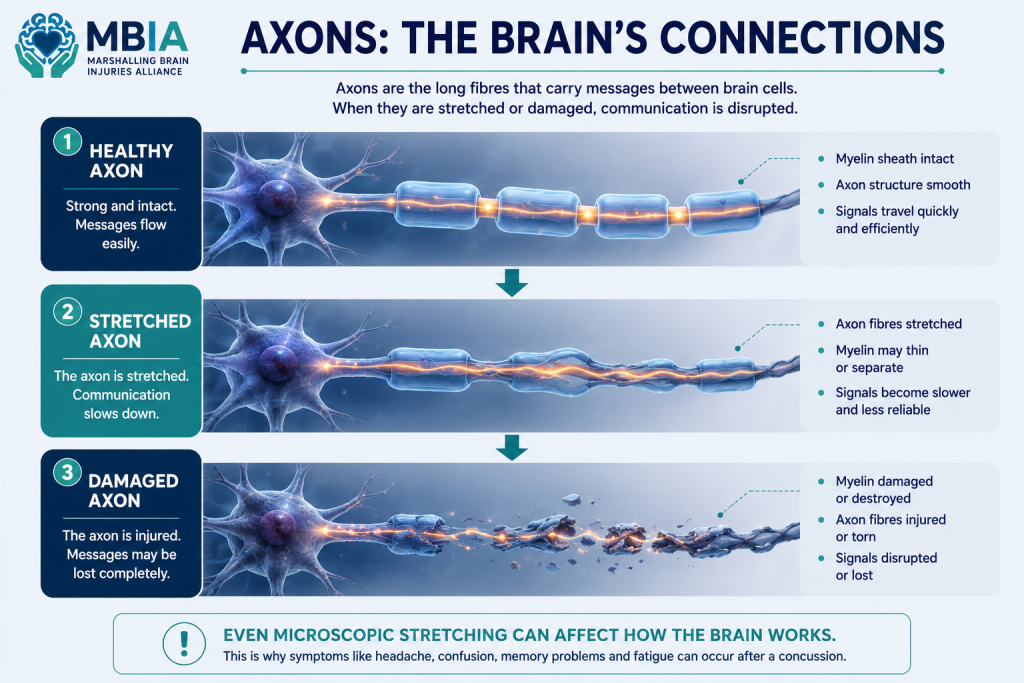
The brain contains billions of long nerve fibres called axons.
Think of axons like tiny electrical cables connecting different regions of the brain.
These cables allow information to travel almost instantly.
Rapid twisting can stretch these fibres beyond their normal limits.
Sometimes they recover.
Sometimes tiny injuries remain.
This stretching can interfere with communication between brain regions, contributing to symptoms such as slowed thinking, poor concentration, memory difficulties and reduced processing speed.
Researchers believe this type of microscopic injury plays an important role in concussion and, in more severe cases, diffuse axonal injury (DAI).
What Happens Immediately After Injury?
A concussion does not usually involve large areas of the brain dying.
Instead, there is a temporary disruption of how brain cells work.
Researchers often describe this as a neurometabolic cascade—a chain reaction of changes inside brain cells.
Although the term sounds complicated, the basic idea is easier to understand.
Within seconds:
- brain cells are stretched
- chemical messengers are released
- potassium leaks out of cells
- calcium moves into cells
- nerve cells work much harder to restore balance
All of this requires a great deal of energy.
The Brain's Energy Crisis
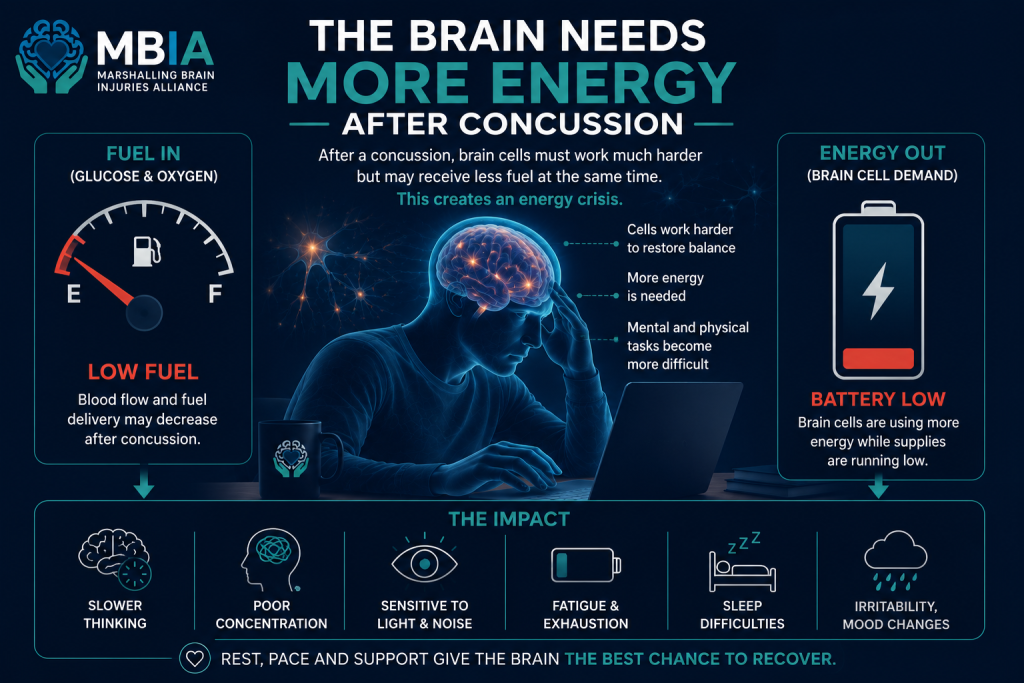
After concussion, brain cells suddenly need more energy.
Unfortunately, blood flow to the brain may temporarily decrease at the same time.
This creates what researchers sometimes call an energy mismatch or energy crisis.
The brain is trying to work harder while receiving less of the fuel it needs.
This helps explain why people often feel:
- mentally exhausted
- overwhelmed
- sensitive to noise
- sensitive to bright lights
- unable to concentrate
- slower at processing information
This doesn't necessarily mean permanent damage has occurred. In many people, these changes improve over days to weeks as the brain recovers. However, recovery times vary, and some people experience symptoms for much longer.
Why Do Symptoms Vary So Much?
No two concussions are identical.
Symptoms depend on many factors, including:
- the direction of the force
- how quickly the head accelerated and stopped
- whether the force was mainly linear, rotational or both
- previous brain injuries
- age
- general health
- genetics
- sleep
- stress
- other medical conditions
This is why one person may recover quickly while another experiences symptoms for months.
Scientists are still investigating why recovery differs so much between individuals.
Does the Brain Bruise?
Sometimes.
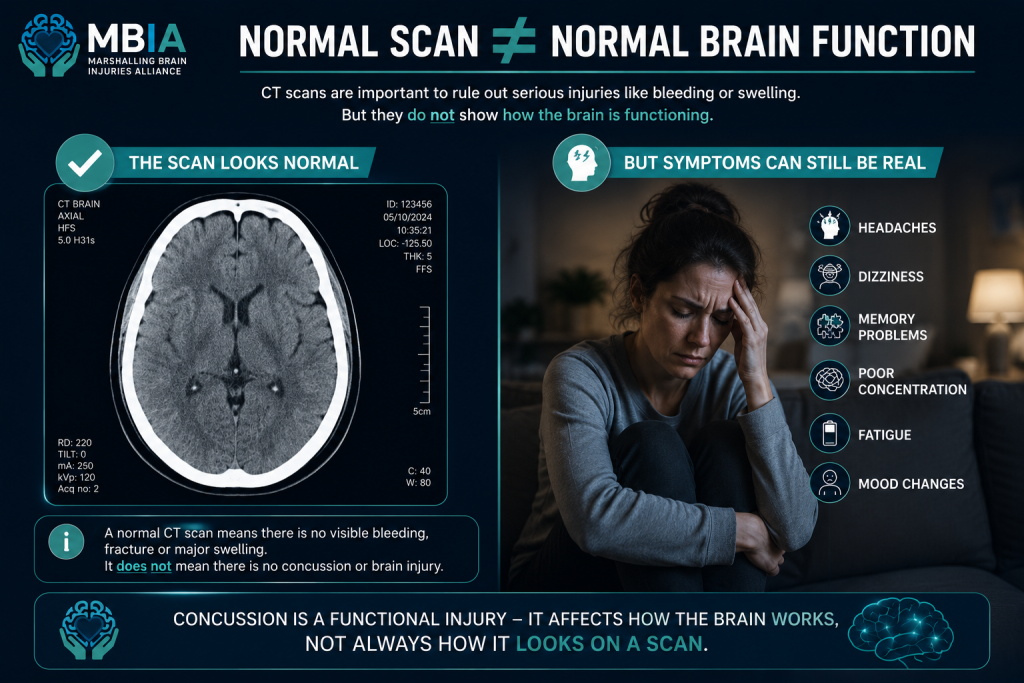
Most concussions do not involve obvious bruising or bleeding that can be seen on a CT scan.
Instead, the injury is usually microscopic.
Brain cells, their connections and the chemicals they use to communicate can be disrupted without creating large structural damage.
This is one reason why scans may appear normal even though symptoms are very real.
A normal CT scan is reassuring because it rules out serious problems such as bleeding, but it does not rule out concussion.
What About Repeated Head Impacts?
Researchers are increasingly interested in what happens when the brain experiences repeated impacts over months or years.
This is particularly relevant in:
- rugby
- football
- boxing
- MMA
- American football
- military blast exposure
- domestic abuse involving repeated head trauma
Current evidence suggests that repeated head impacts may affect the brain differently from a single concussion. Ongoing research is exploring how repeated exposure might influence long-term brain health, including the risk of conditions such as chronic traumatic encephalopathy (CTE). However, scientists are still working to understand why some people appear more vulnerable than others and why many people with similar exposure do not develop the same outcomes.
What Scientists Know Today
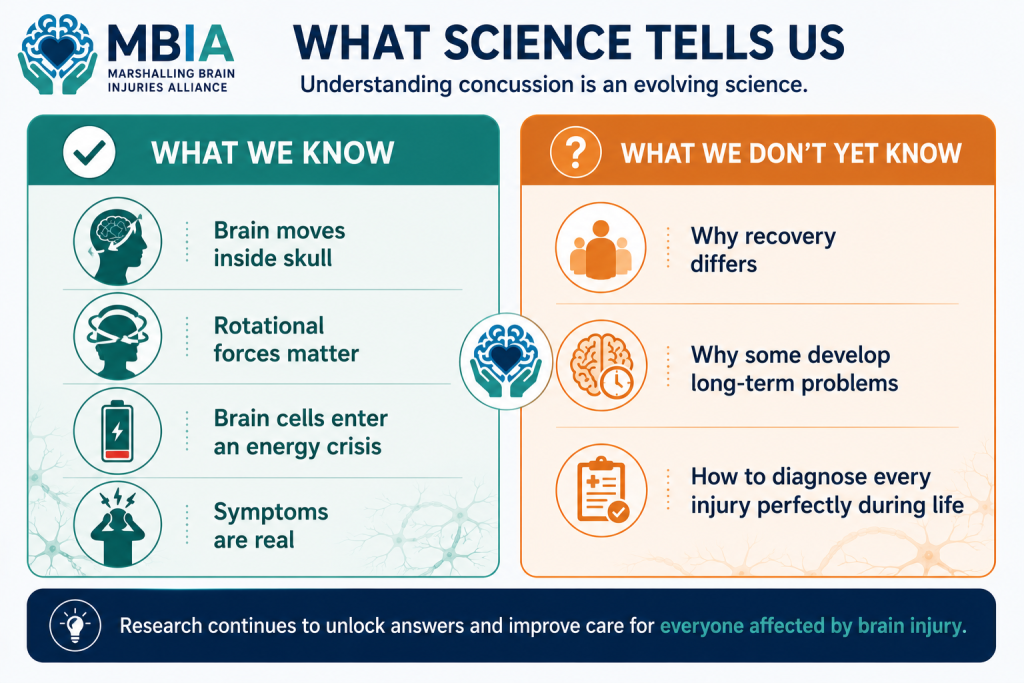
We Know
✅ The brain moves inside the skull during concussion.
✅ Both linear and rotational forces contribute to injury.
✅ Rotational forces can stretch delicate nerve fibres.
✅ Brain cells undergo a temporary chemical and energy imbalance.
✅ Symptoms may occur even when CT scans are normal.
✅ Recovery varies greatly between individuals.
We Don't Yet Know
❌ Exactly why some people recover quickly while others develop persistent symptoms.
❌ Why some individuals appear more susceptible to repeated head impacts.
❌ The precise biological mechanisms linking repeated head impacts to long-term neurodegenerative diseases such as CTE.
❌ Whether future blood tests or advanced brain scans will reliably diagnose all concussion-related injuries during life.
Key Takeaway
Concussion is far more than "just a knock to the head."
It is a complex brain injury caused by the rapid movement of the brain inside the skull. Both straight-line (linear) and twisting (rotational) forces can disrupt the brain's delicate networks, trigger a temporary energy crisis and produce a wide range of symptoms.
While scientists have made major advances in understanding these processes, research continues to improve diagnosis, treatment and prevention. Each new study brings us closer to better care for people living with brain injuries.
Peer-Reviewed References
- Giza CC, Hovda DA. The Neurometabolic Cascade of Concussion. Journal of Athletic Training.
- Meaney DF, Smith DH. Biomechanics of Concussion. Clinics in Sports Medicine.
- Smith DH, Meaney DF, Shull WH. Diffuse Axonal Injury in Head Trauma. Annual Review of Biomedical Engineering.
- Blennow K, Brody DL, Kochanek PM, et al. Traumatic Brain Injuries. Nature Reviews Disease Primers.
- National Institute of Neurological Disorders and Stroke (NINDS). Current concussion and traumatic brain injury research summaries.
- Gennarelli TA, Graham DI. Foundational work on diffuse axonal injury and rotational acceleration.
Enjoyed this article? Join thousands of readers receiving our monthly Brain Injury Brief