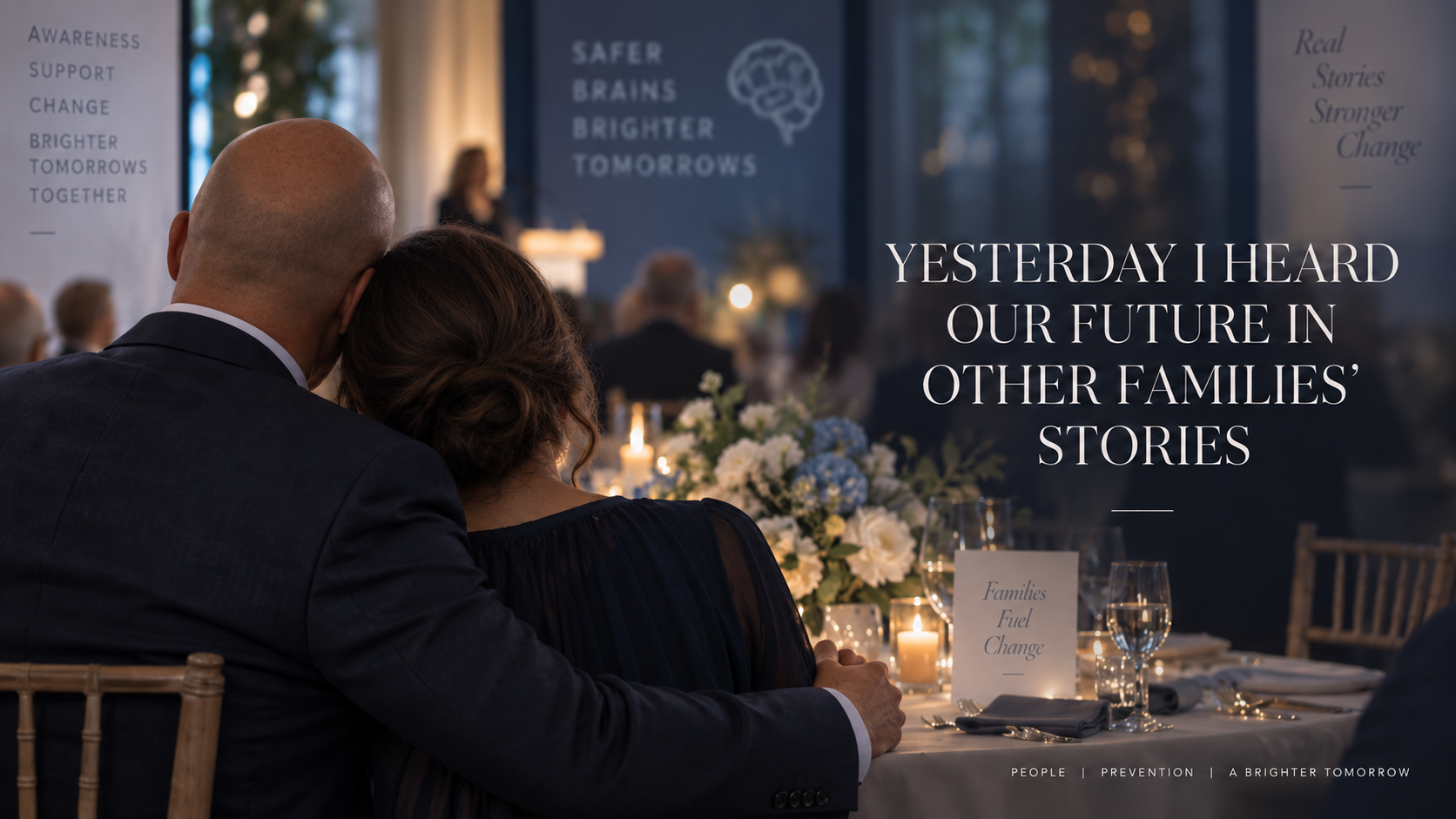
Yesterday I Heard Our Future in Other Families’ Stories
Yesterday was a wonderful day.
It was inspiring, hopeful and important.
But it also broke my heart a little.
We had the honour of attending Head Safe Football’s Lunching & Launching event for the launch of their new national petition calling for greater action to protect the brains of today’s and tomorrow’s footballers.
We were incredibly proud to be there and to be among the first people to put our names behind it.
The petition is calling on Government to take five important steps: to bring the issue before Parliament, promote the message “Think Head Safe: Reduce Heading in Training”, recognise CTE associated with repetitive head impacts as a public-health issue, work with sporting governing bodies to systematically reduce heading in training through policy and coach education, and embed brain-health education within teacher training and PE.
These are changes that matter.
They have the potential to protect children who are only beginning their sporting lives today from some of the consequences families are living with decades later.
And that alone made yesterday incredibly important.
But for me, it became about something much more personal.
Listening to the families
During the afternoon, families who have lost husbands, fathers and brothers after years living with dementia, CTE and other brain disease stood up and spoke.
They didn't speak in statistics.
They spoke about people they loved.
They spoke about watching someone change.
About the gradual loss of independence.
About personality changes.
About memories disappearing.
About becoming a carer as well as a wife or family member.
About watching the person they had known for decades slowly becoming someone different.
And ultimately, they spoke about losing them.
Sitting there listening, I found myself becoming increasingly emotional.
Because although their stories belonged to them, parts of those stories felt frighteningly familiar.
And I realised I wasn't simply listening to what had happened to other families.
I was thinking about us.
I was thinking about Rich.
Grieving someone who is still sitting beside you
There is a strange kind of grief that comes with progressive brain disease.
You can be sitting next to the person you love while simultaneously grieving parts of them that have already disappeared.
I love Rich beyond words.
He is still here.
We still laugh.
We still make memories.
We still have good days.
We still plan things.
We still have a life together.
And that is incredibly important to say, because I never want his life to be defined only by illness.
But I would be lying if I said I didn't grieve.
Because Rich has changed so much.
I grieve the independence he has already lost.
I grieve the things that used to come easily to him and now require help.
I grieve parts of the personality I remember.
And perhaps hardest of all, I grieve our memories.
A marriage is made from thousands upon thousands of moments.
Some are enormous.
Some would mean absolutely nothing to anybody else.
A look across a room.
A stupid joke.
A holiday.
A conversation in the car.
A family Christmas.
Something the children did when they were little.
Places we have visited.
Arguments we can laugh about years later.
Our daughter's wedding.
Our own wedding.
Our life.
These memories are part of the invisible thread that connects two people who have spent years together.
But increasingly, I can say to Rich:
"Do you remember when...?"
And the answer is no.
Sometimes it is something small.
Sometimes it is something huge.
He has lost so much of the memory of our daughter's wedding.
Our holidays are disappearing.
And now even memories of our own wedding are beginning to go.
I can show him photographs.
I can tell him the stories.
Sometimes I can fill in the gaps.
But I cannot give him the feeling of remembering something that his brain can no longer find.
And that hurts more than I can explain.
Because I still remember it for both of us.
Yesterday made me think about the future
Listening to those families speak forced me to confront something I usually try not to spend too much time thinking about.
What comes next?
What else will disappear?
How much more independence will Rich lose?
How much of our life together will eventually exist only in my memory?
What will our world look like in another year?
Five years?
Ten?
And what happens if there comes a time when the disease has taken so much that the man sitting beside me no longer remembers the life we built together?
Those thoughts terrify me.
There is already grief.
And I know there may be much more grief to come.
Yesterday I was surrounded by people who had already travelled further down that road.
Families who could tell you exactly what it is like to watch brain disease slowly take pieces of someone you love and eventually take the person themselves.
I looked at them with enormous admiration.
But part of me was also thinking:
Is this our future?
That's a difficult sentence to write.
But it is the truth.
So what do we do with that fear?
For me, the answer has become:
We focus on now.
Because I cannot control everything that may happen to Rich in the future.
I cannot go backwards and change the years that came before we understood what repetitive head impacts could potentially mean.
I cannot restore memories that have disappeared.
And I cannot promise Rich — or myself — what the future will look like.
But there are things I can do.
I can fight for his quality of life now.
I can help him maintain as much independence as possible for as long as possible.
I can keep looking for ways of managing symptoms.
I can help create a life around him that understands how his brain now works rather than constantly expecting his brain to work as it once did.
I can make new memories with him, even knowing that one day I may have to remember some of them for both of us.
And we can use what is happening to us to make things better for somebody else.
That is where so much of my purpose now comes from.
Why I spend so many hours researching
People sometimes see the posts, the research, the support groups, the website, the meetings, the messages, the campaigns and everything happening behind MBIA.
What people don't always see is what happens behind the scenes.
I work seven days a week.
Often eight, ten, twelve or even fifteen hours a day.
A huge amount of that time is spent reading.
Research papers.
Clinical studies.
Emerging research.
Rehabilitation.
Brain health.
Different therapies.
Dementia.
Traumatic brain injury.
Repetitive head impacts.
CTE.
Sleep.
Mental health.
Neurorehabilitation.
Technology.
Anything that might help me understand what is happening and what might genuinely help improve someone's quality of life.
And there is an enormous amount to sift through.
I don't want hype.
I don't want miracle cures.
I don't want vulnerable families spending money because somebody has made an extraordinary promise on social media.
I want to understand what the evidence actually says.
Where it is strong.
Where it is promising.
Where it is early.
Where there are limitations.
And where something might be worth discussing with the right clinician or exploring as part of someone's wider care.
I started doing that because I was desperately trying to help my husband.
Now I do it for many more people.
That is why MBIA exists
Marshalling Brain Injuries Alliance was never supposed to be just another organisation posting brain-injury statistics on social media.
It grew out of lived experience.
Out of fear.
Frustration.
Love.
Anger.
Research.
And the realisation that families like ours desperately need somewhere to turn.
People need somewhere they can say:
"My husband is changing and I don't know what to do."
"My memory is getting worse and nobody seems to understand."
"I'm caring for someone and I'm exhausted."
"I've been told everything is fine, but I know I'm not fine."
"I'm frightened about my future."
Sometimes people need information.
Sometimes they need help finding the right professional.
Sometimes they need practical support.
Sometimes they need to speak to somebody else who simply understands.
And sometimes they just need somewhere safe where they don't have to explain from the beginning why this is so difficult.
That is what we are trying to build.
Grief can become purpose
Yesterday reminded me that there are two sides to this fight.
One is supporting the people who are already living with the consequences.
People like Rich.
People like the individuals and families who come to MBIA.
People whose lives cannot simply be restored by changing a rule today.
They deserve support, research, understanding, treatment, rehabilitation, dignity and the best quality of life we can possibly help them achieve.
But the other side is prevention.
We cannot listen to family after family describe devastatingly similar experiences and then simply accept that another generation should follow them.
That is why what Head Safe launched yesterday matters.
Their campaign is asking us to move beyond sympathy and towards action.
And they are right.
We cannot change what happened decades ago.
But we can decide what knowledge we give today's children.
We can educate parents.
We can educate coaches.
We can reduce unnecessary exposure.
We can demand better research.
We can ask difficult questions of sporting organisations.
And we can make brain health part of the conversation before someone becomes ill, rather than only talking about it once another former player has developed dementia.
For Rich, I choose now
I don't know what our future holds.
Writing that frightens me.
There may be many more things this disease takes from us.
There may be memories I eventually hold alone.
There may be more independence lost.
There may be days ahead that I don't yet have the strength to imagine.
But the disease does not get today.
Today Rich is here.
Today we can still laugh.
Today we can still do things together.
Today we can still make another memory.
Today I can still fight to give him the best quality of life we can possibly create.
And today we can use our experience to help somebody else.
Maybe that is what purpose looks like when it grows out of grief.
Not pretending the grief isn't there.
Not pretending you aren't frightened.
But getting up the next morning and deciding that if you cannot change what has already happened, you will do everything you can with what remains.
Yesterday I cried listening to families talk about the people they had lost.
I thought about my husband sitting beside me.
I thought about everything we have already lost.
I thought about everything I am frightened we may still lose.
But I also looked around that room and saw families, researchers, campaigners, organisations and people who have decided that their experiences will not simply end with grief.
They are turning them into change.
And that gives me hope.
We were incredibly honoured to stand beside them yesterday and to be among the first to support the Head Safe petition.
For the players who came before us.
For the people living with the consequences today.
For the husbands, wives, partners, children and families walking this road alongside them.
And most importantly, for the children running onto pitches today who deserve every opportunity to enjoy the sports they love while adults do everything reasonably possible to protect the brains they will need for the rest of their lives.
Yesterday was emotional.
Today, we keep going.
Because grief may be part of our story.
But so are love, purpose, hope and action.
And while we still have a voice, we intend to use it.
Together, we're stronger.
Jen Coates
Marshalling Brain Injuries Alliance