What Is Paranoia?
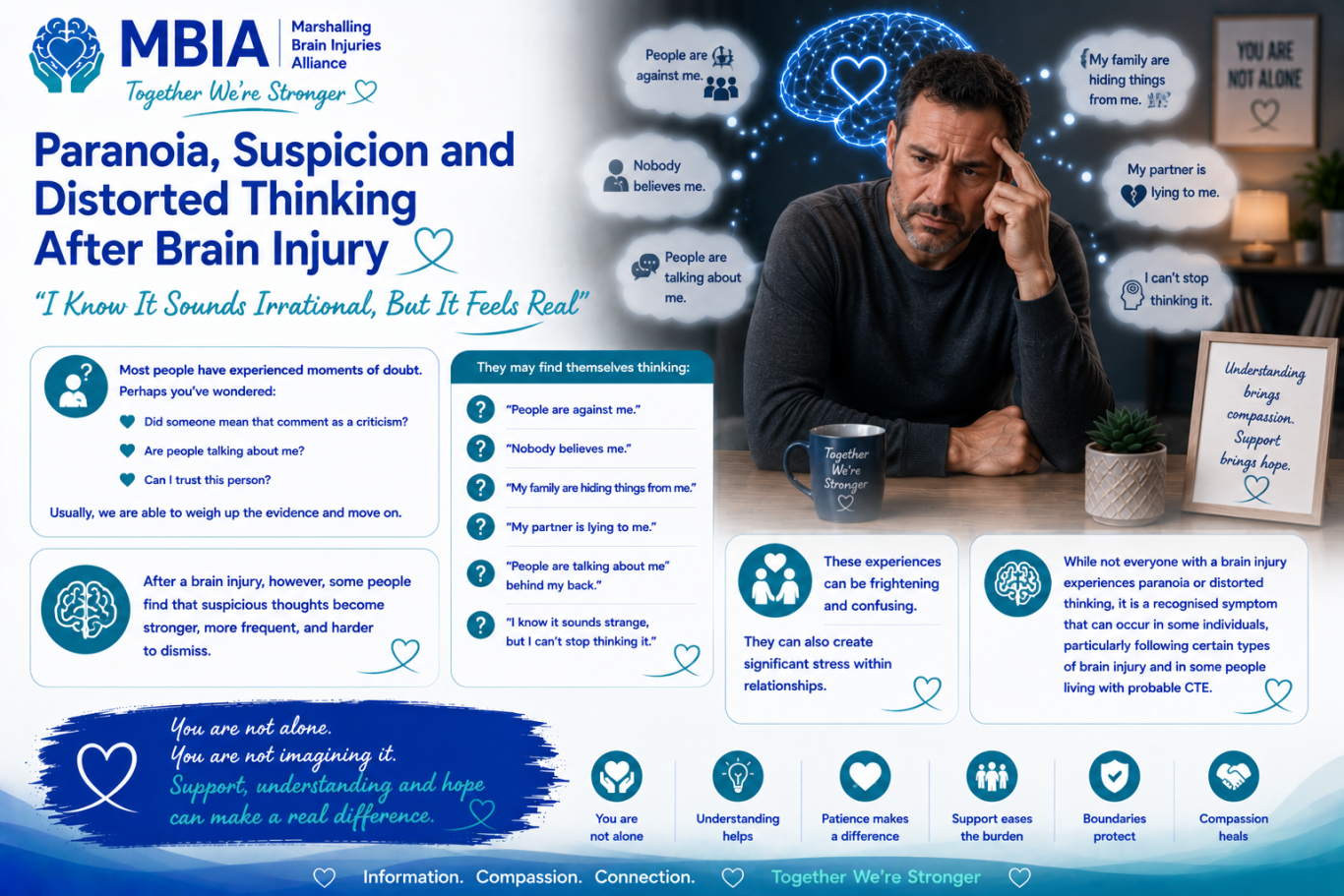
Paranoia involves excessive suspicion, mistrust, or beliefs that others may be intending harm, deception, or betrayal.
Paranoia exists on a spectrum.
At the milder end, it may involve:
- Increased suspicion
- Difficulty trusting people
- Assuming negative intentions
At the more severe end, beliefs may become fixed and difficult to challenge, even when there is little evidence to support them.
Why Can Brain Injury Cause These Symptoms?
Several factors may contribute.
Changes in Brain Function
The brain regions involved in:
- Judgement
- Emotional regulation
- Social understanding
- Impulse control
can be affected by injury.
When these systems are disrupted, it may become harder to accurately interpret situations and people's intentions.
Memory Problems
Memory difficulties can create uncertainty.
For example:
If someone cannot remember a conversation clearly, they may begin trying to fill in the gaps.
Sometimes the brain fills those gaps with assumptions rather than facts.
Reduced Insight
Some brain injuries affect a person's ability to accurately assess situations or recognise changes in themselves.
This may make it harder to question suspicious thoughts once they arise.
Anxiety
Anxiety can significantly increase suspicious thinking.
When the brain is in a constant state of alertness, it may begin interpreting neutral situations as threats.
Trauma
Many people living with brain injuries have also experienced trauma.
Examples may include:
- Military service
- Domestic abuse
- Serious accidents
- Violence
A brain that has learned to expect danger can become hypervigilant.
Sometimes this can appear as paranoia when it is actually an exaggerated survival response.
Depression and Isolation
When someone becomes isolated, lonely, or depressed, negative thinking patterns often become stronger.
The brain may begin focusing on threats, rejection, or perceived criticism.
Fatigue and Poor Sleep
Many people notice suspicious thoughts become worse when they are:
- Exhausted
- Stressed
- Overwhelmed
- Sleep deprived
This is because the brain has fewer resources available to challenge irrational thoughts.
What is Distorted Thinking?
Distorted thinking refers to patterns of thinking that do not accurately reflect reality.
This does not mean someone is "crazy."
It simply means the brain may be interpreting situations in ways that are not entirely accurate.
Examples include:
Jumping to Conclusions
Assuming something is true without enough evidence.
Catastrophising
Automatically expecting the worst possible outcome.
Mind Reading
Believing you know what other people are thinking.
Personalising
Assuming unrelated events are somehow about you.
Black and White Thinking
Seeing situations as entirely good or entirely bad with no middle ground.
Why Might This Be More Common in Probable CTE?
While not everyone with probable CTE experiences paranoia or distorted thinking, families and clinicians have reported symptoms such as:
- Suspicion
- Increased mistrust
- Personality changes
- Emotional dysregulation
- Impulsive thinking
Researchers are still working to understand exactly why these symptoms occur, but changes affecting emotional regulation, judgement, and behaviour may play a role.
Importantly:
Not everyone with probable CTE develops paranoia.
And paranoia alone does not mean someone has CTE.
The Hidden Effort Families Don't See
Many people describe an internal battle.
Part of them recognises a thought may not make sense.
Another part feels absolutely convinced it is true.
This can be exhausting.
Some people say:
"I know it sounds irrational, but I can't shake the feeling."
Others become deeply distressed because the thoughts feel completely real.
Common Examples
Examples might include:
- Believing people are talking about them.
- Thinking friends are avoiding them intentionally.
- Assuming family members are hiding information.
- Becoming convinced a partner is being dishonest without evidence.
- Believing professionals are deliberately dismissing them.
Not every suspicious thought is paranoia.
The key issue is whether the belief is disproportionate to the evidence available.
Coping Strategies for Patients
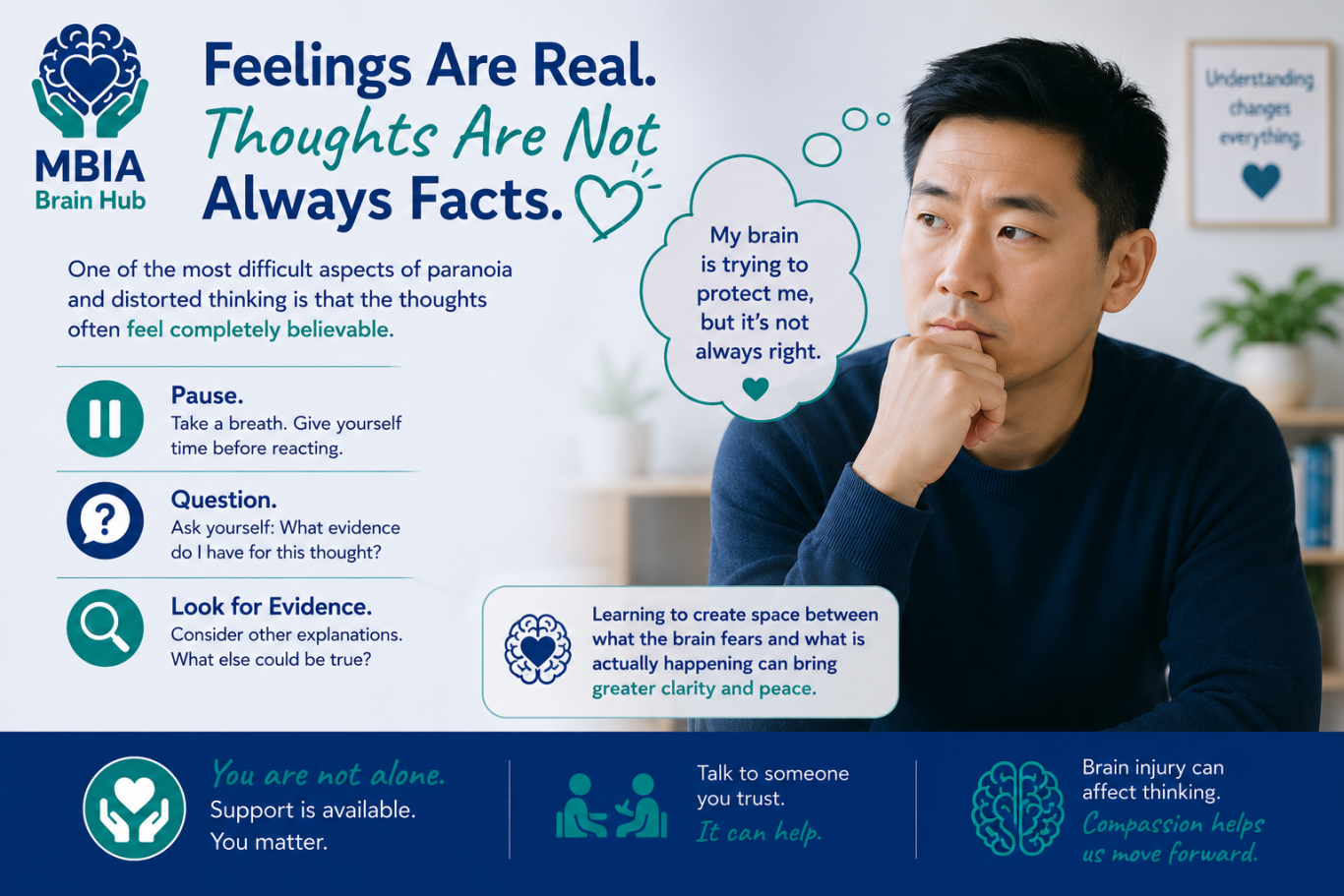
Pause Before Reacting
When a suspicious thought appears, try asking:
"What evidence do I have for this?"
"What evidence do I have against it?"
This simple exercise can help slow down automatic conclusions.
Consider Alternative Explanations
For example:
Instead of:
"They didn't answer my message because they're ignoring me."
Consider:
"They may be busy."
"They may not have seen it yet."
Looking for multiple explanations can reduce certainty around negative assumptions.
Keep a Thought Journal
Writing down:
- The thought
- The situation
- The evidence
can help identify patterns over time.
Many people discover that certain triggers repeatedly contribute to suspicious thinking.
Monitor Fatigue
Ask yourself:
- Am I exhausted?
- Have I slept poorly?
- Am I overwhelmed?
Many people notice distorted thinking worsens when the brain is running on empty.
Reduce Stress
Stress can amplify suspicious thoughts.
Helpful strategies may include:
- Walking
- Exercise
- Meditation
- Breathing exercises
- Spending time outdoors
- Talking to trusted people
Check the Facts
Before acting on a belief, ask:
"Do I know this is true, or do I feel it is true?"
Feelings are real.
But feelings are not always facts.
Talk to Someone You Trust
Sometimes simply saying a thought out loud can help.
A trusted friend, family member, therapist, or support group member may be able to provide perspective.
Seek Professional Support
If suspicious thoughts are:
- Causing distress
- Affecting relationships
- Becoming more frequent
- Affecting daily life
professional support may be helpful.
How These Thoughts Can Affect Relationships
Paranoia and distorted thinking can place enormous strain on relationships.
Families may experience:
- Frequent arguments
- Repeated accusations
- Loss of trust
- Emotional exhaustion
The person experiencing the thoughts is often suffering too.
The fear and uncertainty can feel very real.
When to Seek Urgent Help
Seek immediate support if paranoia becomes severe and involves:
- Significant fear
- Threats of harm
- Severe distress
- Loss of touch with reality
- Thoughts of self-harm or suicide
These situations require urgent assessment.
A Message for People Living With Brain Injury
If you experience paranoia or distorted thinking, you are not weak.
You are not failing.
You are not "going mad."
These symptoms can occur when the brain is struggling with injury, fatigue, trauma, stress, or emotional overload.
Recognising them is not something to be ashamed of.
In fact, awareness is often the first step towards managing them.
A Message of Hope
Suspicious thoughts and distorted thinking can feel frightening and isolating.
They can affect confidence, relationships, and emotional wellbeing.
But they do not define who you are.
Many people learn to recognise triggers, challenge unhelpful thoughts, and develop strategies that help them feel more grounded.
The thoughts may feel powerful.
But with support, understanding, and practice, they do not have to control your life.
Key Takeaways
- Paranoia and distorted thinking can occur after brain injury and in some people living with probable CTE.
- These symptoms may be influenced by changes in brain function, memory problems, anxiety, trauma, fatigue, and poor sleep.
- Suspicious thoughts often feel very real, even when evidence is limited.
- Fatigue and stress commonly make symptoms worse.
- Learning to pause, check evidence, and consider alternative explanations can help.
- Professional support may be beneficial when symptoms become distressing or affect relationships.
- Recognising these symptoms is a sign of awareness, not weakness.
- Help and support are available.
Continue Exploring
Together We're Stronger